Which statement best represents Mendel's experiments with garden peas?
-
A
As a result, Mendel developed several theories that have since been disproved.
-
B
Mendel realized he was on an incorrect track, which led him to other experimental media.
-
C
As a result, Mendel developed foundational conclusions that are still valued and followed today.
-
D
Mendel collaborated with others interested in genetics to develop heredity guidelines we still use today.
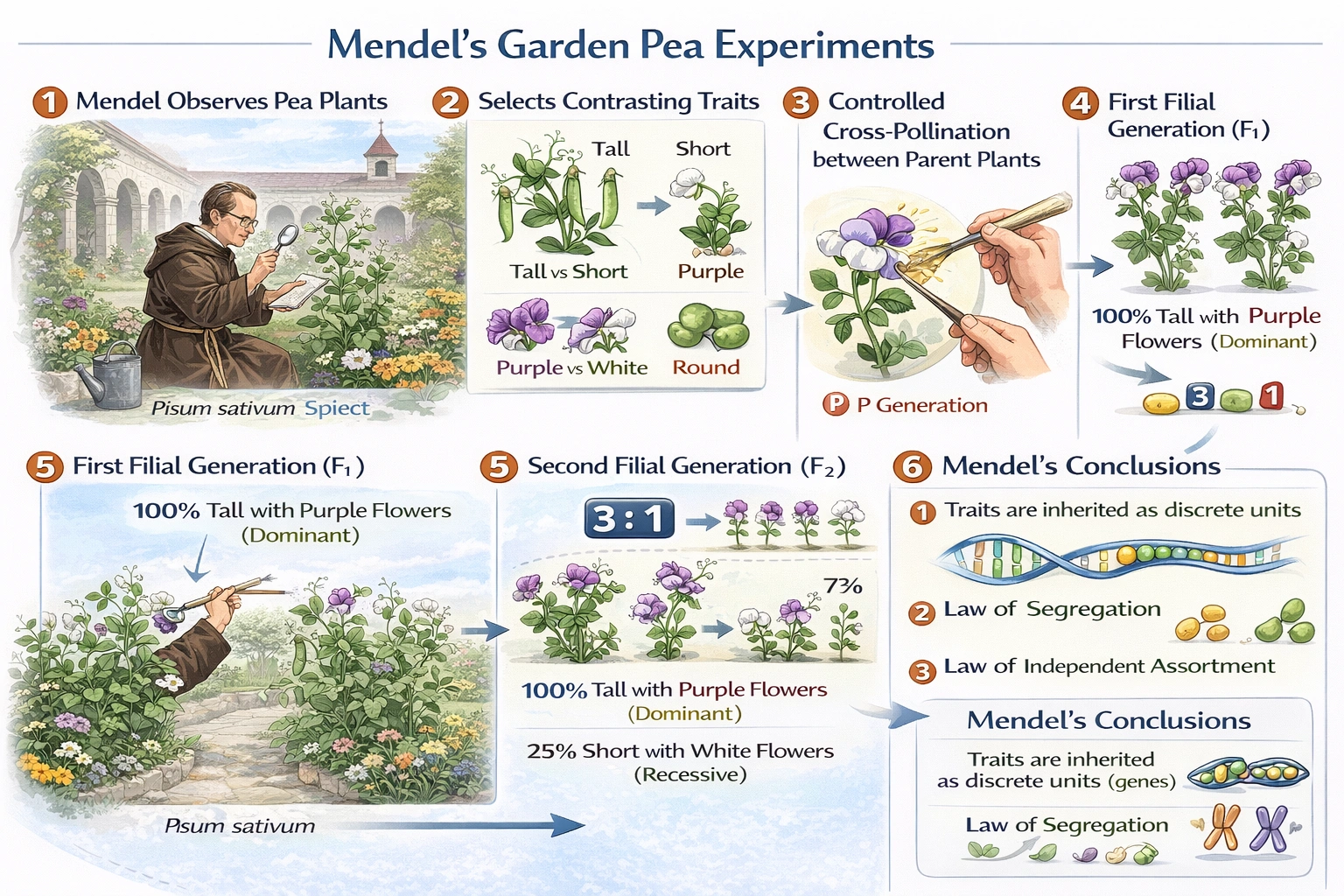
Mendel's experiments with garden peas led him to develop foundational conclusions that are still valued and followed today.
Gregor Mendel, an Augustinian monk, conducted meticulous breeding experiments with pea plants (Pisum sativum) in the 1850s and 1860s. By tracking the inheritance of seven contrasting traits over multiple generations and applying mathematical analysis, he deduced fundamental principles of heredity. He proposed that traits are determined by discrete "factors" (now called genes) that are passed from parents to offspring. From his work, he formulated two key laws: the Law of Segregation (allele pairs separate during gamete formation) and the Law of Independent Assortment (genes for different traits assort independently). Although his work was largely ignored during his lifetime, it was rediscovered in 1900 and became the cornerstone of classical genetics. His conclusions about particulate inheritance, dominance, and segregation remain valid and are taught as the bedrock of genetic understanding, though they have been integrated with and extended by modern discoveries like linkage, polygenic inheritance, and molecular genetics.
A) As a result, Mendel developed several theories that have since been disproved.
This is false. The core of Mendel's conclusions, the existence of discrete hereditary units, their segregation, and the independent assortment of different genes, has not been disproved. Exceptions and complexities have been discovered (such as incomplete dominance, codominance, gene linkage, epigenetics), but these do not invalidate Mendel's laws; they show the laws apply under specific conditions (e.g., for genes on different chromosomes). Mendel's work forms a solid and enduring foundation.
B) Mendel realized he was on an incorrect track, which led him to other experimental media.
Historical evidence does not support this. Mendel published his pea plant results in 1866 in "Experiments on Plant Hybridization." He later worked on hawkweeds, but this was an attempt to extend his findings to other species, not an admission that his pea work was flawed. His hawkweed experiments were frustrating because hawkweeds reproduce asexually via apomixis, a phenomenon unknown at the time, which made patterns of inheritance unclear. He did not abandon his correct theories from the pea experiments.
C) As a result, Mendel developed foundational conclusions that are still valued and followed today.
This is accurate. Mendel's work is celebrated as a paradigm of scientific inquiry. His methods of controlled crosses, quantitative analysis, and hypothesis testing set a standard. His laws of segregation and independent assortment are essential for predicting inheritance patterns in diploid organisms and are routinely applied in fields ranging from agriculture and animal breeding to medical genetics and genetic counseling.
D) Mendel collaborated with others interested in genetics to develop heredity guidelines we still use today.
Mendel worked in relative isolation at the St. Thomas's Abbey in Brno. He corresponded with a few prominent botanists, like Carl Nägeli, but he did not engage in wide collaboration. His guidelines were developed independently through his own painstaking research. His work was not widely recognized or built upon collaboratively until decades after his death. The statement misrepresents the solitary nature of his pioneering research.
Conclusion
Mendel's pea plant experiments represent a landmark in the history of science. Through careful observation, experimentation, and deduction, he uncovered the basic rules governing the transmission of traits. While the field of genetics has exploded in complexity since the 19th century, the principles he derived from counting pea plants, the concepts of genes, alleles, dominance, and segregation, remain fundamentally correct and indispensable. His work is the prototype of foundational scientific discovery, whose value has only increased with time.
Topic Flashcards
Click to FlipWhat was the major outcome of Mendel’s experiments with garden peas?
He developed foundational conclusions about heredity that are still used today.
What key idea did Mendel propose about inheritance? .
Traits are passed as discrete units (genes)
Name one law Mendel developed from his pea experiments.
Law of Segregation.
Why are Mendel’s conclusions still important in modern genetics?
They form the foundation for understanding inheritance patterns.
When was Mendel’s work widely recognized by the scientific community?
After it was rediscovered around 1900.