Once RNA polymerase reaches a stop codon on the DNA molecule, the enzyme detaches from the DNA and releases the RNA molecule
-
A
into the cell for the next stage.
-
B
into the cytoplasm for translation.
-
C
into the nucleus for the next stage.
-
D
into the cytoplasm for transcription.
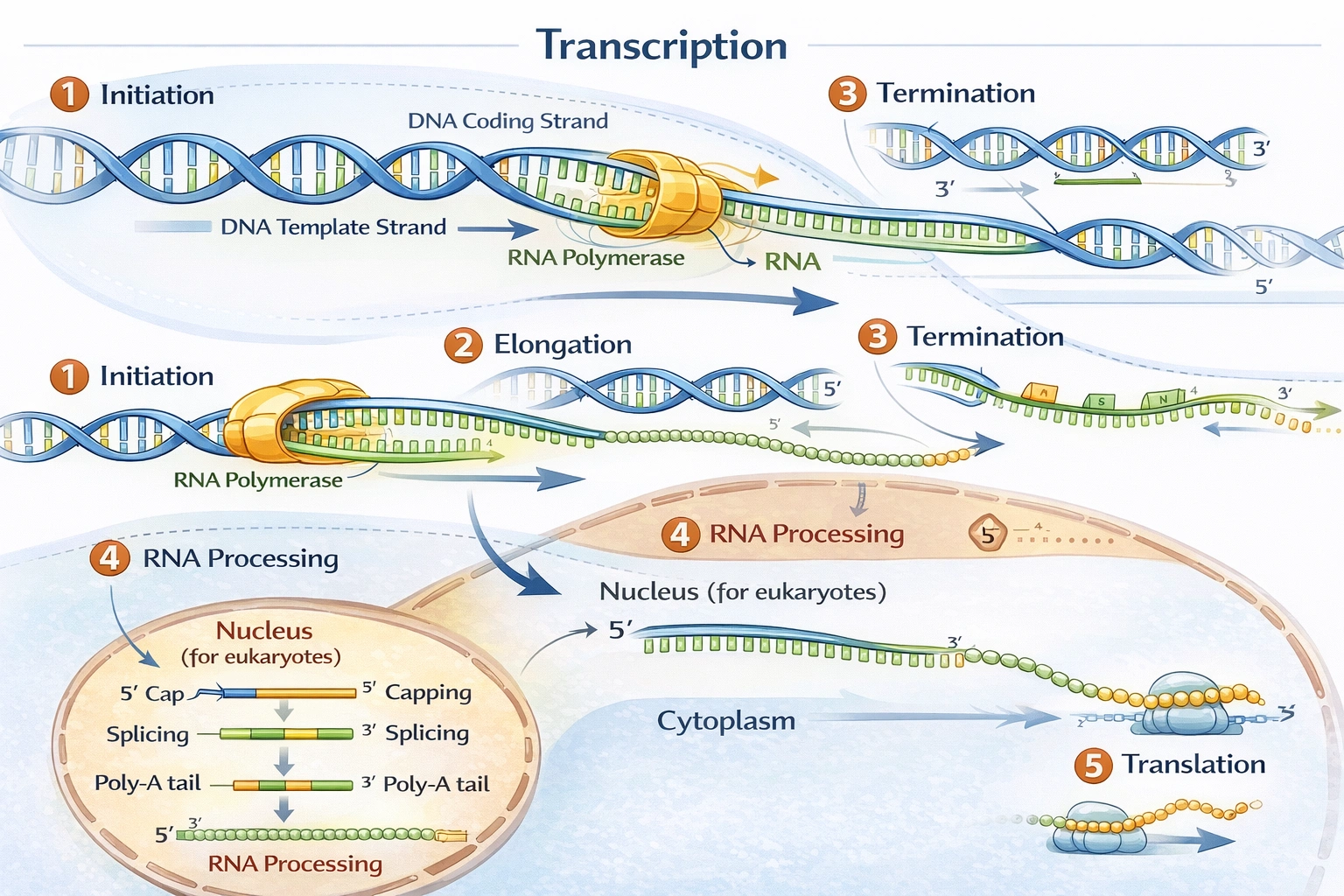
Once RNA polymerase reaches a stop codon on the DNA, the enzyme detaches and releases the RNA molecule into the cell for the next stage.
Transcription is the process of synthesizing an RNA molecule from a DNA template, carried out by RNA polymerase. The process terminates when the polymerase transcribes a specific DNA sequence called a termination signal (which, when transcribed into RNA, may form a hairpin loop or, in eukaryotes, is recognized by termination factors). In prokaryotes, which lack a nucleus, transcription occurs in the cytoplasm, and the released RNA transcript is immediately accessible to ribosomes for translation. In eukaryotes, transcription occurs in the nucleus. The primary transcript (pre-mRNA) is released into the nucleoplasm. It must then undergo processing (5' capping, splicing, 3' polyadenylation) before being exported through nuclear pores into the cytoplasm to engage with ribosomes for translation. The phrase "into the cell for the next stage" is the most accurate and encompassing answer because it applies universally: the RNA is released into the cellular compartment where its subsequent processing and/or function will occur.
A) into the cell for the next stage.
This is the most general and correct statement. It acknowledges that the RNA's release is a handoff to the subsequent steps in gene expression without specifying a compartment, which differs between prokaryotes and eukaryotes. The "next stage" refers to RNA processing (in eukaryotes) and/or translation.
B) into the cytoplasm for translation.
This is specifically true for prokaryotes, where transcription and translation are coupled in the cytoplasm. It is also true for the final destination of processed eukaryotic mRNA. However, for eukaryotic pre-mRNA, the initial release upon termination is into the nucleoplasm, not directly into the cytoplasm. The RNA must be processed and exported first. Therefore, this answer is not universally correct for all cells at the moment of polymerase detachment.
C) into the nucleus for the next stage.
In eukaryotes, the RNA is indeed released into the nucleus. However, "the next stage" for a protein-coding transcript is processing within the nucleus (capping, splicing, polyadenylation), followed by export to the cytoplasm. For some non-coding RNAs (like snRNAs), the next stage may involve functioning within the nucleus. This option is partially correct for eukaryotes but completely inapplicable to prokaryotes, which have no nucleus.
D) into the cytoplasm for transcription.
This is incorrect. Transcription is the process that has just been completed; the RNA molecule is the product of transcription. It is not released "for transcription." The released RNA is destined for roles such as translation (mRNA), ribosomal function (rRNA), or transfer (tRNA). "Transcription" describes its synthesis, not its future use.
Conclusion
Transcription termination results in the release of a nascent RNA molecule from its DNA template and RNA polymerase. The fate of this RNA depends on the cellular context. The broad, accurate description is that it is released into the cellular environment to proceed to the next stage of its functional pathway, whether that involves immediate translation in prokaryotes or nuclear processing and export in eukaryotes. The key is that termination marks the end of synthesis and the beginning of the RNA's independent career within the cell.
Topic Flashcards
Click to FlipWhat happens when RNA polymerase reaches a termination signal on DNA?
It detaches from the DNA and releases the RNA molecule.
What process has just been completed when RNA polymerase releases RNA?
Transcription.
What is the next stage for RNA after transcription?
RNA processing (in eukaryotes) or translation.
Where is RNA released immediately after transcription in eukaryotic cells?
Into the nucleus.
Why is “into the cell for the next stage” the most accurate description? .
Because RNA’s next step depends on the type of cell and RNA