In eukaryotes, what does transcription produce?
-
A
mRNA
-
B
pre-mRNA
-
C
rRNA
-
D
tRNA
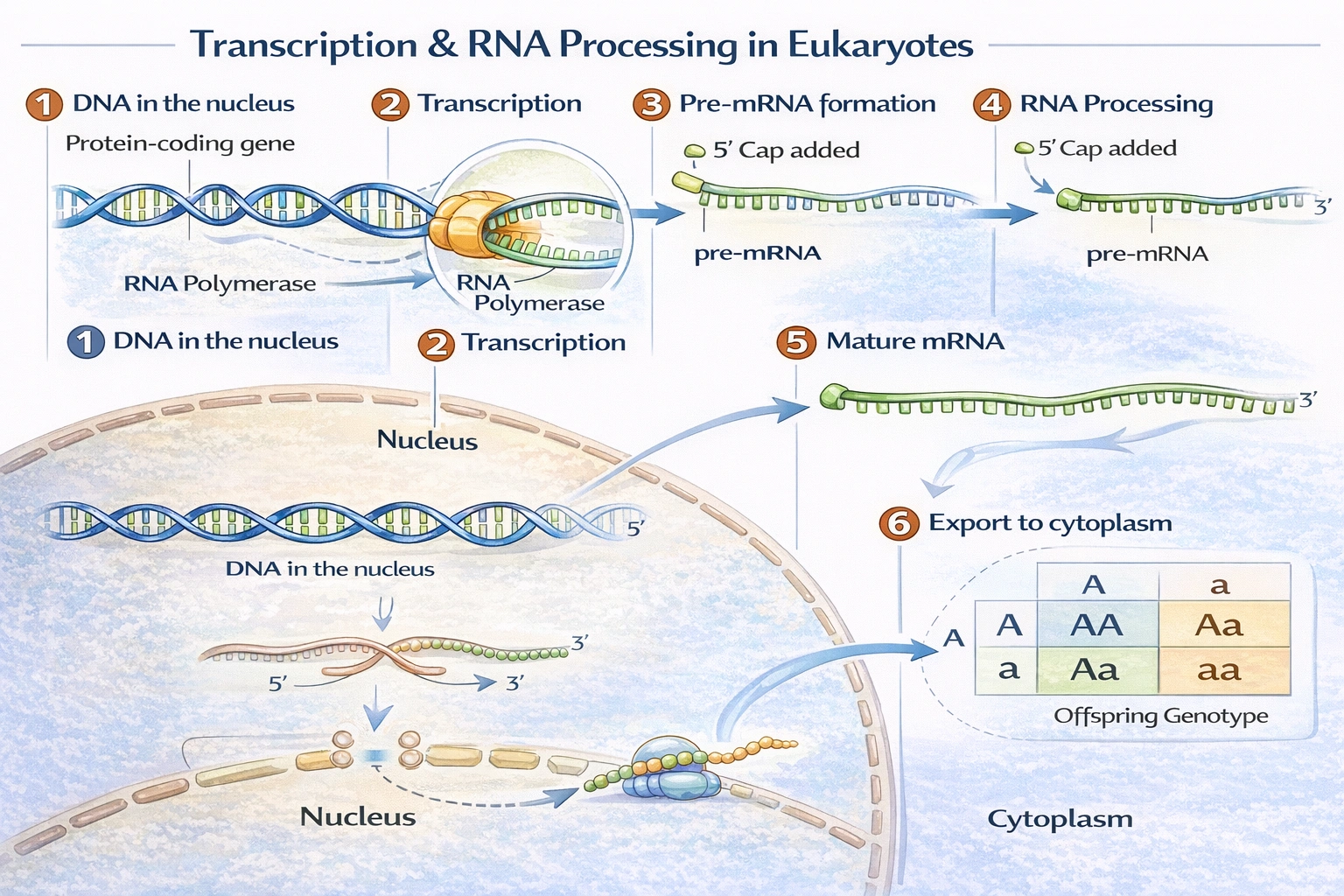
In eukaryotes, transcription of protein-coding genes produces pre-mRNA.
Transcription is the synthesis of an RNA molecule from a DNA template. In eukaryotes, this occurs within the nucleus. For genes that encode proteins, the immediate RNA product is not the mature messenger RNA (mRNA) that will be translated. Instead, it is a precursor molecule known as pre-messenger RNA (pre-mRNA). This primary transcript is an exact RNA copy of the gene, including both coding sequences (exons) and non-coding intervening sequences (introns). It also has unmodified ends. This pre-mRNA must undergo several processing steps in the nucleus before it becomes functional mRNA: addition of a 5' cap (a modified guanine nucleotide), addition of a 3' poly-A tail (a string of adenine nucleotides), and splicing to remove introns and join exons together. Only after this processing is the molecule considered mature mRNA, which is then exported to the cytoplasm for translation.
A) mRNA
Mature mRNA is the final, processed form that is translated into protein. Transcription itself does not directly produce this mature form. The enzyme RNA polymerase synthesizes the primary transcript (pre-mRNA), and subsequent processing events convert it into mRNA. Therefore, while mRNA is the ultimate functional product of the transcription/processing pathway, it is not the direct product of the transcription event.
B) pre-mRNA
Pre-mRNA is the direct, unprocessed RNA transcript synthesized by RNA polymerase II from protein-coding genes. It is chemically identical to the DNA template strand (with uracil replacing thymine) and contains all the intronic and exonic sequences. It is the raw material that the nuclear processing machinery acts upon. For most biology contexts focusing on gene expression, "transcription" refers to this initial synthesis, making pre-mRNA the correct answer.
C) rRNA
Ribosomal RNA (rRNA) is also a product of transcription, synthesized by RNA polymerase I (for the large rRNAs) and RNA polymerase III (for the 5S rRNA) from rRNA genes. The initial transcripts are pre-rRNA molecules that are then processed (cleaved and modified) to yield the mature rRNA components of the ribosome. While transcription does produce pre-rRNA, the question is typically interpreted in the context of the central dogma and protein synthesis, where the product of transcribing a protein-coding gene is of primary interest.
D) tRNA
Transfer RNA (tRNA) is transcribed by RNA polymerase III from tRNA genes. The initial transcript is a pre-tRNA that undergoes processing (trimming, base modifications, and sometimes splicing) to become a functional tRNA. Like rRNA, it is a non-coding RNA and a valid product of transcription, but it is not the primary answer when considering the general output of transcription for gene expression.
Conclusion
Eukaryotic gene expression is characterized by a spatial and functional separation between transcription and translation, facilitated by the nuclear envelope. This allows for extensive RNA processing before the message leaves the nucleus. The immediate product of transcribing a protein-coding gene is the pre-mRNA molecule. This distinction between primary transcript and mature product is a key difference between prokaryotes (where transcription directly produces mRNA) and eukaryotes. Recognizing pre-mRNA as the initial product is fundamental to understanding post-transcriptional regulation and the flow of genetic information in eukaryotic cells.
Topic Flashcards
Click to FlipWhat does transcription of a protein-coding gene produce in eukaryotes? .
pre-mRNA
Why is the initial RNA called pre-mRNA?
Because it must be processed before becoming functional mRNA.
What structures are present in pre-mRNA but not in mature mRNA?
Introns.
What three modifications convert pre-mRNA into mRNA?
5′ capping, intron splicing, and poly-A tail addition.
Where does transcription occur in eukaryotic cells?
In the nucleus.
What is the name of the primary, unprocessed RNA transcript produced when a eukaryotic protein-coding gene is transcribed?
Pre-mRNA. It contains exons and introns and must be processed to become mature mRNA.
In which cellular compartment does the transcription of a eukaryotic gene into pre-mRNA occur?
The nucleus. Transcription and RNA processing are nuclear events before export to the cytoplasm.
What are the three major modifications that convert eukaryotic pre-mRNA into mature, functional mRNA?
1. Addition of a 5' cap. 2. Addition of a 3' poly-A tail. 3. Splicing to remove introns and join exons.
Which type of RNA polymerase is primarily responsible for transcribing eukaryotic protein-coding genes into pre-mRNA?
RNA Polymerase II.
True or False: The pre-mRNA transcript has the same sequence as the gene's non-template (coding) DNA strand, except with T replaced by U.
True. Pre-mRNA is complementary to the template strand and identical to the coding strand (with U instead of T).