In which reaction do the reactants form a homogeneous mixture and the products form a heterogeneous mixture?
-
A
CaO(s) + H₂O(l) → Ca(OH)₂(s)
-
B
C₃H₈(g) + 5O₂(g) → 3CO₂(g) + 4H₂O(g)
-
C
2Na(s) + ZnCl₂(aq) → Zn(s) + 2NaCl(aq)
-
D
Pb(NO₃)₂(aq) + 2KI(aq) → PbI₂(s) + 2KNO₃(aq)
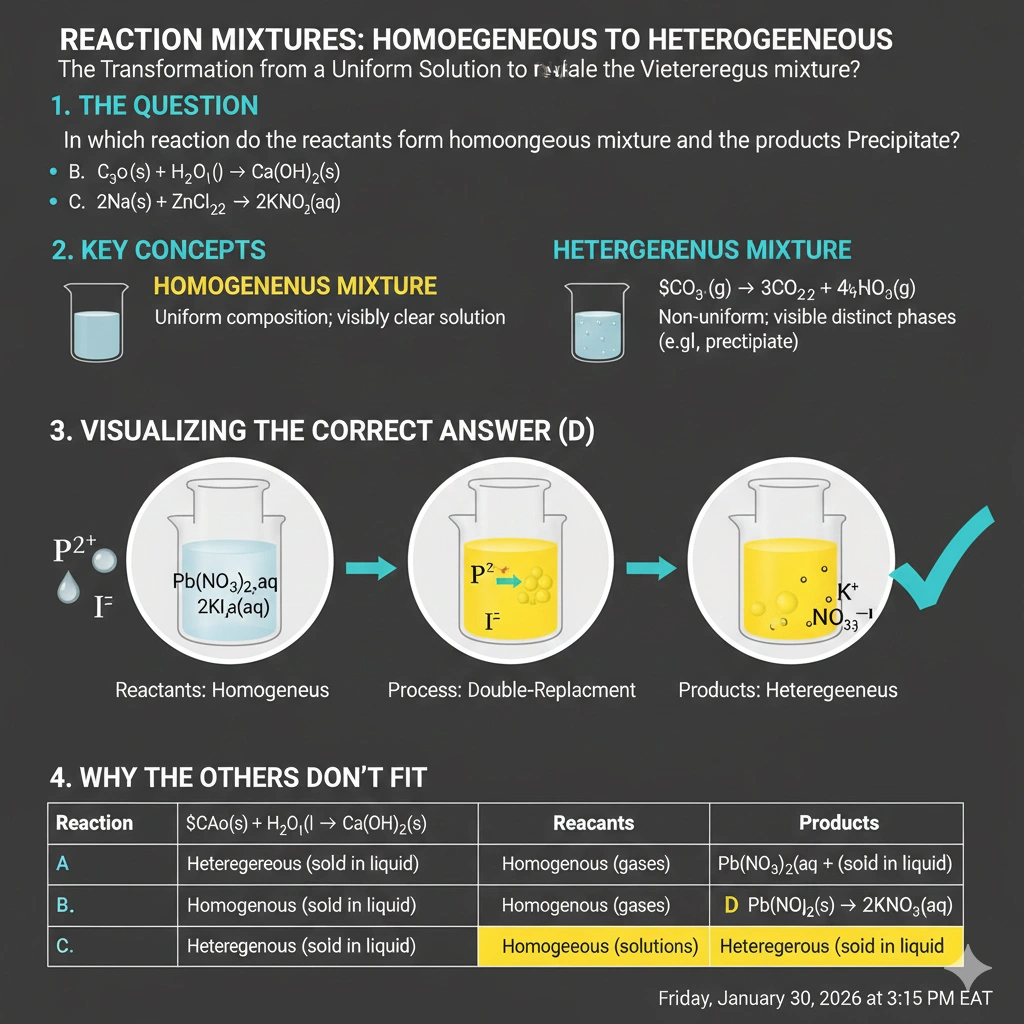
In the reaction Pb(NO₃)₂(aq) + 2KI(aq) → PbI₂(s) + 2KNO₃(aq), the reactants form a homogeneous mixture and the products form a heterogeneous mixture.
A homogeneous mixture is uniform in composition and appearance (like a solution). A heterogeneous mixture has visibly distinct phases (like a solid precipitate in a liquid). The question asks for a reaction where the initial mixture of reactants is homogeneous, but the final mixture containing products is heterogeneous.
A) CaO(s) + H₂O(l) → Ca(OH)₂(s)
Reactants: Solid calcium oxide and liquid water. A solid mixed with a liquid typically forms a heterogeneous mixture unless the solid dissolves. CaO reacts with water but initially, the mixture is heterogeneous. Product: Solid calcium hydroxide. The product is a solid, not a mixture at all. This does not fit the criteria.
B) C₃H₈(g) + 5O₂(g) → 3CO₂(g) + 4H₂O(g)
Reactants: Gaseous propane and gaseous oxygen. Gases mix completely to form a uniform, homogeneous gaseous mixture. Products: Carbon dioxide gas and water vapor. All products are gases, which also mix completely to form a homogeneous gaseous mixture. The mixture remains homogeneous.
C) 2Na(s) + ZnCl₂(aq) → Zn(s) + 2NaCl(aq)
Reactants: Solid sodium metal and aqueous zinc chloride solution. Solid sodium does not dissolve in the aqueous solution; it sits as a distinct solid phase. Therefore, the initial mixture is heterogeneous. Products: Solid zinc metal and aqueous sodium chloride. Solid zinc is suspended in or settles from the liquid, creating a heterogeneous mixture. The mixture starts and ends heterogeneous.
D) Pb(NO₃)₂(aq) + 2KI(aq) → PbI₂(s) + 2KNO₃(aq)
Reactants: Both lead(II) nitrate and potassium iodide are dissolved in water, forming clear, colorless aqueous solutions. When these two solutions are mixed, they initially form a single, uniform liquid phase—a homogeneous mixture. Products: The reaction produces lead(II) iodide (PbI₂), which is insoluble in water and precipitates as a bright yellow solid. Potassium nitrate (KNO₃) remains dissolved. The final mixture consists of solid PbI₂ particles dispersed in or settled from the aqueous KNO₃ solution, which is a classic heterogeneous mixture (a precipitate in a solution).
Conclusion:
Only in option D do we start with two soluble ionic compounds dissolved in water, creating a homogeneous solution. The double-replacement reaction produces an insoluble solid precipitate, transforming the uniform mixture into a non-uniform, heterogeneous mixture with distinct solid and liquid phases.

Topic Flashcards
Click to FlipWhat defines a homogeneous mixture versus a heterogeneous mixture in the context of chemical reactions?
A homogeneous mixture is uniform (e.g., a solution where all components are in the same phase). A heterogeneous mixture has visibly distinct parts or phases (e.g., a solid precipitate in a liquid).
In the correct reaction (Pb(NO₃)₂(aq) + 2KI(aq) → PbI₂(s) + 2KNO₃(aq)), why are the reactants considered a homogeneous mixture?
Both reactants are aqueous solutions, meaning the ions (Pb²⁺, NO₃⁻, K⁺, I⁻) are uniformly dissolved in water, creating a single, clear liquid phase.
What specific product in the reaction causes the shift from a homogeneous to a heterogeneous mixture, and what is its state?
Lead(II) iodide (PbI₂). It is a solid (s) that is insoluble in water, so it precipitates out as a distinct yellow solid.
What type of chemical reaction is Pb(NO₃)₂(aq) + 2KI(aq) → PbI₂(s) + 2KNO₃(aq), and how does this type often relate to mixture homogeneity changes?
It is a double-replacement/precipitation reaction. This type often starts with homogeneous aqueous solutions and produces a heterogeneous mixture due to the formation of an insoluble solid (precipitate).
If both products in a double-replacement reaction between two aqueous solutions were also aqueous (aq), what would be true about the product mixture's homogeneity?
The product mixture would remain homogeneous because all ions would stay dissolved in a single, uniform aqueous phase.