Which of the following is a strong acid?
-
A
HF
-
B
HCL
-
C
H₃PO₄
-
D
CH₃COOH
HCl (hydrochloric acid) is a strong acid.
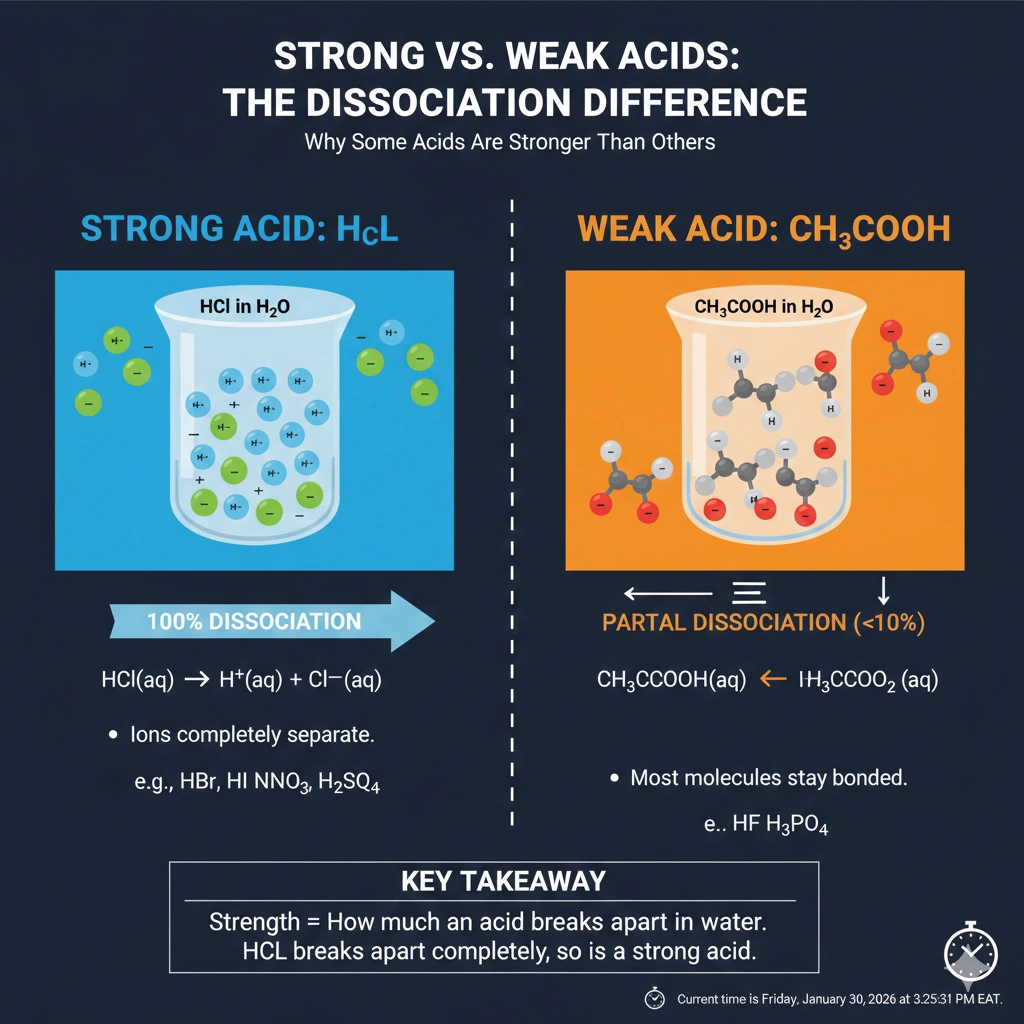
Strong acids are defined as those that ionize completely (100%) in aqueous solution. Their dissociation is essentially irreversible. Memorizing the common strong acids is a standard requirement in chemistry.
A) HF (Hydrofluoric acid)
Hydrofluoric acid is a weak acid. Despite the high electronegativity of fluorine, the H-F bond is relatively strong due to the small size of fluorine and high bond energy. Additionally, fluoride ions are heavily solvated (surrounded by water molecules) in solution. These factors limit its dissociation, so it only partially ionizes in water, establishing an equilibrium between HF molecules and H⁺ and F⁻ ions.
B) HCl (Hydrochloric acid)
Hydrochloric acid is one of the seven common strong acids (HCl, HBr, HI, HNO₃, HClO₄, H₂SO₄ for the first proton). When dissolved in water, HCl molecules completely dissociate into hydronium ions (H₃O⁺) and chloride ions (Cl⁻). No significant amount of undissociated HCl exists in aqueous solution, making it a strong acid.
C) H₃PO₄ (Phosphoric acid)
Phosphoric acid is a weak acid. It is a triprotic acid, meaning it can donate three protons. However, each dissociation step is incomplete. The first dissociation is the strongest but still weak, with only a fraction of H₃PO₄ molecules losing a proton to form H₂PO₄⁻ and H⁺. It does not fully ionize in water.
D) CH₃COOH (Acetic acid)
Acetic acid is the classic example of a weak organic acid. It is the main component of vinegar. In water, it establishes a dynamic equilibrium: CH₃COOH(aq) ⇌ H⁺(aq) + CH₃COO⁻(aq). The equilibrium lies far to the left, meaning most acetic acid remains in its molecular form, and only a small percentage dissociates.
Conclusion:
Among the given options, only hydrochloric acid (HCl) is a strong acid, characterized by its complete dissociation in aqueous solution. The others—HF, H₃PO₄, and CH₃COOH—are weak acids that only partially ionize.

Topic Flashcards
Click to FlipWhat is the defining property of a strong acid in aqueous solution?
It ionizes completely (100%), meaning no significant amount of the undissociated acid molecule remains.
Which of the seven common strong acids is present in the answer choices, and what is its formula?
Hydrochloric acid, HCl.
Why is hydrofluoric acid (HF) considered a weak acid despite fluorine's high electronegativity?
The H-F bond is strong due to fluorine's small size and high bond energy, and fluoride ions are heavily solvated, limiting dissociation.
What term describes an acid like acetic acid (CH₃COOH) that establishes an equilibrium between molecules and ions in water?
A weak acid. It only partially dissociates.
For phosphoric acid (H₃PO₄), how does its strength as an acid change as it loses each successive proton?
It becomes progressively weaker. The first dissociation (to H₂PO₄⁻) is weak, and each subsequent proton is harder to remove.