It is advantageous to use the English system when
-
A
converting units using multiples of 10.
-
B
describing a reported value using tons.
-
C
working with functionally related base units.
-
D
communicating information around the world.
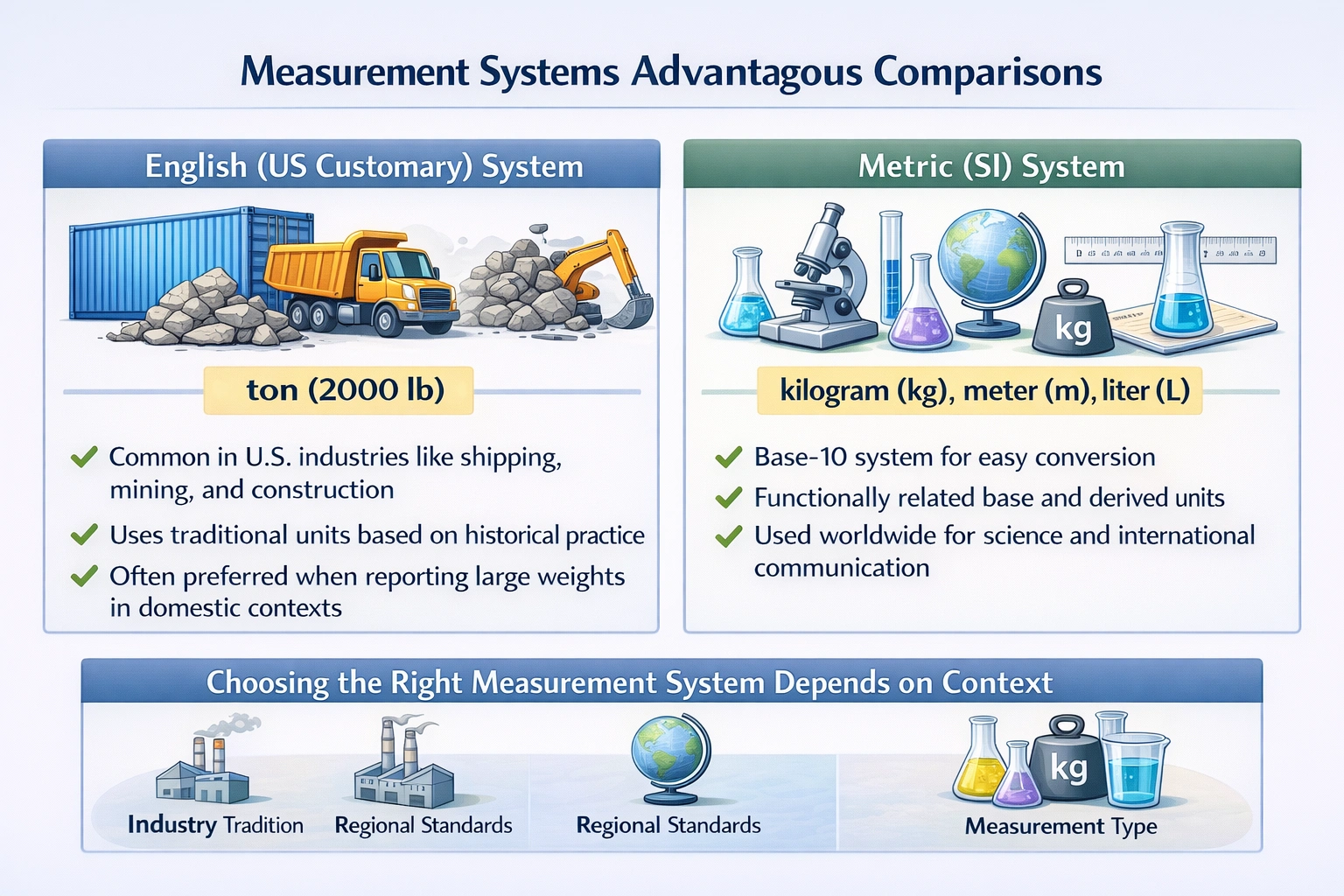
It is advantageous to use the English system when describing a reported value using tons.
The English system (or US customary system) and the metric system (International System of Units, SI) each have contexts where they are conventionally used. Advantage is often determined by tradition, specific industry standards, or regional prevalence rather than inherent mathematical superiority.
A) converting units using multiples of 10.
This is the primary and greatest advantage of the metric system, not the English system. The metric system is based on powers of ten, making conversions straightforward by simply moving the decimal point (e.g., 1 kilometer = 1000 meters; 1 gram = 1000 milligrams). The English system uses irregular conversion factors (12 inches in a foot, 3 feet in a yard, 1760 yards in a mile), making mental calculation more complex.
B) describing a reported value using tons.
The "ton" is a unit of mass (or weight) deeply embedded in the English system, with common variants like the short ton (2000 pounds) used in the US and the long ton (2240 pounds) used historically in the UK. In industries like shipping, freight, mining, and certain manufacturing sectors within English-system countries, weights are conventionally reported in tons. Using the English system in such contexts avoids unnecessary conversion and aligns with standard practice, legal documents, and machinery calibrations. This is a legitimate, practical advantage in those specific locales and fields.
C) working with functionally related base units.
This is a hallmark of the metric system. The SI base units (meter, kilogram, second, ampere, etc.) are coherently designed so that derived units for force (newton), energy (joule), power (watt), and pressure (pascal) are defined by simple relationships without conversion constants (e.g., 1 newton = 1 kg·m/s²). The English system lacks this coherence; derived units often require awkward numerical constants.
D) communicating information around the world.
The metric system is the nearly universal language of science, medicine, engineering, and international trade. Over 95% of the world's population uses the metric system as their primary or official system. Using the English system, which is predominantly used only in the United States, Liberia, and Myanmar, would be a significant disadvantage for global communication, as it would require translation and conversion for most international partners, increasing the risk of error.
Conclusion:
While the metric system is superior for its decimal base, coherence, and global adoption, the English system retains an advantage in specific, entrenched applications within certain regions. When a value is traditionally and officially reported in tons, a unit native to the English system, it is most practical and clear to use that system for that description.
Topic Flashcards
Click to FlipWhat is the primary mathematical advantage of the metric system over the English system?
Its decimal base (multiples of 10), which allows for easy unit conversion by simply moving the decimal point.
In which specific scenario does the explanation state it is advantageous to use the English system?
When describing a reported value using tons (e.g., in US shipping, mining, or industries where it is the conventional and legal standard).
Why is the metric system considered "coherent" and superior for scientific calculations?
Its base units are functionally related, allowing derived units (like Newtons or Joules) to be formed without needing extra conversion constants (e.g., 1 N = 1 kg·m/s²).
Which system is overwhelmingly used for global communication in science, trade, and medicine, and why?
The metric system (SI). It is the official system of over 95% of the world's population, reducing errors and simplifying international communication.
What is a key disadvantage of the English system for unit conversion, as seen in length units?
It uses irregular conversion factors (e.g., 12 inches/foot, 3 feet/yard, 1760 yards/mile) instead of a consistent decimal multiplier.