The ratio of the mass of a proton to the mass of an electron is 1,840. How is this number represented in scientific notation?
-
A
0.184×10^4
-
B
1.84×10^3
-
C
18.4×10^2
-
D
184×10^3
The number 1,840 is represented in scientific notation as 1.84 × 10³.
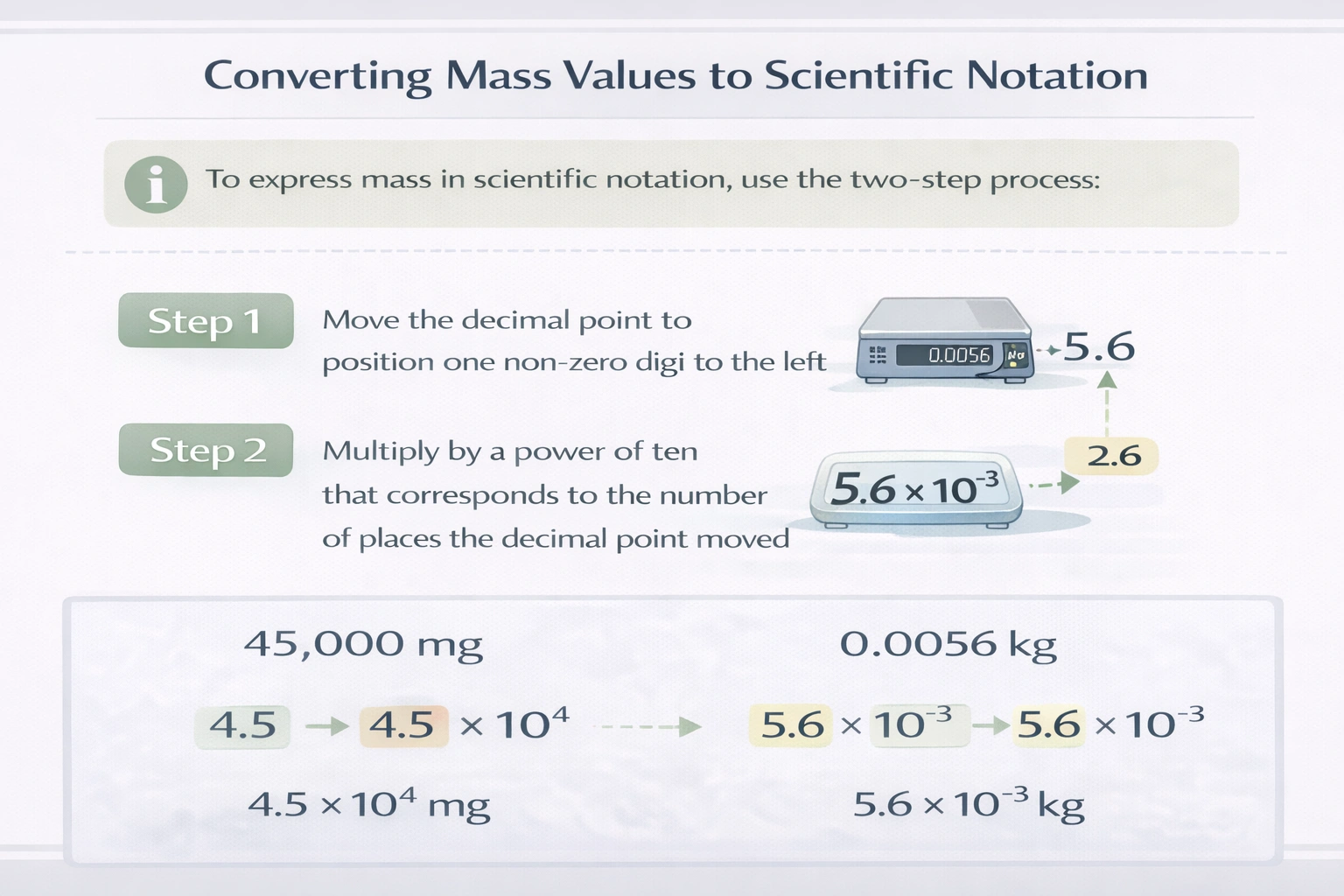
Proper scientific notation requires the coefficient to be a number greater than or equal to 1 and less than 10, multiplied by a power of ten. To convert 1840, the decimal point is moved three places to the left, changing it to 1.840 (or 1.84). Compensating for this move requires multiplying by 10³ (1000), because 1.84 × 1000 = 1840.
A) 0.184×10^4
While mathematically equivalent to 1840 (0.184 × 10,000 = 1840), this format does not conform to the standard convention for proper scientific notation. The coefficient, 0.184, is less than 1. Standard practice dictates that the coefficient should be between 1 and 10.
B) 1.84×10^3
The coefficient 1.84 is between 1 and 10. The exponent 3 indicates 10³, or 1000. The product, 1.84 × 1000, equals the original number, 1840. This representation adheres strictly to the rules of proper scientific notation.
C) 18.4×10^2
The product 18.4 × 100 also equals 1840. However, the coefficient 18.4 is not less than 10. This form is sometimes used in engineering notation but is not considered proper scientific notation, which mandates a single non-zero digit to the left of the decimal point in the coefficient.
D) 184×10^3
This expression, 184 × 1000, equals 184,000, not 1,840. It uses an incorrect coefficient and misapplies the exponent. Even if the coefficient were adjusted, 184 is not less than 10, so it does not meet the criteria for proper scientific notation.
Conclusion:
Scientific notation provides a standardized method for writing very large or very small numbers. The correct form places a coefficient with one non-zero integer digit. For the number 1,840, moving the decimal three places left yields the coefficient 1.84, necessitating a multiplier of 10³ to restore the original value, resulting in 1.84 × 10³
Topic Flashcards
Click to FlipWhat is the defining rule for the coefficient in proper scientific notation?
The coefficient must be a number greater than or equal to 1 and strictly less than 10 (e.g., 1 ≤ coefficient < 10).
o convert 1,840 to scientific notation, how many places and in which direction do you move the decimal point to get the coefficient?
You move the decimal point 3 places to the left. This changes 1,840 (or 1840.0) to 1.84.
Why is the expression 0.184 × 10⁴ for 1,840 considered incorrect for proper scientific notation?
While mathematically equal, its coefficient (0.184) is less than 1, violating the standard rule that the coefficient must be between 1 and 10.
What is the purpose of the exponent in scientific notation, and what exponent for 10 correctly scales 1.84 back to 1,840?
The exponent indicates how many places the decimal point was moved. Since we moved it 3 places left to create the smaller number 1.84, we use a positive exponent of 3 to scale it back: 1.84 × 10³.
How can you quickly verify that 1.84 × 10³ correctly equals 1,840?
Calculate 1.84 × 10³, which is 1.84 × 1,000. This multiplication equals 1,840, confirming the notation is correct.