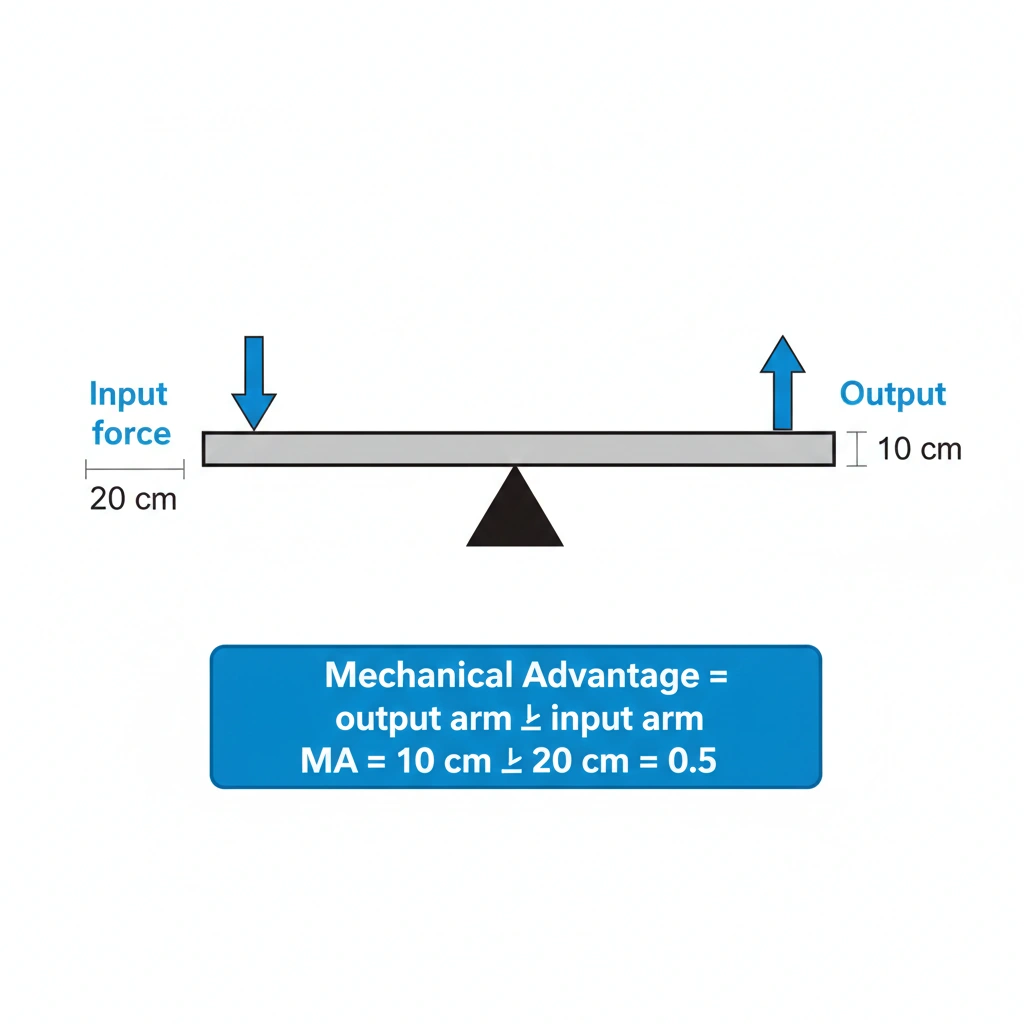
Lever: input at 20 cm from fulcrum, output at 10 cm. Mechanical advantage?
-
A
½
-
B
2
-
C
20
-
D
200
The mechanical advantage of the lever is ½.
Mechanical advantage (MA) for an ideal lever is determined by the ratio of the output arm length to the input arm length. This compares how far from the fulcrum the load is applied versus where the effort is applied.
A) ½
Using the lever formula,
MA = output arm / input arm = 10 cm / 20 cm = 0.5.
This indicates a speed (distance) advantage but a force disadvantage, which is characteristic of this lever arrangement.
B) 2
This value results from reversing the ratio (input/output instead of output/input), which does not follow the definition of mechanical advantage for levers.
C) 20
This option reflects a magnitude error and does not come from any valid ratio of the given distances.
D) 200
This value is far too large and suggests a misplaced decimal or incorrect calculation unrelated to lever mechanics.
Conclusion
With the input applied 20 cm from the fulcrum and the output at 10 cm, the mechanical advantage is 0.5 (½).
Topic Flashcards
Click to FlipState Newton's Second Law of Motion in the form of its defining equation. What does it state about the relationship between net force, mass, and acceleration?
F_net = m * a. It states that the acceleration of an object is directly proportional to the net force acting on it and inversely proportional to its mass.
The law says acceleration is directly proportional to net force. What crucial condition must be met for the statement "If force doubles, acceleration doubles" to be true?
The mass (m) of the object must remain constant.
If the net force on an object is held constant but its mass is doubled, what happens to its acceleration?
The acceleration is halved (a = F/m; if m doubles, a is cut in half).
A car's engine provides a force to accelerate it. If the car is towing a heavy trailer (increasing total mass), will it accelerate more, less, or the same for the same engine force? Why?
It will accelerate less. Because a = F/m, an increase in mass (m) with constant force (F) results in a decrease in acceleration (a).
How does Newton's Second Law explain why it's harder to push a full shopping cart than an empty one to achieve the same acceleration?
The full cart has greater mass (m). To achieve the same acceleration (a), a much greater force (F) is required (since F = m*a).