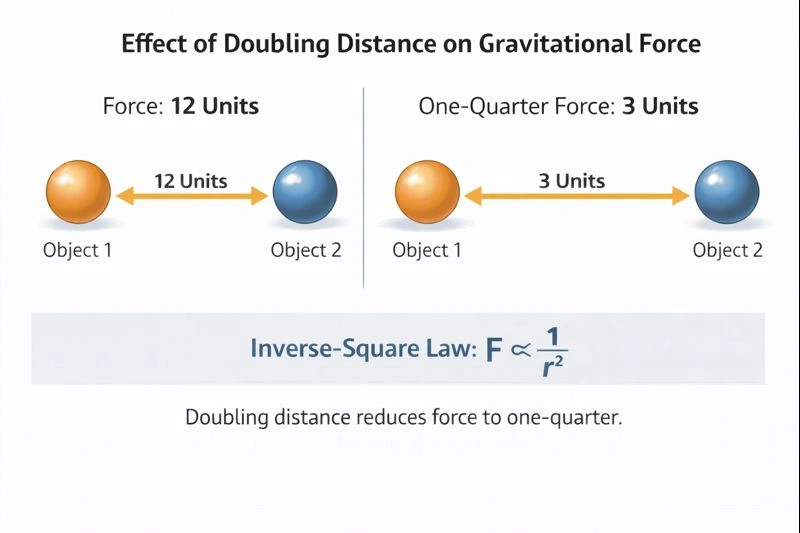
Two objects attract each other with a gravitational force of 12 units. If you double the distance between the objects, what is the new force of attraction between the two?
-
A
3 units
-
B
6 units
-
C
24 units
-
D
48 units
The new gravitational force of attraction is 3 units.
Gravitational force follows Newton’s law of universal gravitation, which states that the force between two objects is inversely proportional to the square of the distance between them. This means that as the distance increases, the force decreases rapidly according to the inverse-square relationship.
A) 3 units
Doubling the distance increases the separation by a factor of 2. Because gravitational force varies as one divided by the square of the distance, the new force becomes one divided by two squared, which is one quarter of the original force. One quarter of 12 units is 3 units, which matches this option.
B) 6 units
Reducing the force to 6 units assumes a linear inverse relationship, where doubling the distance halves the force. Gravitational force does not behave linearly with distance, so this value is incorrect.
C) 24 units
This choice treats the relationship as directly proportional, implying the force increases when distance increases. This contradicts the inverse-square nature of gravity.
D) 48 units
This value incorrectly increases the force by a factor of four, which is the opposite of what occurs when distance is doubled under an inverse-square law.
Conclusion
Because gravitational force decreases with the square of the distance, doubling the distance reduces the force to one quarter of its original value. Starting from 12 units, this results in a new force of 3 units.
Topic Flashcards
Click to FlipState Newton's Law of Universal Gravitation. What is the relationship between gravitational force (F), the masses (m1, m2), and the distance (r) between them?
F = G * (m1*m2) / r². The force is directly proportional to the product of the masses and inversely proportional to the square of the distance.
If the distance between two objects is tripled, by what factor does the gravitational force change?
The force becomes 1/9th of the original force. (Since force ∝ 1/r², 3² = 9).
Two objects attract each other with a force of 20 N. What would the new force be if the distance between them is halved?
Halving the distance means r becomes r/2. Force is proportional to 1/(r/2)² = 4/r². Therefore, the new force is 4 × 20 N = 80 N.
In the formula F = G(m1m2)/r², which variable(s) must remain constant for the inverse-square relationship (F ∝ 1/r²) to hold true when distance changes?
The masses (m1 and m2) and the gravitational constant (G) must be constant.
If the gravitational force between two planets is 100 units at a certain distance, what would the force be if their masses were both doubled and the distance between them was also doubled?
Doubling both masses multiplies force by 4 (2*2). Doubling distance divides force by 4 (2²). The two changes cancel: 4 / 4 = 1, so the new force remains 100 units.