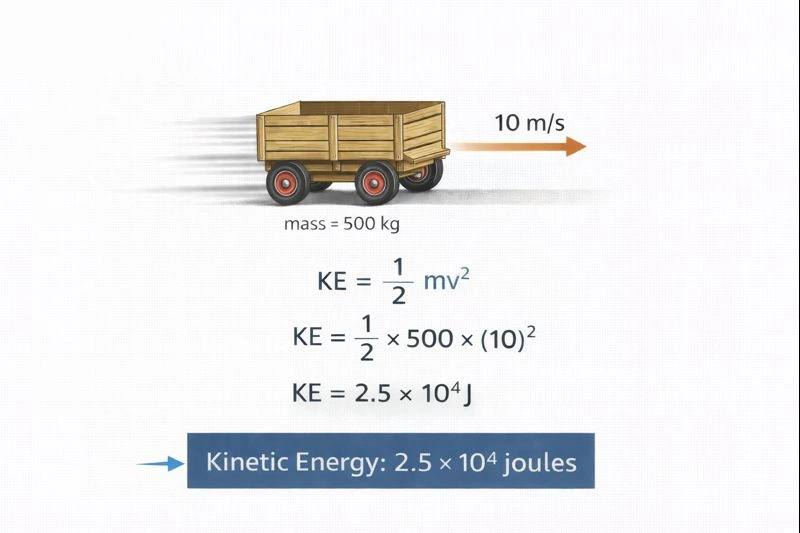
What is the kinetic energy of a 500 kg wagon moving at 10 m/s?
-
A
50 J
-
B
250 J
-
C
2.5 × 10⁴ J
-
D
5.0 × 10⁵ J
The kinetic energy of the wagon is 2.5 × 10 to the power of 4 joules.
Kinetic energy is the energy an object possesses due to its motion and is calculated using the formula:
kinetic energy equals one half multiplied by mass multiplied by velocity squared
where m is the mass and v is the velocity. Substituting the given values for a 500 kg wagon moving at 10 m per second allows the kinetic energy to be determined directly.
A) 50 J
This value results from using only mass multiplied by velocity or omitting the square of the velocity. The kinetic energy formula requires squaring the speed and including the one-half factor, so this value is far too small.
B) 250 J
This outcome comes from multiplying the mass by the speed, 500 times 10, and stopping there. It ignores both the squaring of the velocity and the one-half factor required by the kinetic energy formula, leading to an incorrect result.
C) 2.5 × 10 to the power of 4 J
Using the correct formula gives:
kinetic energy equals one half multiplied by 500 multiplied by 10 squared
kinetic energy equals one half multiplied by 500 multiplied by 100
kinetic energy equals 25,000 joules
This is correctly written as 2.5 × 10 to the power of 4 joules. This calculation correctly applies all components of the kinetic energy equation.
D) 5.0 × 10 to the power of 5 J
This value reflects using mass multiplied by velocity squared without the required one-half factor and misplacing the decimal. As a result, the energy is overestimated by an order of magnitude.
Conclusion
Applying the standard kinetic energy formula with the given mass and velocity yields 25,000 joules, which is correctly written as 2.5 × 10 to the power of 4 joules.

Topic Flashcards
Click to FlipWhat is the formula for calculating the kinetic energy (KE) of a moving object? Define each variable.
KE = ½ * m * v², where m is mass (kg) and v is velocity (m/s).
Calculate the kinetic energy of a 2000 kg car moving at 10 m/s. How does it compare to the 500 kg wagon at the same speed?
KE = ½ * 2000 kg * (10 m/s)² = ½ * 2000 * 100 = 100,000 J or 1.0 × 10⁵ J. It has four times the KE of the wagon (25,000 J) because the mass is four times greater.
In the kinetic energy formula, which has a greater effect on the energy: doubling the mass or doubling the velocity? Prove it with a calculation.
Doubling the velocity has a greater effect. Doubling mass doubles KE. Doubling velocity quadruples KE (since KE ∝ v²). Example: For the wagon (500 kg, 10 m/s), KE = 25,000 J. Double mass (1000 kg): KE = 50,000 J (doubled). Double velocity (20 m/s): KE = ½ * 500 * (20)² = 100,000 J (quadrupled).
What would the kinetic energy of the 500 kg wagon be if its speed were reduced to 5 m/s?
KE = ½ * 500 kg * (5 m/s)² = ½ * 500 * 25 = 6,250 J or 6.25 × 10³ J.
The kinetic energy of the wagon is 2.5 × 10⁴ J. Express this value in kilojoules (kJ).
1 kJ = 1000 J, so 25,000 J = 25 kJ.