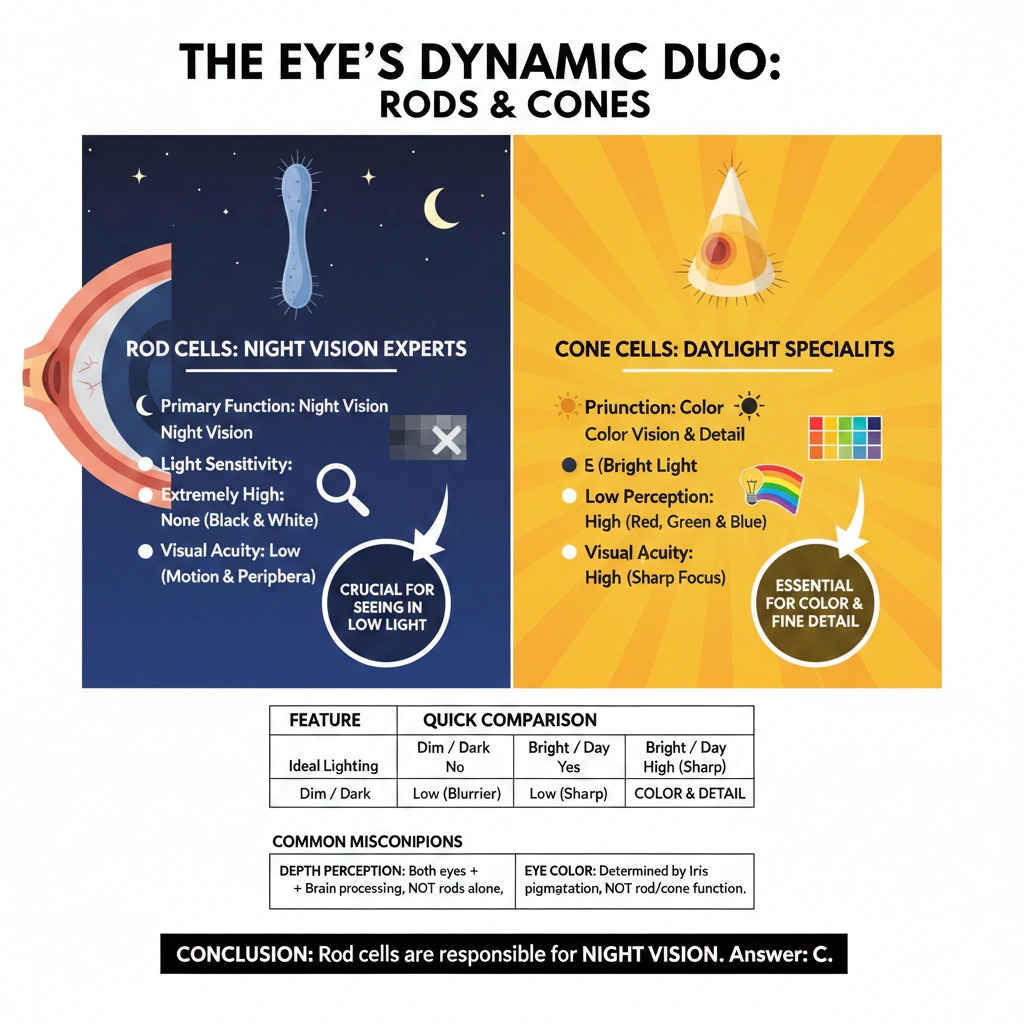
Unlike the cone cells in the eye, the rod cells are responsible for ___________.
-
A
color vision
-
B
depth perception
-
C
night vision
-
D
eye color
Unlike the cone cells in the eye, the rod cells are responsible for night vision.
Rod cells and cone cells serve different roles in the retina. Rod cells are specialized for vision in low-light conditions (scotopic vision), making them crucial for seeing in dim light or at night. They are highly sensitive to light but do not detect color. In contrast, cone cells are responsible for color vision and function best in bright light conditions.
- A. Color vision: This function is performed by cone cells, not rod cells. Cone cells detect different wavelengths of light, which allows for the perception of color. Rod cells, however, do not contribute to color vision, as they are not sensitive to wavelength differences.
- B. Depth perception: Depth perception is a visual process that allows us to judge the distance between objects. This is largely a result of input from both eyes (binocular vision) and the brain’s processing of the visual signals. Rod cells are not involved in depth perception; they are primarily involved in detecting light intensity and motion, particularly in low-light conditions.
- C. Night vision: This is the correct answer. Rod cells are specialized for night vision or vision in low-light conditions. They are highly sensitive to light and can detect the intensity of light even in dim environments, which is why they are essential for seeing in the dark. However, they do not detect color.
- D. Eye color: Eye color is determined by the pigmentation of the iris, specifically the amount and type of melanin present. It has nothing to do with the function of rod or cone cells in the retina. Rod cells do not affect eye color.
Conclusion: Rod cells are responsible for night vision, enabling us to see in low-light environments. Therefore, the correct answer is C. Night vision
.
Topic Flashcards
Click to FlipWhat is the term for the type of vision provided by rod cells in low-light conditions?
Scotopic vision (night vision).
What is the name of the light-sensitive pigment found in rod cells?
Rhodopsin
Where in the retina are rod cells most densely located?
In the peripheral retina (outside the central fovea).
What are the three types of cone cells, and what colors are they most sensitive to?
S-cones (blue), M-cones (green), and L-cones (red).
Which part of the retina contains the highest concentration of cone cells and is responsible for sharp, detailed vision?
The fovea centralis.