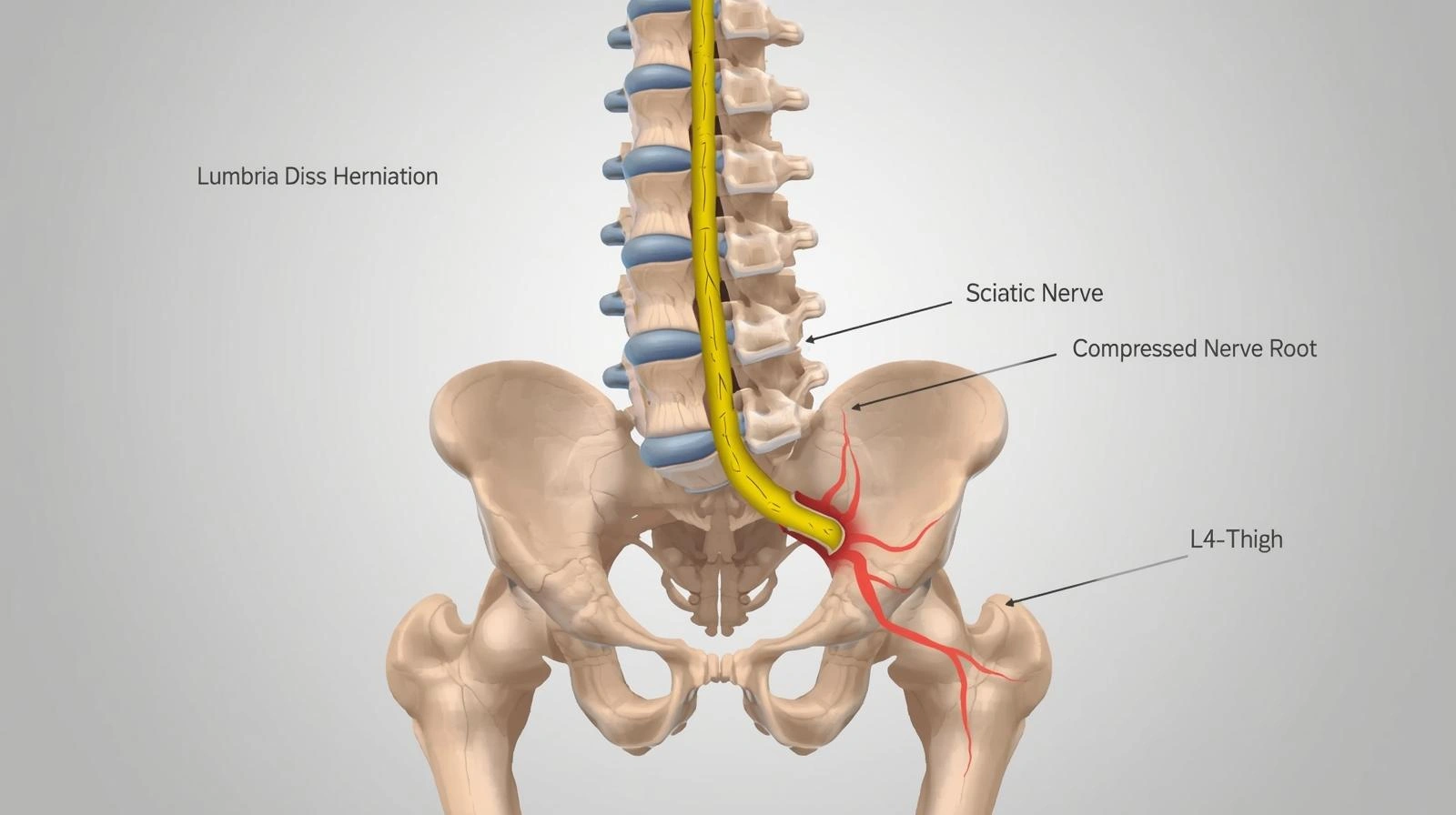
Where might a herniated lumbar disc be most likely to create pain?
-
A
Along the radial nerve
-
B
Within the spinal cord
-
C
Along the sciatic nerve
-
D
Along the plantar nerves
A herniated lumbar disc most commonly causes pain along the sciatic nerve due to nerve root compression in the lumbar spine.
The lumbar spine consists of five vertebrae, and between these vertebrae are intervertebral discs that provide cushioning. When one of these discs herniates, or bulges, it can press on the nerves that exit the spinal cord. These nerves often extend into the lower extremities, and when compressed, can cause pain, tingling, numbness, or weakness along the path of the affected nerve. In the case of a lumbar disc herniation, the most likely nerve affected is the sciatic nerve, which extends from the lower back through the buttocks and down the legs.
- A. Along the radial nerve: The radial nerve is located in the arm and is responsible for movement and sensation in the upper limb, including the forearm and hand. It is not associated with the lower back or lumbar region, so a herniated lumbar disc would not affect the radial nerve. Pain from a lumbar disc herniation is confined to the lower back and legs, not the upper body.
- B. Within the spinal cord: While a herniated disc can cause significant pressure on spinal structures, it typically affects the nerve roots rather than the spinal cord itself. The spinal cord runs through the vertebral column but is located deeper within the spine, whereas the nerve roots branch off from the spinal cord to supply different parts of the body. A herniated disc might press on these nerve roots as they exit the spinal canal, causing pain, but it is unlikely to directly affect the spinal cord.
- C. Along the sciatic nerve: This is the correct answer. The sciatic nerve is the largest nerve in the body, and it originates from the nerve roots in the lower back, specifically from the lumbar and sacral segments of the spine (L4-S3). When a herniated disc presses on the nerve roots in the lumbar region, it often causes pain that radiates from the lower back down through the buttocks and into the legs—this condition is known as sciatica. Sciatica is characterized by sharp, shooting pain, numbness, or tingling along the sciatic nerve's pathway, making it the most likely area to experience pain from a herniated lumbar disc.
- D. Along the plantar nerves: The plantar nerves are located in the feet and are responsible for sensation and some motor control in the foot. While nerve compression in the lumbar spine can sometimes lead to referred pain in the feet, a herniated lumbar disc is not typically associated with direct compression of the plantar nerves. The pain from a herniated disc would usually be felt in the back and legs, and only in rare cases would it affect the foot in this manner.
Conclusion: A herniated lumbar disc most often causes pain along the sciatic nerve, as it compresses the nerve roots in the lumbar region. This leads to sciatica, which causes pain, tingling, or numbness down the back of the leg. Therefore, the correct answer is C. Along the sciatic nerve.

Topic Flashcards
Click to FlipWhich specific nerve roots are most commonly compressed by a herniation at the L5-S1 intervertebral disc?
The S1 nerve root.
What is the term for the pain that originates in the lower back and radiates down the back of the leg along the sciatic nerve?
Sciatica (or radicular pain).
Besides pain, what are two other common symptoms of sciatic nerve compression from a herniated disc?
Numbness, tingling (paresthesia), muscle weakness, or reduced reflexes in the leg/foot.
What imaging test is most commonly used to confirm a suspected lumbar disc herniation?
Magnetic Resonance Imaging (MRI).
What is the name of the test where the examiner lifts the patient's straightened leg to see if it reproduces sciatic pain?
The straight leg raise test (Lasègue's test).