What are the components of chyle?
-
A
Nutrients and erythrocytes
-
B
Proteins and electrolytes
-
C
Cholesterol and salts
-
D
Lymph and fatty acids
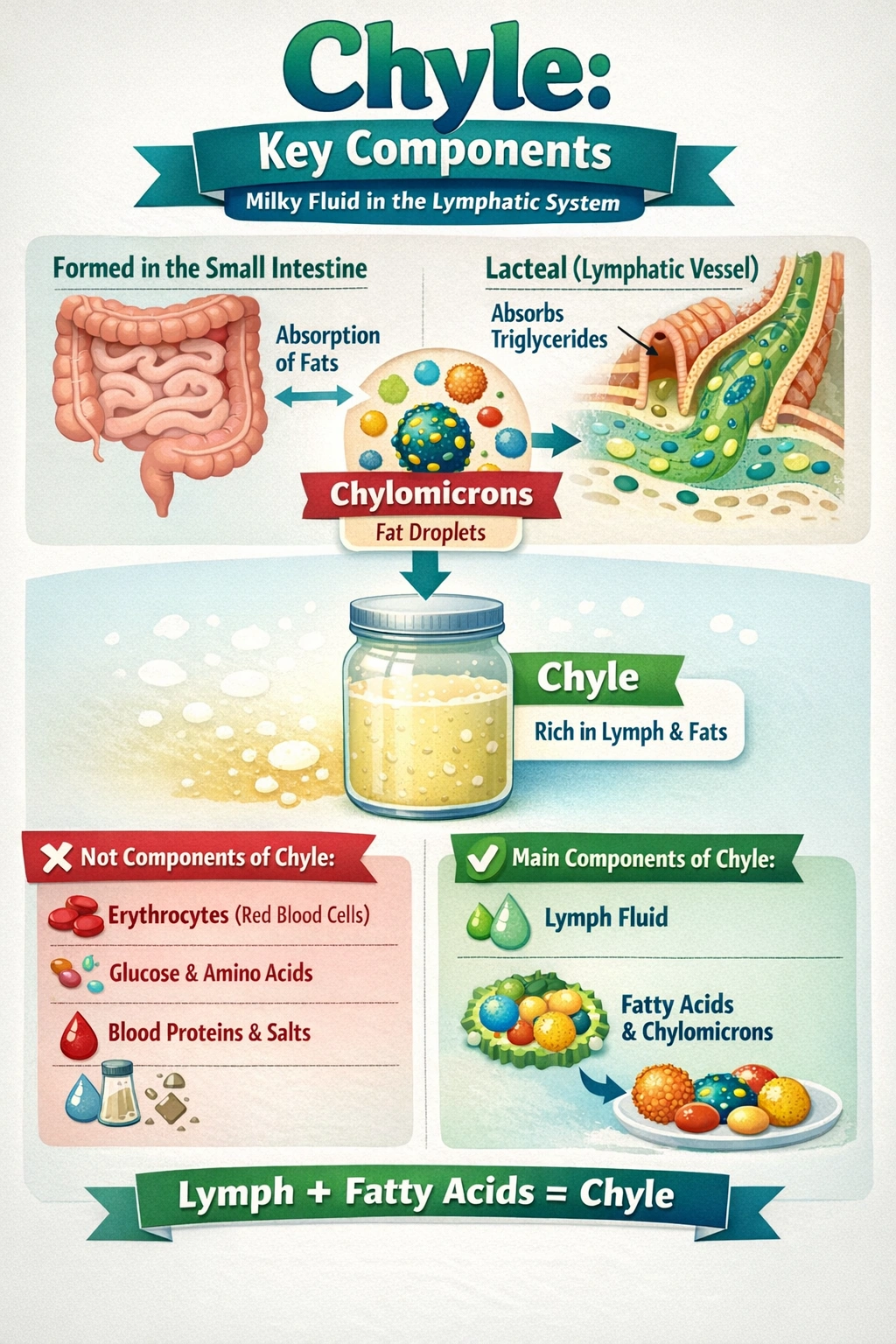
Chyle is primarily composed of lymph and fatty acids.
It is a milky fluid formed in the small intestine during the digestion of fats. After a fatty meal, the intestines' lacteals (lymphatic vessels) absorb triglycerides, re-esterify them, and package them into chylomicrons. These chylomicrons, which are too large to enter capillaries, enter the lymphatic system, resulting in the formation of chyle, which is rich in fats and lymph.
A) Nutrients and erythrocytes
This is incorrect. Erythrocytes (red blood cells) are confined to blood vessels and do not appear in chyle. Nutrients like glucose and amino acids are absorbed directly into the blood and do not enter the lymphatic system as part of chyle. The components of chyle are primarily related to lipids and lymph, not red blood cells or water-soluble nutrients.
B) Proteins and electrolytes
While lymph does contain plasma proteins and electrolytes, these are not unique to chyle. All lymph vessels carry these components, so they do not serve to specifically define chyle. Chyle's defining feature is its lipid content, particularly chylomicrons, and not just plasma proteins or electrolytes.
C) Cholesterol and salts
This is too generic. Cholesterol is primarily transported via LDL and HDL in the blood, not in chyle. Salts and electrolytes are present throughout the body, including in the lymphatic system, but they are not the defining characteristic of chyle. The primary characteristic of chyle is its high lipid content, including chylomicrons.
D) Lymph and fatty acids
This is the correct answer. Chyle is a milky fluid formed in the lymphatic system after the absorption of fats in the intestines. The lacteals absorb triglycerides, repackage them into chylomicrons, and these are transported through the lymphatic system, resulting in chyle. This fluid is rich in lymph, fatty acids, and chylomicrons.
Conclusion:
Chyle's hallmark is its high lipid content, primarily derived from the absorption of fats in the intestines, making lymph and fatty acids the most accurate description of its components. The other options describe components that are either not specific to chyle or are found in other fluids in the body.

Topic Flashcards
Click to FlipWhat is the definition of chyle?
A milky fluid consisting of lymph and emulsified fats (fatty acids, triglycerides in chylomicrons) formed in the small intestine during digestion.
Where in the body is chyle formed?
In the lacteals (specialized lymphatic capillaries) of the small intestinal villi.
What are the main components of chyle?
Lymph (water, electrolytes, proteins) and dietary lipids (fatty acids, triglycerides) packaged into chylomicrons.
What are chylomicrons?
Large lipoprotein particles that transport dietary lipids from the intestines to the rest of the body via the lymphatic system.
Through which lymphatic structure is chyle delivered into the bloodstream?
The thoracic duct, which empties into the left subclavian vein.