What is a benefit of a taxonomic system?
-
A
Researchers can describe how living things behave.
-
B
Researchers can develop names for new organisms.
-
C
Living things can be distinguished from nonliving things.
-
D
Living things can be classified based on their molecular traits.
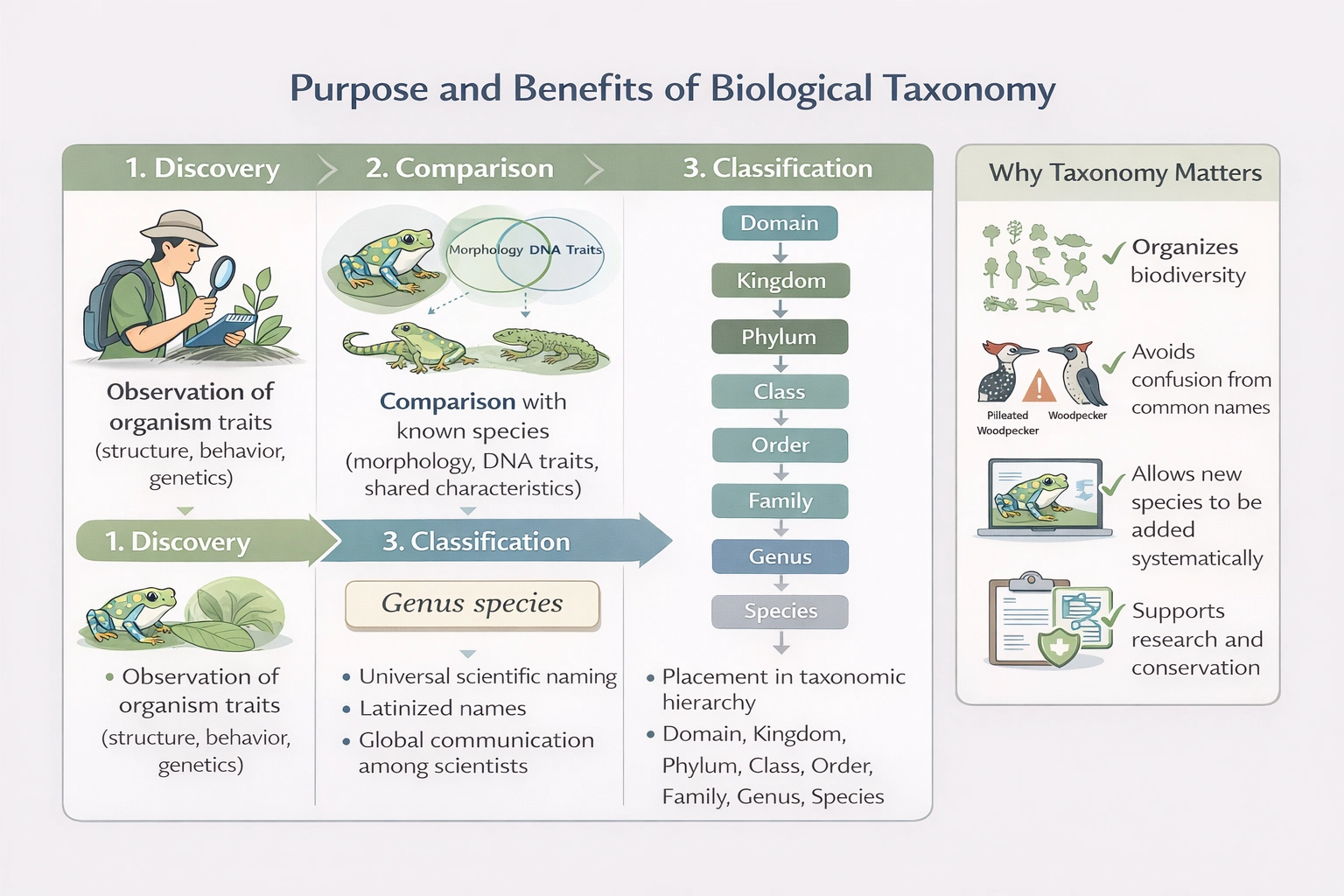
A primary benefit of a taxonomic system is that researchers can develop consistent and universally accepted names for new organisms.
Taxonomy is the scientific discipline concerned with classifying organisms based on shared characteristics and evolutionary relationships. A standardized taxonomic system, such as the Linnaean system employing binomial nomenclature, provides a universal framework for naming and organizing life. This system addresses a fundamental challenge in biology: the need for clear, precise, and unambiguous communication among scientists worldwide. Common names for organisms vary by language and region, leading to confusion. Taxonomy solves this by assigning a unique, Latinized two-part name (genus and species) to each organism, governed by international codes like the International Code of Nomenclature for algae, fungi, and plants (ICN) or the International Code of Zoological Nomenclature (ICZN). This allows newly discovered species to be integrated into the existing hierarchical classification (Domain, Kingdom, Phylum, etc.) in an orderly manner, facilitating research, conservation, and education.
A) Researchers can describe how living things behave.
Describing behavior is the focus of ethology, a sub-discipline of biology. While behavioral traits can sometimes inform taxonomic classifications—for instance, distinguishing between species with different mating rituals—this is not the primary purpose or benefit of the taxonomic system itself. Taxonomy is fundamentally concerned with identification, naming, and denoting evolutionary relationships, not with documenting behavioral patterns.
B) Researchers can develop names for new organisms.
This is a core utility of taxonomy. The system provides the rules and structure for naming new discoveries. When a new species is identified, taxonomists follow established conventions to assign it a unique binomial name, ensuring it can be reliably referenced in all future scientific literature. This prevents the chaos that would result from ad hoc naming and allows for the systematic organization of the planet's biodiversity into a coherent, searchable catalog.
C) Living things can be distinguished from nonliving things.
The distinction between living and nonliving entities is based on the characteristics of life, such as metabolism, growth, reproduction, response to stimuli, and homeostasis. This is a philosophical and biological definition problem addressed by fields like astrobiology and theoretical biology. While taxonomy applies only to living organisms, its primary function is not to define life but to classify it once it has been identified as living. The system itself does not provide the criteria for making this fundamental distinction.
D) Living things can be classified based on their molecular traits.
The use of molecular traits (e.g., DNA sequences, protein structures) is a modern method within taxonomy, known as molecular phylogenetics. It is a tool that enhances the accuracy and objectivity of classification. However, the benefit described is a specific methodological advantage, not the overarching benefit of the taxonomic system as a whole. The system's benefit is the framework itself, which allows for classification using any set of consistent traits, whether morphological, ecological, behavioral, or molecular.
Conclusion
Taxonomy serves multiple purposes, including revealing evolutionary relationships and organizing biological diversity. Its most immediate and practical benefit, however, is providing a standardized, global protocol for naming organisms. This nomenclature is the bedrock of biological communication, enabling precise discourse, efficient data retrieval, and the orderly integration of new knowledge. While behavior can be studied, life can be defined, and molecules can be analyzed, the unique capacity to assign and regulate universally recognized names is a fundamental benefit conferred by a formal taxonomic system.
Topic Flashcards
Click to FlipWhat is a major benefit of a taxonomic system?
It allows researchers to develop consistent names for new organisms.
What naming system is used in biological taxonomy?
Binomial nomenclature.
Why are scientific names important in biology?
They allow universal and unambiguous communication among scientists.
What two parts make up a scientific name?
Genus and species.
What problem does taxonomy solve compared to common names?
It prevents confusion caused by regional or language-based naming differences.