What is a control variable?
-
A
The variable that is used for comparisons
-
B
The responding variable in an experiment
-
C
The manipulated variable in an experiment
-
D
The variable that is measured or able to be changed
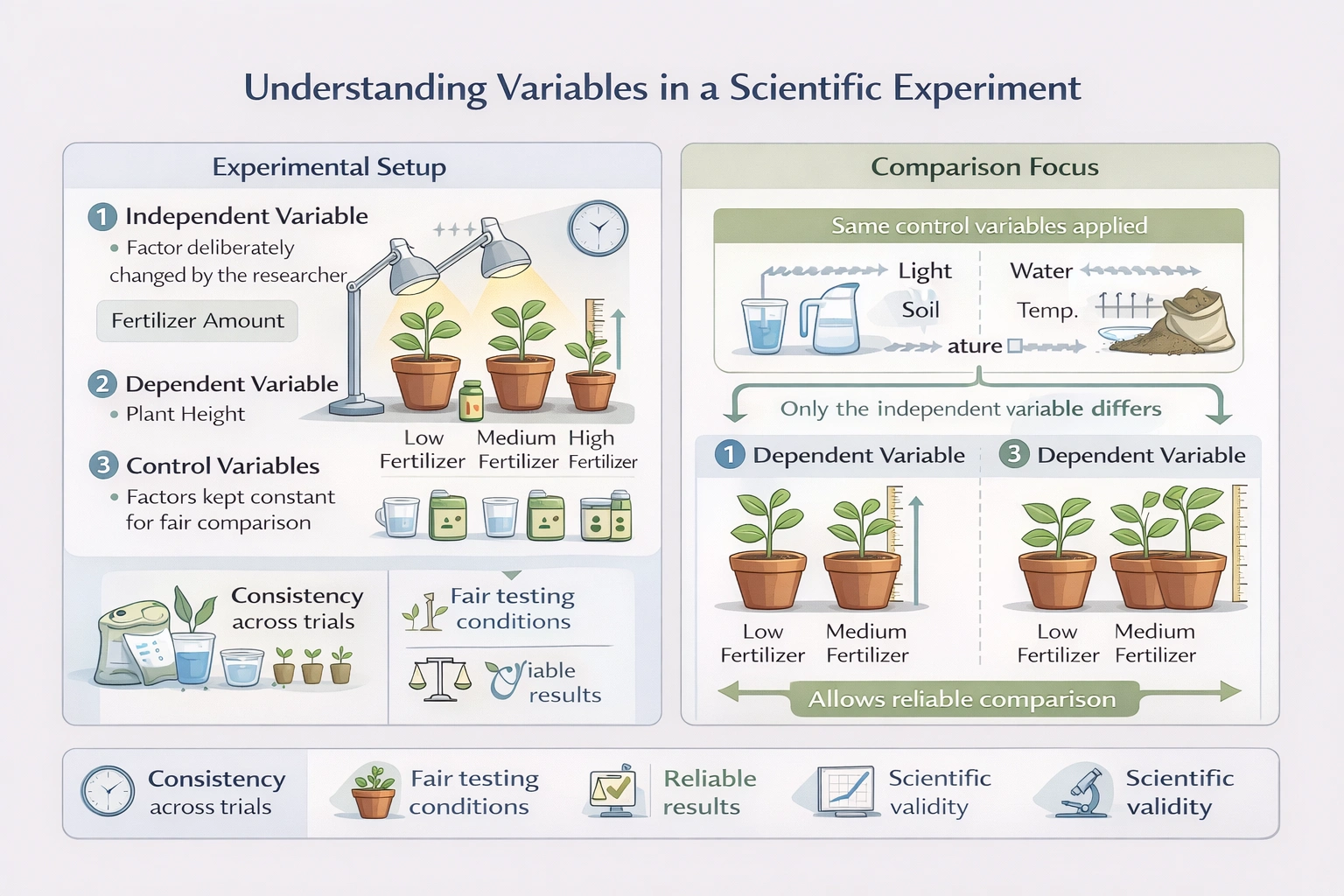
A control variable is a factor that is held constant throughout an experiment to provide a baseline for comparison.
In experimental design, establishing causality requires isolating the effect of a single factor. Variables are categorized as independent (manipulated), dependent (measured outcome), and controlled. A control variable is any factor that could potentially influence the dependent variable but is not the subject of the investigation. By deliberately keeping these factors unchanged between the control group and the experimental group(s), the researcher ensures that any observed difference in the dependent variable can be more confidently attributed to the manipulation of the independent variable alone. This practice minimizes the influence of confounding variables and is fundamental to maintaining internal validity. For example, in an experiment testing the effect of fertilizer on plant growth, variables like light intensity, water volume, pot size, and soil type would be controlled.
A) The variable that is used for comparisons
This describes the role of a control variable. By being held constant, it creates a stable experimental environment. The experimental group, where the independent variable is manipulated, is then compared to the control group, where it is not. The consistency of the control variables across groups means that any difference in the outcome is likely due to the independent variable, making the comparison meaningful.
B) The responding variable in an experiment
The responding variable, also known as the dependent variable, is the outcome that is measured or observed in response to changes in the independent variable. It is the data collected during the experiment. In the plant example, plant height or biomass would be the responding variable. This variable is expected to change; it is not held constant.
C) The manipulated variable in an experiment
The manipulated variable, or independent variable, is the condition that is intentionally altered by the researcher to test its effect. It is the presumed cause in the hypothesized cause-and-effect relationship. In the example, the type or amount of fertilizer is the manipulated variable. Control variables are not manipulated; their purpose is to remain unchanged so that the effect of the manipulation can be clearly seen.
D) The variable that is measured or able to be changed
This description is too broad and applies to variables in general. Both independent and dependent variables are "able to be changed" or measured. The defining feature of a control variable is not that it is measured as an outcome or changed as a treatment, but that it is specifically prevented from changing to isolate the effect of the independent variable.
Conclusion
Proper experimental design hinges on the careful management of variables. The manipulated variable is the factor being tested, the responding variable is the effect being measured, and the control variables are all other relevant conditions that are kept consistent. Holding control variables constant eliminates alternative explanations for the results, thereby strengthening the conclusion that changes in the dependent variable are caused by changes in the independent variable. Therefore, a control variable's essential function is to serve as a constant baseline, enabling valid comparisons between experimental conditions.