Fats and steroids belong to what biomolecule class?
-
A
Lipids
-
B
Proteins
-
C
Nucleic acids
-
D
Carbohydrates
Fats and steroids belong to the biomolecule class known as lipids.
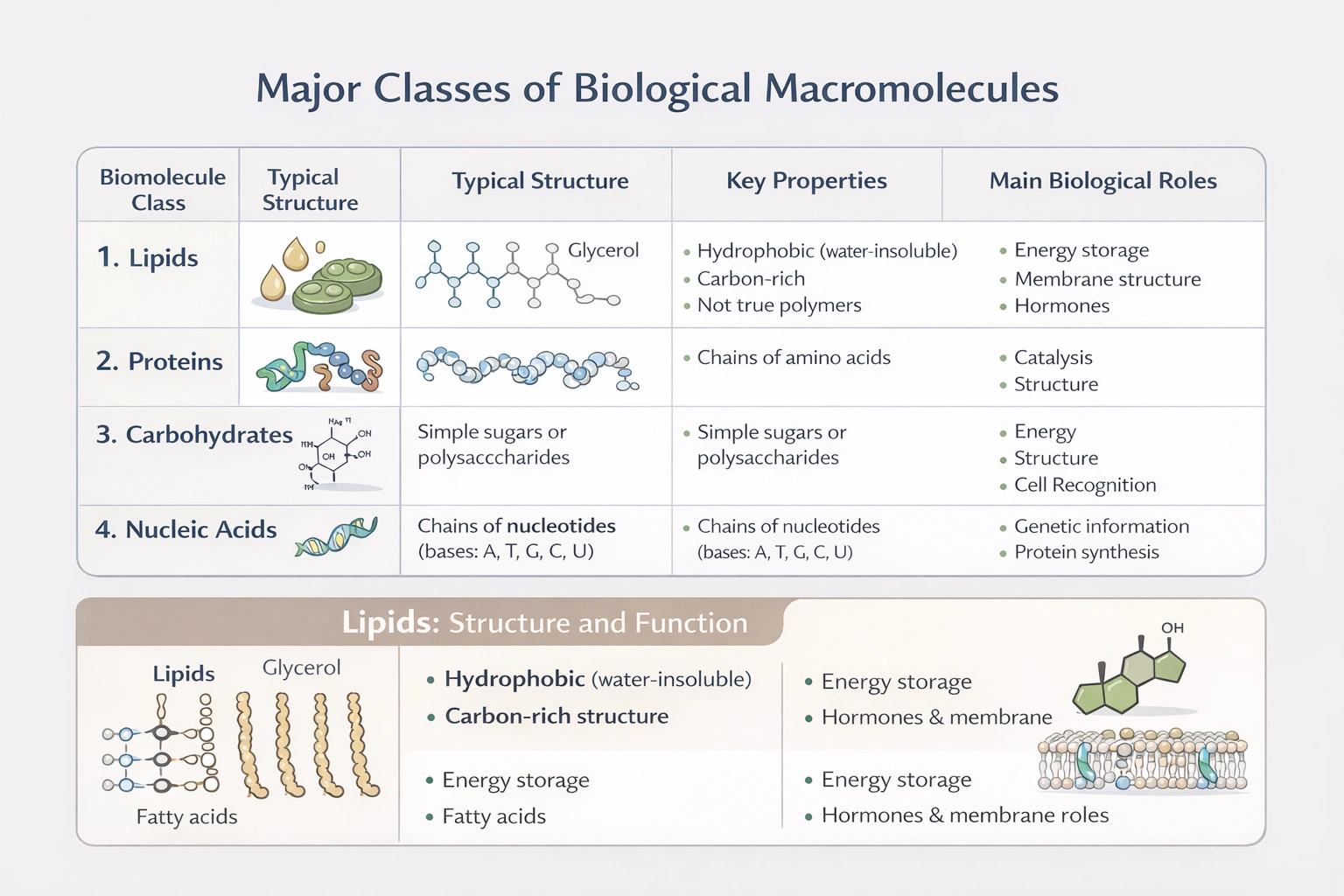
Biomolecules are categorized into four primary classes based on their chemical structure, solubility, and biological function: carbohydrates, lipids, proteins, and nucleic acids. Lipids are a diverse group defined by their hydrophobic nature; they are insoluble in water but soluble in nonpolar organic solvents like ether or chloroform. This class serves critical roles in long-term energy storage, insulation, cellular membrane structure, and signaling. Fats, specifically triglycerides, are composed of a glycerol molecule bonded to three fatty acid chains and are the body's primary form of stored energy. Steroids, characterized by a signature four-fused carbon ring structure, are also lipids. They include important molecules like cholesterol, a key component of cell membranes, and hormones such as estrogen and testosterone, which regulate physiological processes. The shared physicochemical property of hydrophobicity unites fats and steroids under the lipid classification.
A) Lipids
Lipids encompass a broad range of hydrophobic molecules, including fats (triglycerides), phospholipids, steroids, and waxes. Their defining characteristic is a high proportion of nonpolar carbon-hydrogen bonds, making them repel water. Fats serve as concentrated energy reserves, while steroids function as signaling molecules and structural components. Their classification together is based on this shared solubility behavior and their biosynthetic pathways, not on a common monomeric structure like other biomolecule classes.
B) Proteins
Proteins are polymers constructed from amino acid monomers linked by peptide bonds. They exhibit immense diversity in structure and function, acting as enzymes, structural components, transporters, and antibodies. While some lipids associate with proteins to form lipoproteins, fats and steroids themselves are not composed of amino acids and do not possess a polypeptide backbone. Their chemical composition and fundamental structure are entirely different from that of proteins.
C) Nucleic acids
Nucleic acids, such as DNA and RNA, are polynucleotides made of nucleotide monomers. Their primary role is to store, transmit, and express genetic information. Their structure includes a sugar-phosphate backbone and nitrogenous bases. Fats and steroids contain no phosphate groups, sugar rings, or nitrogenous bases. They play no direct role in genetic coding or information transfer, placing them in a completely separate functional and structural category.
D) Carbohydrates
Carbohydrates are composed of carbon, hydrogen, and oxygen, typically in a ratio approximating 1:2:1. They include sugars, starch, and cellulose and serve primarily as immediate energy sources and structural materials. Fats and steroids have a much lower oxygen content relative to carbon and hydrogen. They lack the characteristic carbonyl and hydroxyl groups arranged as saccharides and are not readily metabolized for quick energy. Their metabolic and structural roles are distinct from those of carbohydrates.
Conclusion
The classification of biomolecules is based on distinct chemical properties and functions. Proteins are polymers of amino acids, nucleic acids are polymers of nucleotides, and carbohydrates are polymers of saccharides. Lipids, however, are a class defined by hydrophobicity and include non-polymeric molecules like steroids and polymeric forms like triglycerides. Both fats and steroids exhibit this key hydrophobic trait and fulfill roles—such as energy storage and hormonal signaling—that are hallmark functions of lipids. Their shared insolubility in water and solubility in organic solvents definitively places them within the lipid class.
Topic Flashcards
Click to FlipWhat biomolecule class includes fats and steroids?
Lipids.
What property defines lipids as a biomolecule class?
They are hydrophobic and insoluble in water.
What type of lipid is used for long-term energy storage?
Fats (triglycerides).
What structural feature characterizes steroids? .
Four fused carbon rings
Name one biological role of steroids.
Hormonal signaling or membrane structure.