What metabolic process helps a cell yield a large amount of ATP?
-
A
Glycolysis
-
B
Chemiosmosis
-
C
Citric acid cycle
-
D
Oxidation of pyruvate
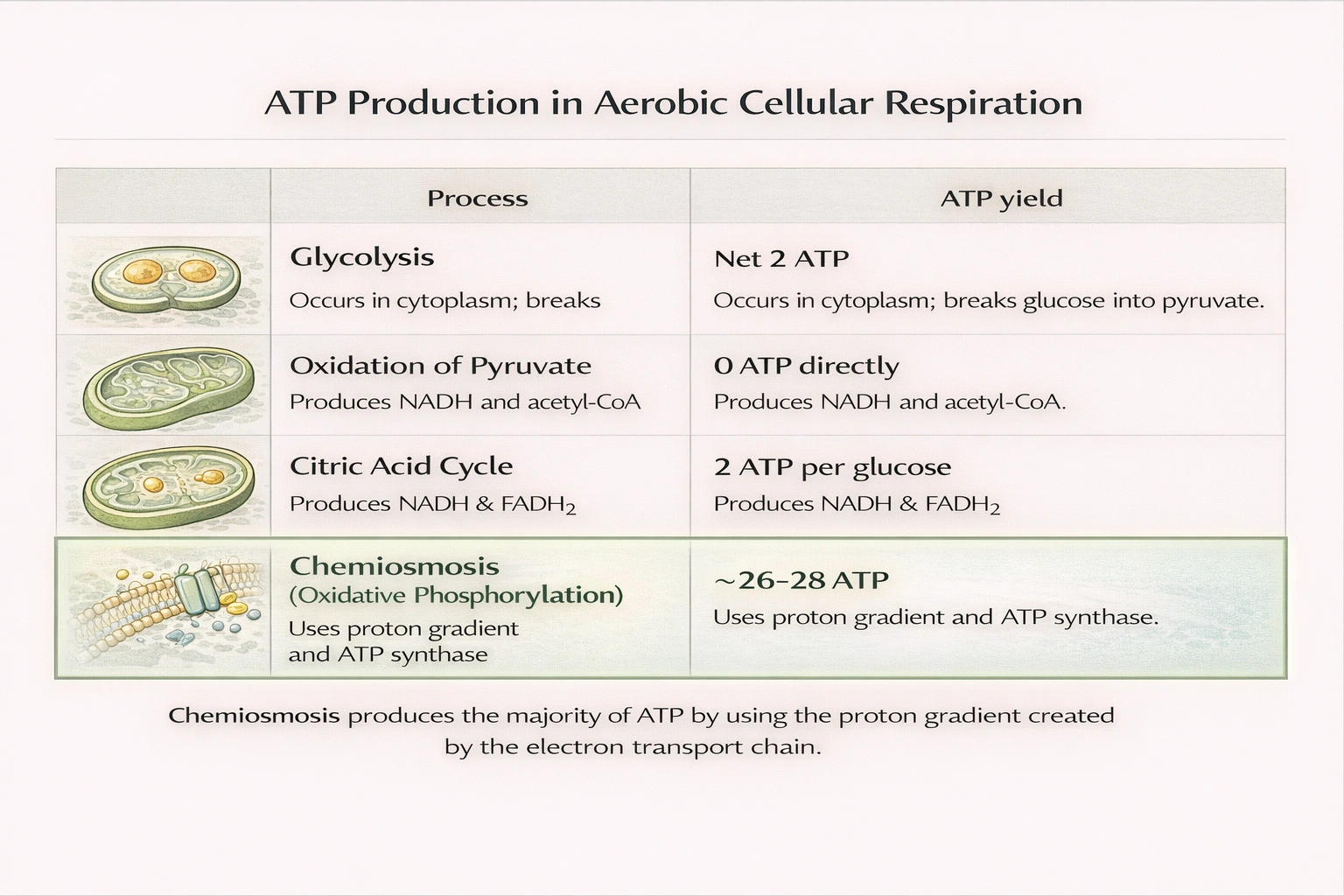
Chemiosmosis is the mechanism underlying oxidative phosphorylation and is responsible for generating the overwhelming majority of ATP during aerobic cellular respiration.
Chemiosmosis couples electron transport to ATP synthesis. As electrons pass through the Electron Transport Chain (ETC), energy is used to pump protons across a membrane, creating a strong electrochemical gradient. The flow of protons back across the membrane through ATP synthase drives the phosphorylation of ADP to ATP. This process can produce approximately 26-28 ATP molecules per glucose in eukaryotic cells.
A) Glycolysis
Glycolysis breaks down glucose into pyruvate and produces a net gain of 2 ATP molecules per glucose through substrate-level phosphorylation. While essential and universal, this is a relatively small yield.
B) Chemiosmosis
Chemiosmosis harnesses the energy released from the oxidation of NADH and FADH₂ (generated in earlier stages) to produce a large yield of ATP. It is not a standalone metabolic pathway but the efficient mechanism by which the ETC generates ATP, constituting the bulk of ATP production in aerobic respiration.
C) Citric acid cycle
The citric acid cycle completely oxidizes acetyl-CoA. It generates a small amount of ATP directly via substrate-level phosphorylation (1 ATP per turn, equivalent to 2 ATP per glucose). Its primary role is to produce high-energy electron carriers (NADH, FADH₂) for the ETC, not to yield large amounts of ATP directly.
D) Oxidation of pyruvate
This linking step converts pyruvate into acetyl-CoA, producing NADH and CO₂ but no ATP directly. The NADH contributes to the proton gradient via the ETC, but this step is not itself a significant producer of ATP.
Conclusion:
While glycolysis, the citric acid cycle, and pyruvate oxidation all contribute to ATP production, their direct yields are small. The process that multiplies this yield dramatically is chemiosmosis, which uses the potential energy of a proton gradient, built by the ETC, to synthesize ATP in large quantities. This makes chemiosmosis the key process for high-yield ATP production.
Topic Flashcards
Click to FlipWhich metabolic process produces the largest amount of ATP in aerobic respiration?
Chemiosmosis.
What creates the proton gradient used in chemiosmosis?
The Electron Transport Chain pumping protons across the membrane.
Which molecules donate electrons to the Electron Transport Chain?
NADH and FADH₂.
Approximately how many ATP molecules are produced by chemiosmosis per glucose?
About 26–28 ATP in eukaryotic cells.
What structure allows chemiosmosis to produce ATP?
ATP synthase.