What organism makes a cell plate during cytokinesis?
-
A
Bacterium
-
B
Human
-
C
Mushroom
-
D
Plant
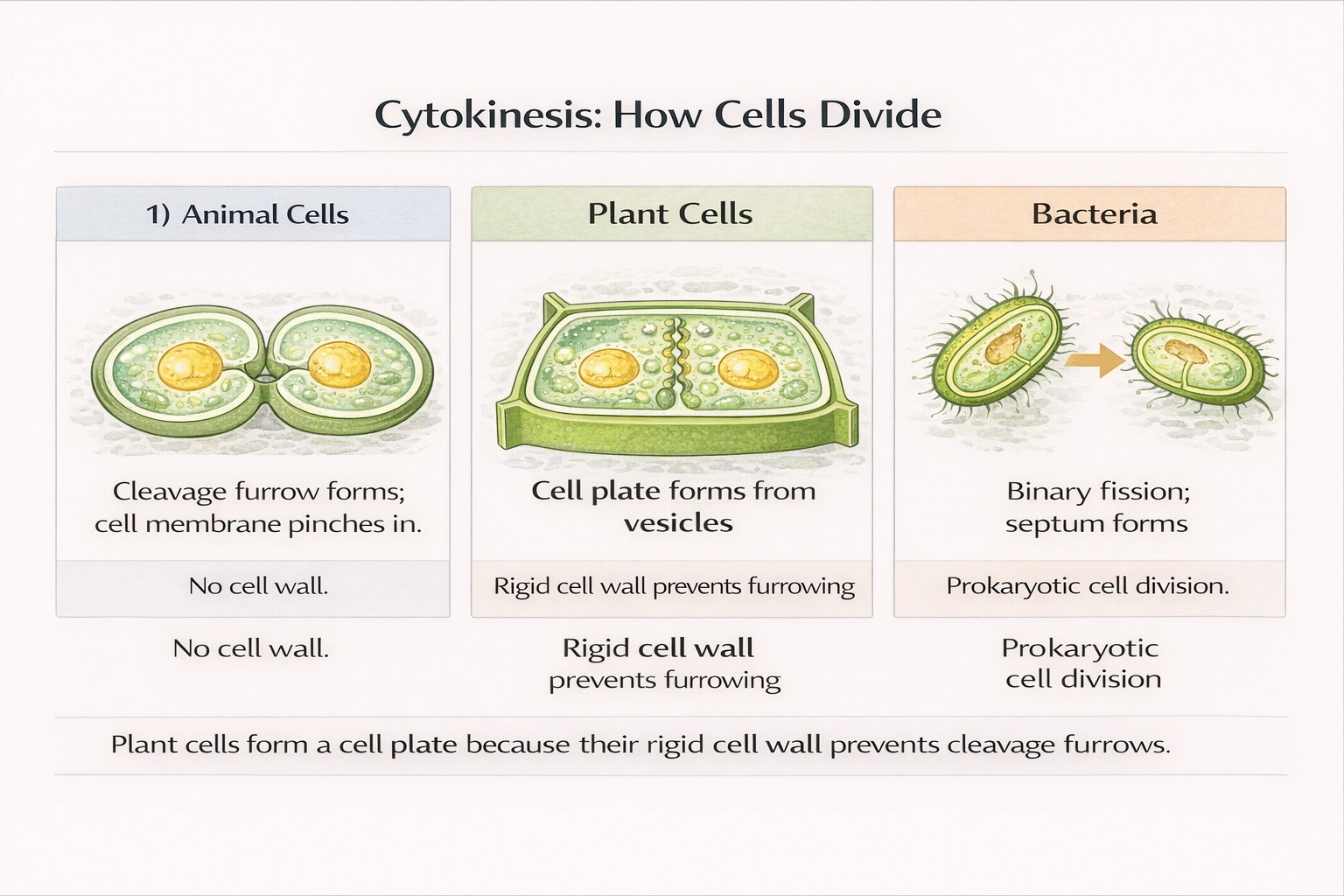
The formation of a cell plate from fusing vesicles is the distinctive mechanism of cytokinesis in plant cells, allowing them to divide while maintaining their rigid cell wall.
Plant cells possess a rigid cellulose cell wall that prevents the inward pinching of a cleavage furrow. During telophase, Golgi-derived vesicles carrying cell wall precursors (like pectins and hemicellulose) travel to the cell's center. These vesicles fuse to form a disc-like cell plate, which expands outward until it fuses with the parent cell wall, creating two separate daughter cells.
A) Bacterium
Bacteria are prokaryotes and divide by binary fission. This involves replication of the chromosome and the inward growth of the cell membrane and cell wall, forming a septum. Bacteria do not have a mitotic spindle and do not form a cell plate; their division apparatus is structurally different.
B) Human
Human cells, as representative animal cells, lack a cell wall. During cytokinesis, a cleavage furrow forms. A contractile ring composed of actin and myosin filaments pinches the cell membrane inward until the cytoplasm is partitioned. No cell plate is involved.
C) Mushroom
Mushrooms are fungi, and fungal cells have cell walls made of chitin. Fungal cytokinesis often involves septation, where new cell wall material is deposited at the division site. While conceptually similar to building a partition, the process in fungi can be more variable and is not universally referred to as "cell plate" formation in the same definitive way it is for plants.
D) Plant
The cell plate is a definitive structure in plant cell cytokinesis. It is formed by the fusion of vesicles guided by the phragmoplast (a microtubule structure). This process is necessary to construct a new cell wall between the daughter cells, a requirement imposed by the presence of a rigid outer wall.
Conclusion:
The mechanism of cytokinesis differs based on cellular structure. Bacteria divide via binary fission, animal cells use a cleavage furrow, and fungi use septation. The formation of a cell plate is a specific, vesicle-driven process unique to plant cells (and some algae), allowing for the construction of a new cell wall during division.
Topic Flashcards
Click to FlipWhat structure forms during cytokinesis in plant ce
A cell plate formed from the fusion of Golgi-derived vesicles.
Why do plant cells form a cell plate instead of a cleavage furrow?
Because their rigid cellulose cell wall prevents membrane pinching.
Which organelle supplies vesicles for cell plate formation?
The Golgi apparatus.
What cytoskeletal structure guides vesicles to the center during plant cytokinesis?
The phragmoplast.
What eventually forms from the mature cell plate?
A new cell wall separating the two daughter plant cells.