Which gives the correct order of cellular respiration?
-
A
Glycolysis, Acetyl-CoA, Citric Acid Cycle, Electron Transport Chain
-
B
Citric Acid Cycle, Glycolysis, Acetyl-CoA, Electron Transport Chain
-
C
Glycolysis, Acetyl-CoA, Electron Transport Chain, Citric Acid Cycle
-
D
Glycolysis, Citric Acid Cycle, Electron Transport Chain, Acetyl-CoA
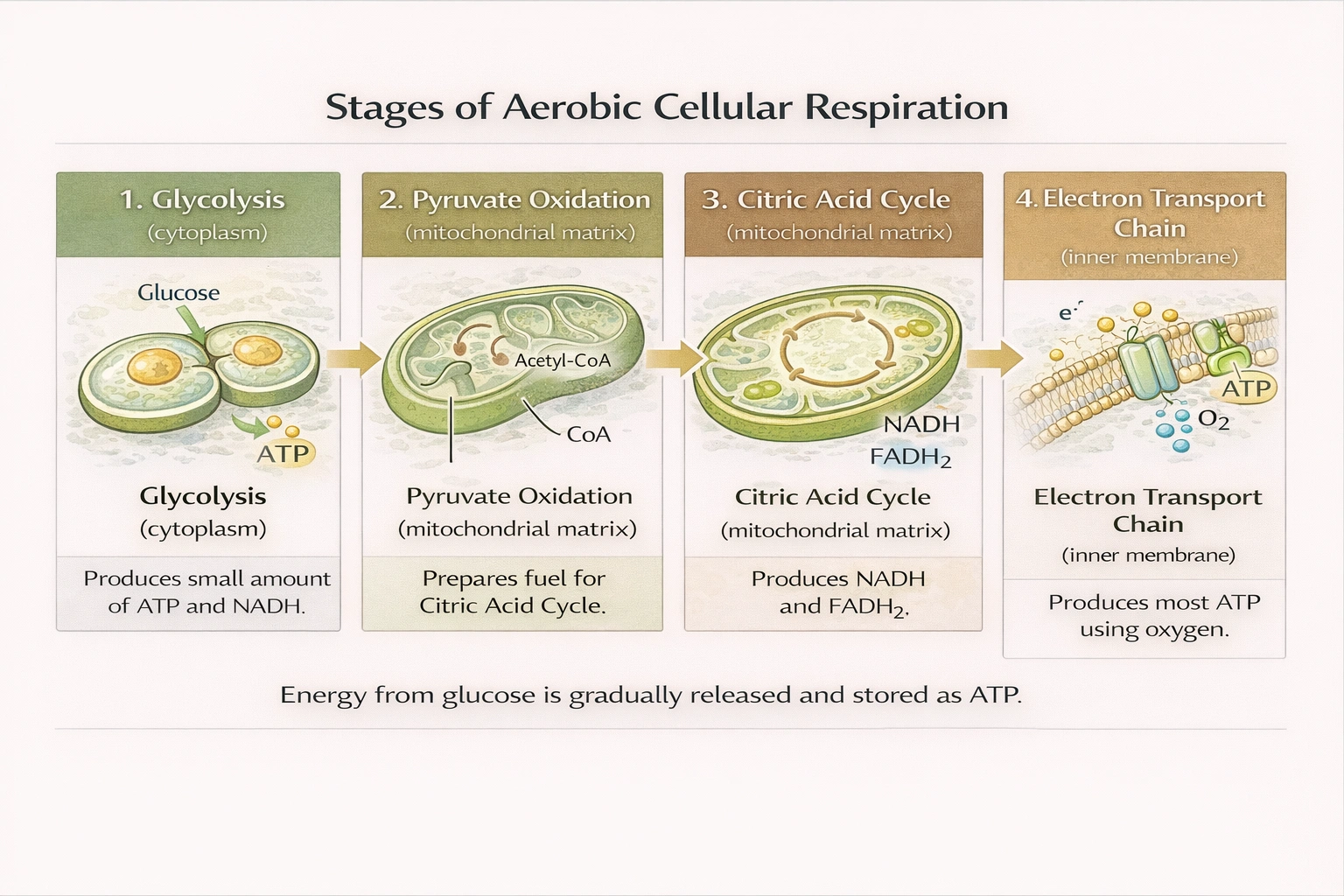
Glycolysis (breaks glucose into pyruvate), Pyruvate Oxidation/formation of Acetyl-CoA, Citric Acid Cycle (Krebs cycle), and finally the Electron Transport Chain & Chemiosmosis.
Aerobic cellular respiration follows a strict biochemical sequence where each stage prepares the substrates for the next, maximizing energy extraction from glucose. This sequence respects the dependencies of carbon flow and energy transfer.
A) Glycolysis, Acetyl-CoA, Citric Acid Cycle, Electron Transport Chain
This is the correct, linear sequence. Glycolysis in the cytoplasm produces pyruvate. Pyruvate oxidation in the mitochondrial matrix converts pyruvate to acetyl-CoA. The citric acid cycle completely oxidizes acetyl-CoA, producing electron carriers. The electron transport chain uses these carriers to create a proton gradient that drives ATP synthesis.
B) Citric Acid Cycle, Glycolysis, Acetyl-CoA, Electron Transport Chain
This sequence is biochemically impossible. The Citric Acid Cycle cannot begin without its fuel, acetyl-CoA. Acetyl-CoA is produced from pyruvate, which is the end-product of glycolysis. Placing the cycle first violates this essential substrate dependency.
C) Glycolysis, Acetyl-CoA, Electron Transport Chain, Citric Acid Cycle
This order sends electron carriers to the Electron Transport Chain before they are fully generated. The Citric Acid Cycle is a major producer of NADH and FADH₂. Bypassing the cycle would deprive the ETC of most of its electron donors, drastically reducing ATP yield and leaving the carbon skeletons incompletely oxidized.
D) Glycolysis, Citric Acid Cycle, Electron Transport Chain, Acetyl-CoA
This sequence misplaces acetyl-CoA, which is the input for the Citric Acid Cycle. Acetyl-CoA is produced after glycolysis and is consumed by the Citric Acid Cycle. It is illogical for it to appear after the Electron Transport Chain, as all usable energy from the acetyl group should have been harvested by that point.
Conclusion:
The flow of cellular respiration is a stepwise breakdown process. The Citric Acid Cycle requires acetyl-CoA, which requires glycolysis. The Electron Transport Chain requires the reduced carriers produced by the previous stages. Only the sequence beginning with glycolysis, proceeding to acetyl-CoA formation, then the citric acid cycle, and finally the electron transport chain respects these biochemical dependencies and allows for maximal ATP production.
Topic Flashcards
Click to FlipWhat is the first stage of cellular respiration?
Glycolysis.
What molecule is formed when pyruvate is oxidized before entering the Krebs cycle?
Acetyl-CoA.
Which stage of cellular respiration produces the most NADH and FADH₂?
The Citric Acid Cycle (Krebs cycle).
Where does the Electron Transport Chain occur in eukaryotic cells?
The inner mitochondrial membrane.
What is the primary purpose of the Electron Transport Chain?
To create a proton gradient that drives ATP synthesis via chemiosmosis.