Which would benefit from the use of a taxonomic system?
-
A
A researcher discovers a new organism while surveying a lake.
-
B
A researcher examines the survival of an invasive plant species.
-
C
A researcher studies the growth and development of a living thing.
-
D
A researcher uses fossils to explain how organisms evolved over time.
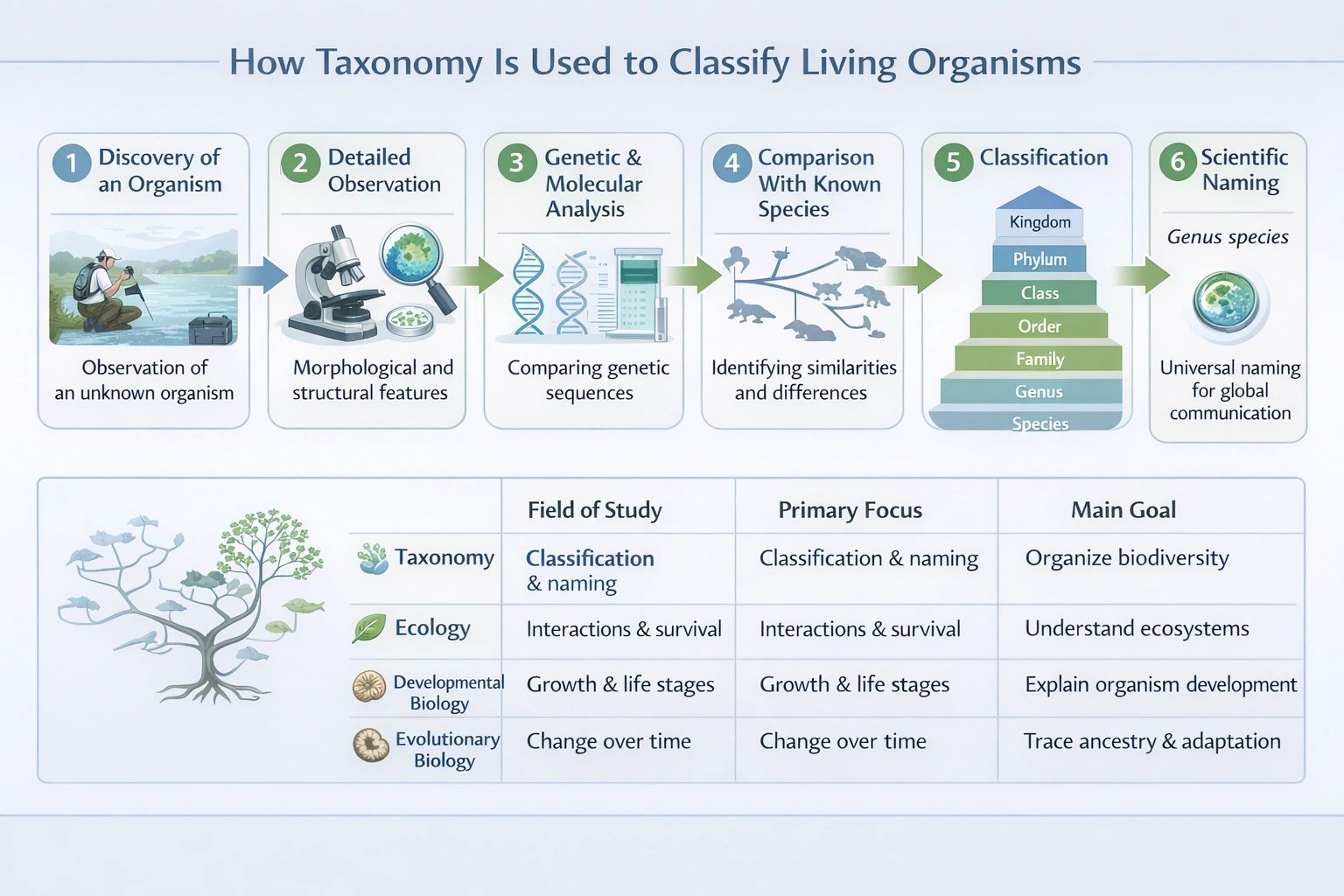
The discovery of a previously unknown organism is the paradigmatic scenario requiring the direct and full application of taxonomic principles.
Taxonomy is the scientific discipline concerned with naming, describing, and classifying organisms based on shared characteristics and evolutionary relationships. Its hierarchical system provides a universal framework for organizing biological diversity. When a new organism is found, the researcher must employ taxonomy to examine its morphology, genetics, and ecology, determine its evolutionary relationships, and assign it a unique, standardized scientific name using binomial nomenclature. This formal classification integrates the discovery into the global biological framework.
A) A researcher discovers a new organism while surveying a lake.
This scenario necessitates the complete suite of taxonomic activities: description, comparison, naming, and hierarchical classification. It is the formal act of integrating novelty into the established tree of life, which is the core purpose of taxonomy.
B) A researcher examines the survival of an invasive plant species.
While accurate taxonomic identification is an absolute prerequisite for this research, one must know exactly which species is invasive—the core focus extends beyond classification. The study is ecological, investigating population dynamics, competitive interactions, and ecosystem impact. Taxonomy provides the essential starting point, but the research objectives are rooted in ecology, not in the act of classification itself.
C) A researcher studies the growth and development of a living thing.
This type of research falls under embryology or developmental biology. It investigates the processes and mechanisms governing ontogeny. Knowing the organism’s precise species, achieved via taxonomy, is important for context, but the study itself is concerned with physiological and genetic mechanisms, not with naming or classifying the organism within a broader hierarchical system.
D) A researcher uses fossils to explain how organisms evolved over time.
This is the domain of paleontology and evolutionary biology. Taxonomy is deeply informed by and informs evolutionary studies, as classifications aim to reflect evolutionary history. However, the primary tools here are the fossil record, comparative anatomy, and molecular clocks to reconstruct phylogenetic trees. The act of classifying fossils is part of the process, but the main goal is to understand evolutionary patterns and processes, not solely to apply a classification system.
Conclusion:
The taxonomic system is most directly and wholly applied when a new organism requires identification, description, and integration into biological order. Other research areas depend on prior taxonomic work but are primarily focused on ecology, development, or evolutionary history. The discovery of a new organism is the activity for which taxonomy is an indispensable and central tool.
Topic Flashcards
Click to FlipWhat is the formal, two-part naming system used to give a newly discovered organism its unique scientific name?
Binomial nomenclature. It assigns a genus and species name (e.g., Homo sapiens), a core function of taxonomy.
True or False: The primary goal of taxonomy is to explain the evolutionary mechanisms that led to a species' adaptation.
False. Taxonomy's primary goal is to name, describe, and classify organisms. Evolutionary explanation is the goal of phylogenetics and evolutionary biology.
In which scenario is the full hierarchical classification (Domain, Kingdom, Phylum, etc.) of an organism most essential to determine from scratch?
When discovering a completely new organism. This requires placing it within the entire taxonomic tree to understand its relationships.
How does accurate taxonomy serve as a foundational tool for a researcher studying an invasive species?
It provides the correct identification. Researchers must know the exact species they are studying to access existing data and communicate findings accurately, but the study itself is ecological.
What field of study most directly builds upon and uses taxonomic classifications to map the history of life?
Phylogenetics (or evolutionary biology). It uses taxonomic groups to build and test evolutionary trees showing descent from common ancestors.