Why are metabolic pathways cyclic?
-
A
Metabolic reactions generally take place one at a time.
-
B
All of the products created in metabolic reactions are used up.
-
C
The reactions are continuous as long as reactants are available.
-
D
Energy in the form of ATP is sent to different cells for various uses.
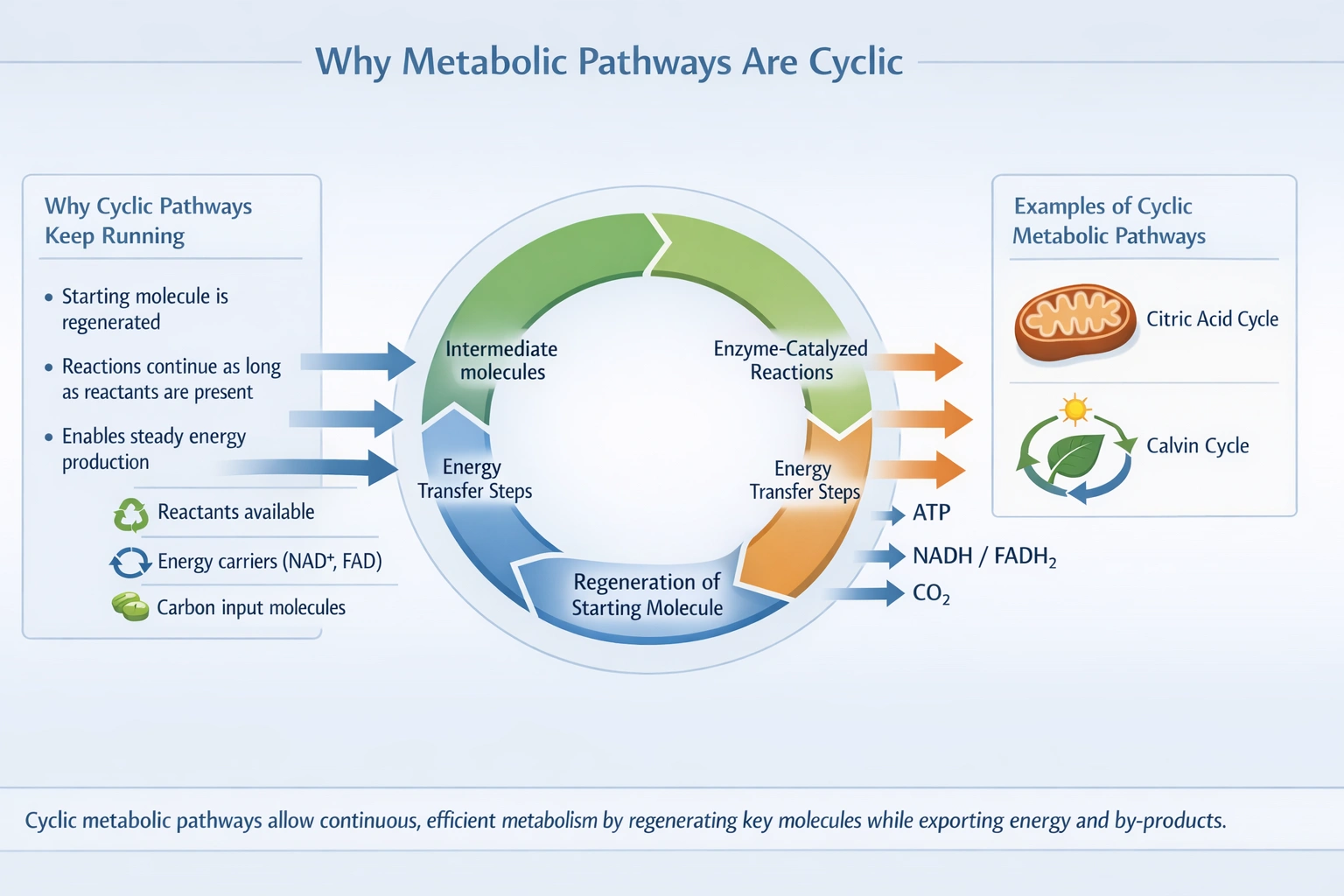
Cyclic pathways, such as the Citric Acid Cycle, are designed for continuous operation by regenerating their starting substrate.
This cyclical architecture allows the pathway to function as a biochemical "roundabout." The initial substrate is regenerated at the end of the reaction sequence, enabling the system to operate perpetually as long as input molecules and necessary cofactors are supplied. This design promotes efficiency, regulatory control, and the economic reuse of enzymes and intermediates, providing a steady, on-demand supply of products like ATP, NADH, and biosynthetic precursors.
A) Metabolic reactions generally take place one at a time.
Reactions within a metabolic pathway are highly coordinated and interconnected. The product of one reaction immediately becomes the substrate for the next, often within multi-enzyme complexes or specific cellular compartments. They do not function as isolated, singular events but as integrated, sequential cascades where multiple steps proceed in a tightly coupled manner.
B) All of the products created in metabolic reactions are used up.
This is not accurate for cyclic pathways. While a cycle regenerates its starting molecule, it also produces valuable end-products that are exported for use elsewhere. For instance, the Citric Acid Cycle generates reduced electron carriers (NADH, FADH₂) and carbon dioxide, which leave the cycle. The pathway’s purpose is often to generate these very products for the broader cellular economy, not to consume all its own outputs internally.
C) The reactions are continuous as long as reactants are available.
The regeneration of the starting compound means the pathway does not have a definitive end point; it is poised to begin another turn immediately. Continuity is a defining feature. As long as key input substrates (like acetyl-CoA for the Krebs cycle) and necessary cofactors (like NAD⁺ and ADP) are supplied, the cycle can spin continuously, adjusting its rate based on cellular demand.
D) Energy in the form of ATP is sent to different cells for various uses.
This describes a physiological destination or function of a metabolic product, not the structural reason for a pathway’s cyclical architecture. ATP distribution is a crucial aspect of organismal physiology, but it does not explain why the reaction sequence itself forms a closed loop. The cyclic design is an intrinsic property of the pathway’s chemistry and enzyme organization, existing even in isolated biochemical systems.
Conclusion:
Metabolic pathways are cyclic primarily to achieve operational continuity, efficiency, and precise regulatory control. The idea that reactions happen in isolation or that all products are consumed internally misrepresents pathway dynamics. While ATP distribution is a critical outcome, it is not the cause of the cyclic structure. The continuous, self-renewing nature of these pathways allows cells to maintain a constant, regulable flow of energy and building blocks.
Topic Flashcards
Click to FlipWhat is a key structural feature of a cyclic metabolic pathway that allows it to operate continuously?
The regeneration of the initial starting substrate at the end of the reaction sequence, creating a closed loop.
In the Citric Acid Cycle (Krebs cycle), what specific molecule is both the first reactant and the final regenerated product?
Oxaloacetate. It combines with acetyl-CoA to form citrate and is reformed at the end of the cycle, allowing the process to repeat.
What major advantage does a cyclic structure provide for the regulation of a metabolic pathway?
It allows for precise control at multiple points. Regulating one step can efficiently speed up or slow down the entire cycle based on cellular energy needs.
True or False: The primary reason a pathway is cyclic is to ensure that all intermediate molecules are completely consumed within the cycle.
False. While intermediates are reused, the cycle also exports important products (like NADH and CO₂) for use elsewhere in the cell.
How does a cyclic pathway, like the Calvin cycle in photosynthesis, differ from a linear pathway, like glycolysis?
A cyclic pathway regenerates its starting compound, while a linear pathway has distinct start and end points with different initial substrates and final products.