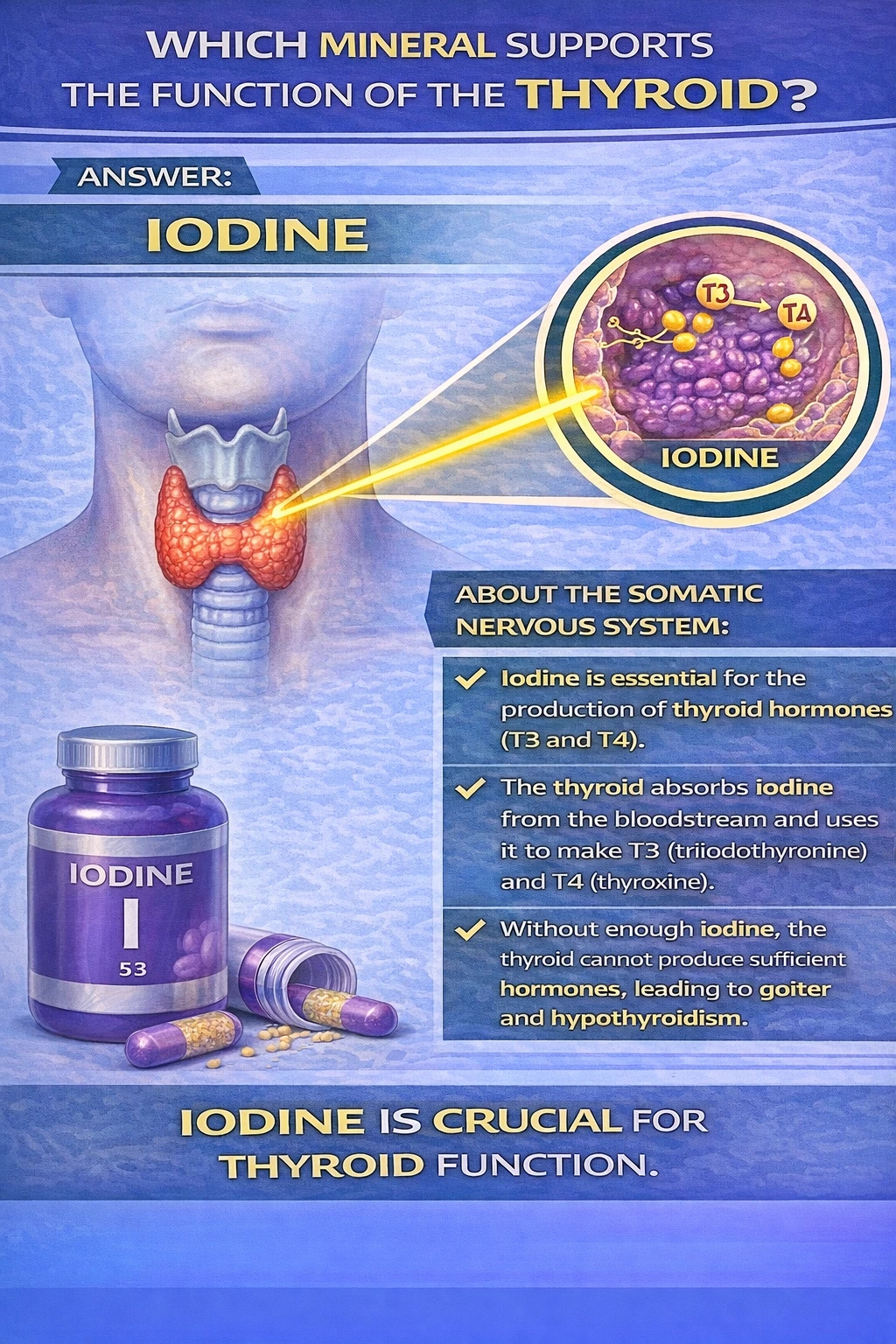
Which mineral supports the function of the thyroid?
-
A
Manganese
-
B
. Iodine
-
C
Phosphorus
-
D
Zinc
The mineral that supports the function of the thyroid is iodine.
Iodine is essential for the production of thyroid hormones, which regulate metabolism, growth, and development. The thyroid gland absorbs iodine from the bloodstream to produce thyroid hormones, mainly thyroxine (T4) and triiodothyronine (T3). A deficiency in iodine can lead to thyroid dysfunction, such as goiter.
A. Manganese
Manganese is an essential trace mineral involved in several processes in the body, including bone formation, metabolism, and the functioning of enzymes. However, manganese does not directly support the function of the thyroid, making it unrelated to the production of thyroid hormones.
B. Iodine
This is the correct answer. Iodine is a critical mineral for the thyroid gland. It is used by the thyroid to produce thyroid hormones, which control important bodily functions such as metabolism and energy regulation. Without sufficient iodine, the thyroid cannot produce enough hormones, leading to conditions like hypothyroidism or goiter.
C. Phosphorus
Phosphorus is important for the formation of bones and teeth, and it also plays a role in energy production within cells. While it is crucial for overall health, phosphorus does not have a direct impact on the thyroid's function.
D. Zinc
Zinc is important for immune function, protein synthesis, and DNA synthesis. While zinc plays a role in supporting overall endocrine health, it does not directly support the production or function of thyroid hormones as iodine does.
Conclusion:
Iodine is the essential mineral that directly supports the function of the thyroid gland by enabling the production of thyroid hormones. Manganese, phosphorus, and zinc play other important roles in the body but are not specifically involved in thyroid function.

Topic Flashcards
Click to FlipWhich mineral deficiency commonly causes goiter and hypothyroidism?
Iodine deficiency prevents adequate synthesis of thyroid hormones, leading the gland to enlarge (goiter) in an attempt to capture more iodine, and often resulting in hypothyroidism.
What mineral forms the structural core of thyroid hormones T3 and T4?
Iodine is incorporated directly into the molecular structure of thyroxine (T4) and triiodothyronine (T3), making it essential for their synthesis.
Which mineral is most directly required for thyroid hormone creation?
Iodine is the primary mineral used by the thyroid gland to build T3 and T4 hormones; the others have only indirect or supportive roles in thyroid activity.
Why must the body obtain sufficient iodine for proper thyroid function?
Iodine is a necessary component in the chemical structure of thyroid hormones, which control metabolism, growth, body temperature, and development.
Why is iodine uniquely critical for normal thyroid function?
It is required for the biosynthesis of thyroid hormones (T3 & T4).