Which of the following CANNOT be found in a human cell's genes?
-
A
Sequences of amino acids to be transcribed into mRNA
-
B
Lethal recessive traits like sickle cell anemia
-
C
Mutated DNA
-
D
DNA that codes for proteins the cell doesn't use
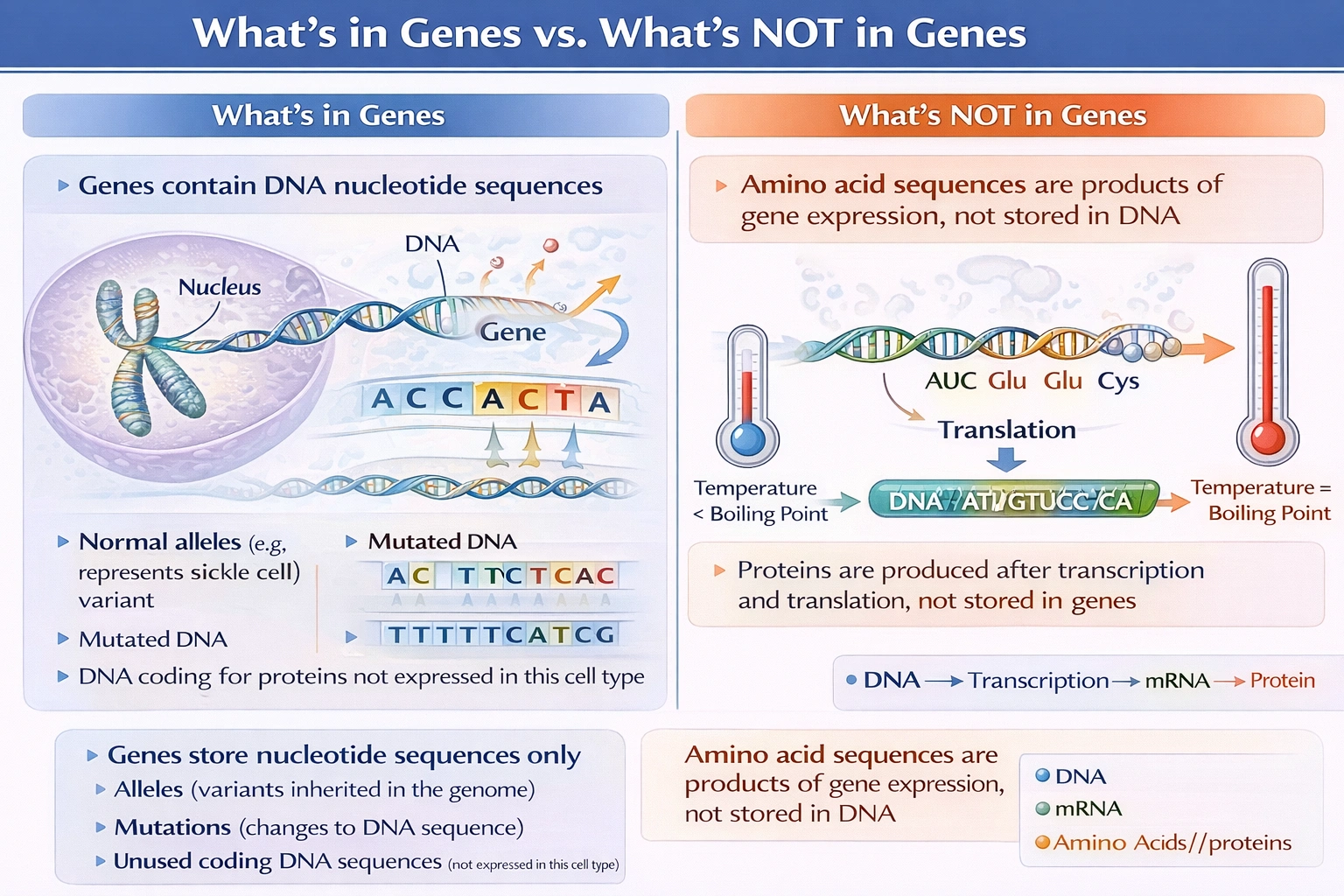
Genes contain nucleotide sequences that are transcribed into mRNA, not pre-formed amino acid sequences—amino acids are assembled during translation after mRNA transcription.
Human genes consist exclusively of DNA nucleotide sequences (adenine, thymine, cytosine, guanine) organized into coding regions that serve as templates for mRNA synthesis during transcription; amino acid sequences represent the polypeptide products of translation, not genetic components stored within DNA itself.
A) Sequences of amino acids to be transcribed into mRNA
Genes contain nucleotide triplets (codons) that specify amino acid sequences during translation, but they do not store actual amino acids or pre-assembled amino acid chains. Transcription converts DNA nucleotide sequences into complementary mRNA nucleotide sequences—not amino acid sequences. Translation subsequently converts mRNA codons into amino acid sequences through ribosomal machinery and tRNA adaptors. Amino acids themselves are metabolic molecules synthesized or obtained from diet, not genetic information stored in chromosomes. This option confuses the informational role of DNA (nucleotide code) with its functional product (polypeptide chains).
B) Lethal recessive traits like sickle cell anemia
Genes absolutely contain alleles responsible for lethal recessive disorders like sickle cell anemia, caused by a specific point mutation (GAG → GTG) in the β-globin gene (HBB) on chromosome 11, substituting valine for glutamic acid at position 6 of the β-chain. Heterozygous carriers (HbAS) possess one mutant allele without disease symptoms, while homozygous individuals (HbSS) express the disorder. Such alleles persist in populations through heterozygote advantage (malaria resistance in carriers), demonstrating that lethal recessive alleles remain present in gene pools despite their homozygous lethality—stored as specific DNA sequence variants within chromosomal DNA.
C) Mutated DNA
Mutations—permanent alterations in DNA nucleotide sequence—constitute normal components of human genomes. Each individual carries approximately 50–100 de novo mutations not present in parental genomes, plus thousands of inherited variants. Mutations range from single nucleotide polymorphisms (SNPs) to insertions, deletions, and structural variants. Somatic mutations accumulate in tissues throughout life (e.g., UV-induced mutations in skin cells), while germline mutations transmit across generations. Cancer genomes exhibit extensive mutated DNA sequences driving oncogenesis. Mutated DNA represents an expected genomic feature rather than an anomaly excluded from genes.
D) DNA that codes for proteins the cell doesn't use
Human cells contain extensive DNA coding for proteins not expressed in that specific cell type—a consequence of cellular differentiation and tissue-specific gene regulation. Each somatic cell possesses the complete diploid genome (~20,000 protein-coding genes), but individual cell types express only 10–20% of these genes. A neuron contains insulin gene sequences but doesn't transcribe them; a pancreatic β-cell contains neurotransmitter receptor genes it doesn't utilize. This genomic redundancy enables developmental plasticity and explains why somatic cell nuclear transfer can generate entire organisms—every cell retains the full genetic blueprint despite expressing only a tissue-appropriate subset.
Conclusion:
Genes store information exclusively as nucleotide sequences that undergo transcription to mRNA and subsequent translation to amino acid sequences—they do not contain pre-formed amino acid chains. Options B, C, and D all represent genuine genomic components: lethal recessive alleles persist as DNA sequence variants, mutations constitute normal genomic diversity, and unused protein-coding sequences remain present due to universal genomic content across cell types. Only option A describes a biological impossibility—amino acid sequences cannot exist within genes prior to translation, as genes function as nucleotide-based templates rather than repositories of protein products. This distinction between genetic information storage (nucleotides) and functional expression (amino acids) represents a cornerstone of molecular biology's central dogma.
