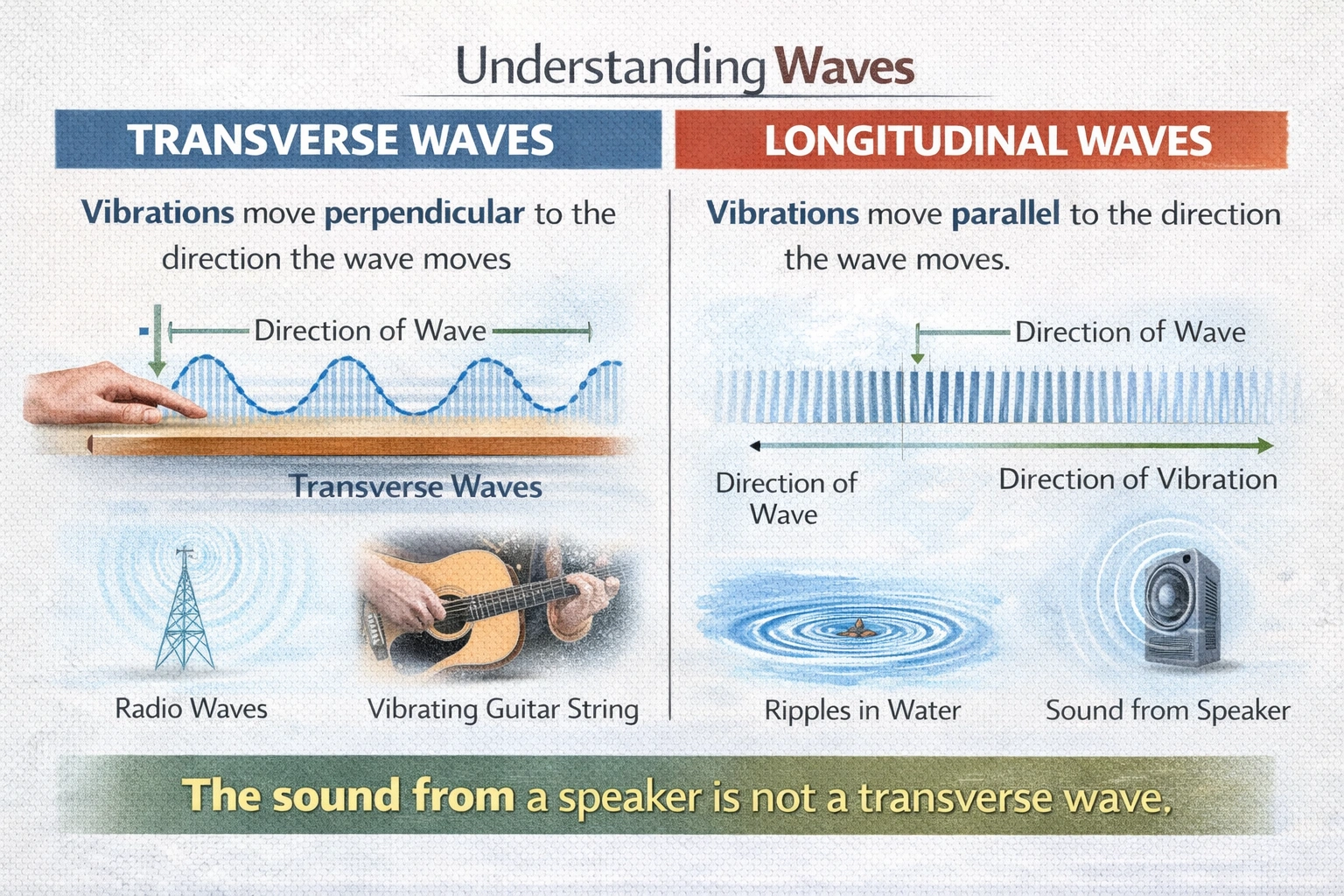
Which of the following is not a transverse wave?
-
A
radio waves
-
B
the sound from a speaker
-
C
a vibrating guitar string
-
D
ripples in a water pond
The sound from a speaker forms Sound waves which are longitudinal waves.
Transverse waves are characterized by oscillations that are perpendicular to the direction of wave propagation. In contrast, sound waves are longitudinal waves, where the oscillations occur in the same direction as the wave's propagation.
- A) Radio waves:
- Radio waves are a form of electromagnetic radiation, and like all electromagnetic waves, they are transverse waves. In a transverse wave, the oscillations occur perpendicular to the direction of wave propagation. Radio waves, as well as light waves and X-rays, are examples of transverse waves. Therefore, this option is incorrect.
- B) The sound from a speaker:
- Sound waves are longitudinal waves, not transverse. In a longitudinal wave, the particles of the medium vibrate in the same direction as the wave's propagation. For example, in a sound wave, particles of air compress and rarefy as the wave travels through the air. Therefore, the sound produced by a speaker is a longitudinal wave, making this option the correct answer.
- C) A vibrating guitar string:
- The vibrations of a guitar string create transverse waves. When the string is plucked, it moves up and down in a direction perpendicular to the length of the string. These oscillations produce sound through the vibration of the air, and the wave on the string itself is a transverse wave. This option is not the correct answer.
- D) Ripples in a water pond:
- Ripples on the surface of a pond are an example of transverse waves. In these waves, the water molecules move up and down, perpendicular to the direction in which the wave propagates across the surface of the pond. This is a classic example of a transverse wave.
Conclusion: The sound produced by a speaker is a longitudinal wave, making B) The sound from a speaker the correct answer.

Topic Flashcards
Click to FlipWhat is the defining characteristic of a transverse wave regarding the direction of particle oscillation?
In a transverse wave, the particles of the medium oscillate perpendicular (at a right angle) to the direction the wave travels.
Name the two main categories of mechanical waves and state which one a sound wave from a speaker belongs to
The two categories are transverse and longitudinal. Sound from a speaker is a longitudinal wave.
In a longitudinal wave like sound, how do the particles of the medium move relative to the wave's direction?
The particles oscillate parallel to the direction the wave travels, creating regions of compression and rarefaction.
Which broad category of waves (e.g., electromagnetic, mechanical) is always transverse, and give two examples
Electromagnetic waves are always transverse. Examples include radio waves, visible light, and X-rays.
A wave travels along a stretched rope. Is this primarily a transverse or longitudinal wave? What about the wave that travels through the air when you speak?
The wave on the rope is transverse. The sound wave through the air when you speak is longitudinal.