Why doesn’t a raindrop accelerate as it approaches the ground?
-
A
Gravity pulls it down at a constant rate.
-
B
Air resistance counteracts the gravitational force.
-
C
Its mass decreases, decreasing its speed.
-
D
Objects in motion decelerate over distance.
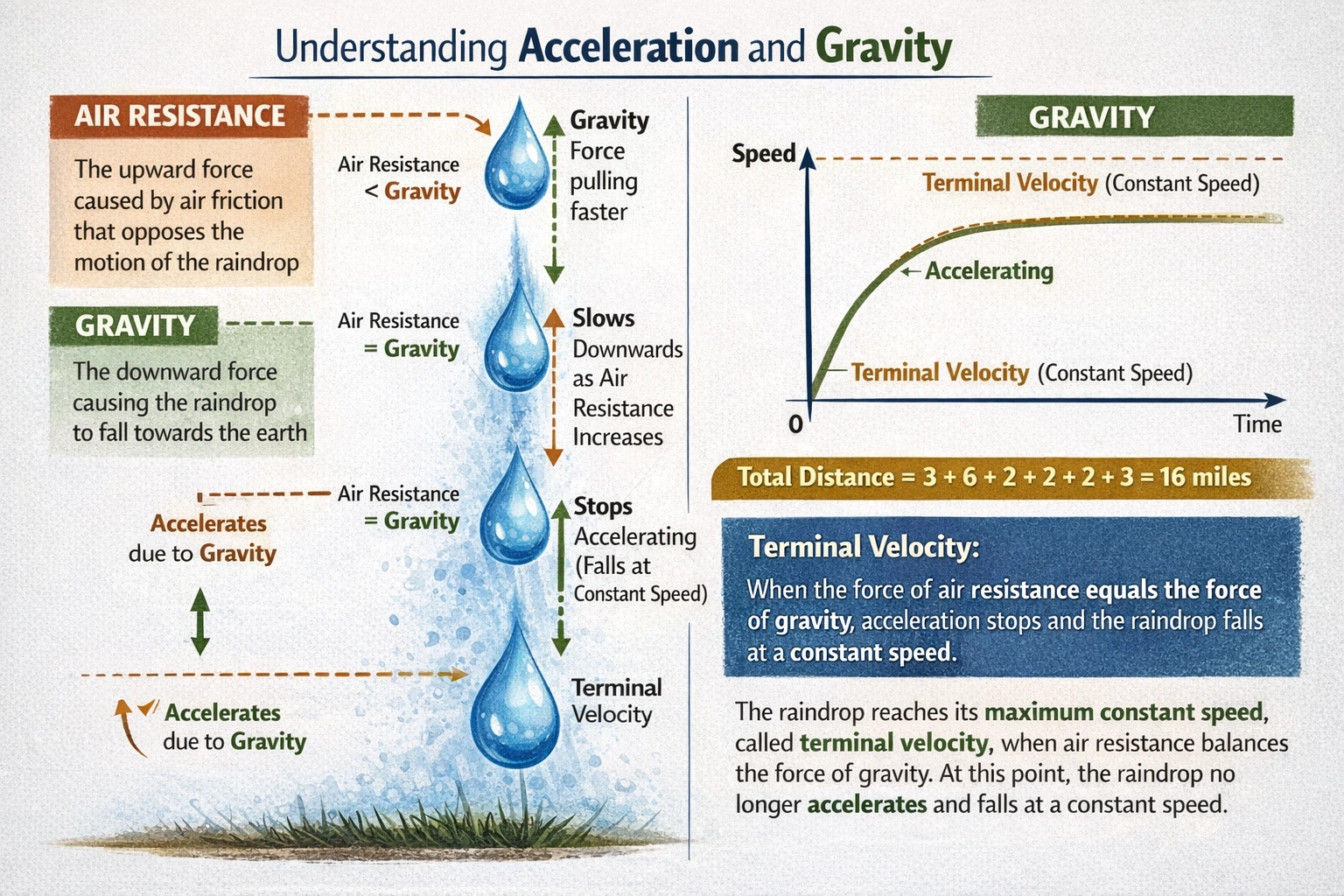
A raindrop does not accelerate as it approaches the ground because air resistance counteracts the gravitational force.
As the drop falls, drag increases with speed until it balances the downward pull of gravity, resulting in terminal velocity, a constant speed with no further acceleration.
A) Gravity pulls it down at a constant rate
Gravity exerts a constant force, but acceleration ceases when drag equals weight. In air, unlike in a vacuum, acceleration is not sustained indefinitely.
B) Air resistance counteracts the gravitational force
This is correct. At terminal velocity, the net force is zero, so acceleration stops. This explains why raindrops fall at safe, steady speeds rather than accelerating to destructive velocities.
C) Its mass decreases, decreasing its speed
Evaporation is negligible for typical raindrops, and mass loss would not produce constant speed. The stabilization is due to force equilibrium, not changes in mass.
D) Objects in motion decelerate over distance
This contradicts Newton’s first law. Objects maintain constant velocity unless acted upon by a net force. Raindrops do not slow down; they stop speeding up.
Conclusion
Terminal velocity occurs when drag force equals gravitational force, eliminating net acceleration. The correct answer is B) Air resistance counteracts the gravitational force.

Topic Flashcards
Click to FlipA skydiver jumps from a plane. After several seconds, she stops speeding up and falls at a constant speed. Explain the forces acting on her at this moment.
The downward force of gravity (weight) is perfectly balanced by the upward force of air resistance (drag). The net force is zero, so according to Newton's First Law, she continues at a constant velocity (terminal velocity).
Two balls of identical size but different mass (e.g., a steel ball and a plastic ball) are dropped from a great height in air. Which one will have a higher terminal velocity, and why?
The steel ball will have a higher terminal velocity. Terminal velocity is reached when drag force equals weight. Heavier objects have greater weight, requiring a higher speed to produce enough drag force to balance it.
Compare the fall of a feather and a rock in a vacuum chamber versus in normal air. Why is the difference dramatic in air but not in a vacuum?
In a vacuum, there is no air resistance, so both objects accelerate downward at *g* and hit the ground simultaneously (if dropped from the same height). In air, the large surface area of the feather creates significant drag at low speeds, causing it to reach a very low terminal velocity almost immediately, while the rock's higher mass-to-area ratio allows it to accelerate to a much higher terminal velocity.
Draw a simple free-body diagram for a falling object that has just reached its terminal velocity. Label the forces.
The diagram should show two force arrows of equal length acting on a dot. One arrow points downward labeled "Weight (F_gravity)". The other arrow points upward labeled "Air Resistance / Drag (F_drag)". The arrows are equal in length, indicating a net force of zero.
Describe what the velocity-time graph looks like for an object dropped from rest in air, as it falls toward the ground.
The graph starts with a positive, increasing slope (acceleration). The slope gradually decreases as speed increases and drag builds. The line eventually becomes horizontal (slope = 0), indicating constant terminal velocity with zero acceleration.