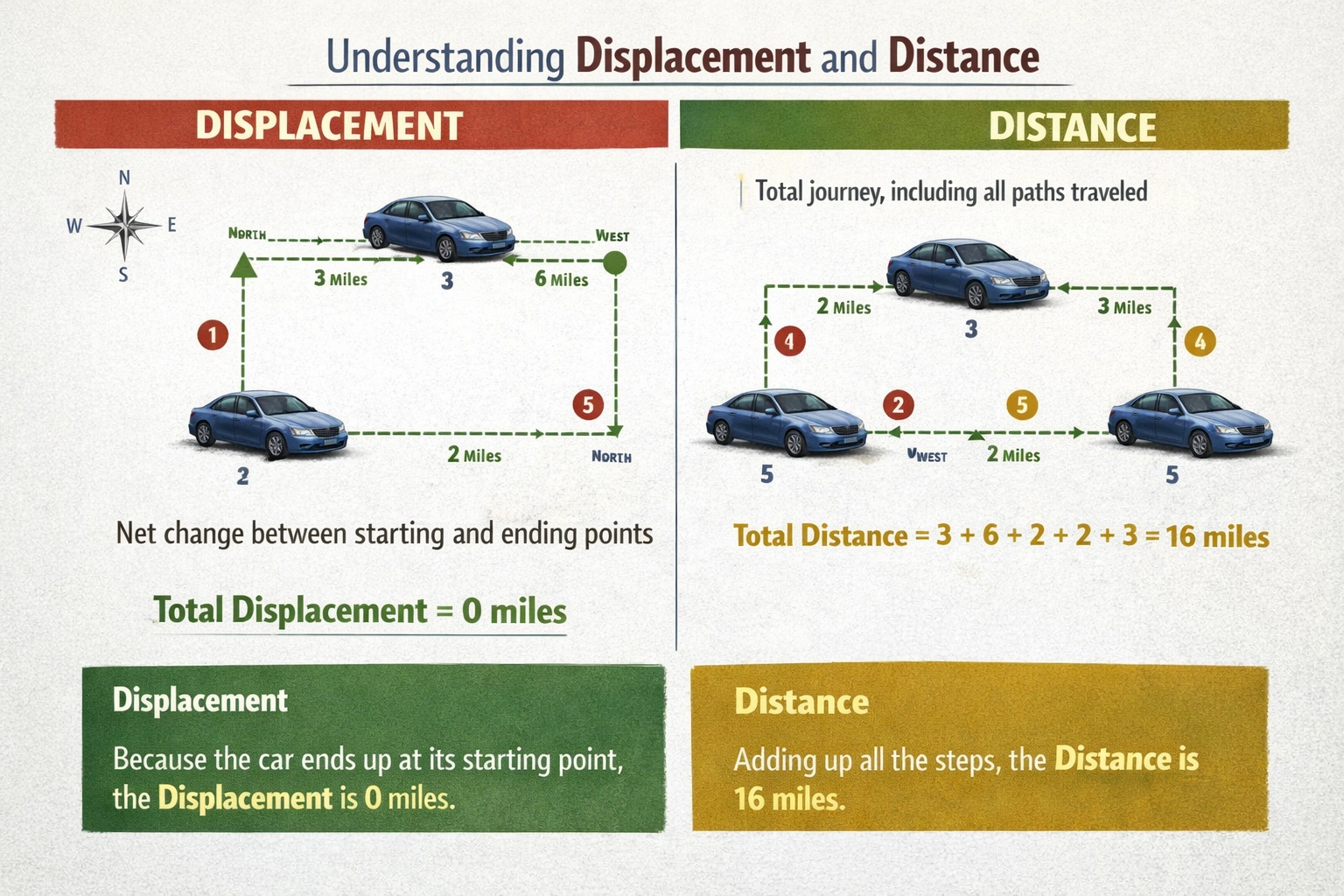
A car travels 3 miles north, 6 miles south, 2 miles east, 2 miles west, and then 3 miles north. Which of the following is true?
-
A
The displacement of the car is 16 miles, and the distance traveled is 0 miles.
-
B
The displacement of the car is 16 miles, and the distance traveled is 16 miles.
-
C
The displacement of the car is 0 miles, and the distance traveled is 0 miles.
-
D
The displacement of the car is 0 miles, and the distance traveled is 16 miles.
After moving north, south, east, west, and north again in the specified amounts, the car returns precisely to its starting point, resulting in zero net displacement, while the total path length sums to 16 miles.
A) The displacement of the car is 16 miles, and the distance traveled is 0 miles
This reverses the definitions: distance cannot be zero if the car moved, and displacement cannot exceed the total path length. This scenario is physically impossible.
B) The displacement of the car is 16 miles, and the distance traveled is 16 miles
This would only occur if the car moved in a straight line without changing direction. Here, opposing motions cancel out, so displacement is not equal to distance.
C) The displacement of the car is 0 miles, and the distance traveled is 0 miles
While the displacement is indeed zero, the car clearly traveled a cumulative distance of 3 + 6 + 2 + 2 + 3 = 16 miles. Distance is never zero when motion has occurred.
D) The displacement of the car is 0 miles, and the distance traveled is 16 miles
This is correct. The north-south movements (+3 – 6 + 3) sum to zero, and the east-west movements (+2 – 2) also cancel. The car ends where it began, so displacement is zero, but the total distance covered is 16 miles.
Conclusion
Displacement depends only on initial and final positions, while distance depends on the entire path. The car returns to its origin, so the correct answer is D) The displacement of the car is 0 miles, and the distance traveled is 16 miles.

Topic Flashcards
Click to FlipA hiker walks 2 km east, then 4 km west, and finally 1 km east. What is the hiker's total distance walked and their net displacement?
Distance: 7 km (2 + 4 + 1). Displacement: 1 km west. (Net east: +2 - 4 + 1 = -1 km, or 1 km west).
A delivery drone flies 5 miles north to drop off a package, then flies directly back to its warehouse 5 miles south. What is the magnitude of its total displacement for the trip?
0 miles. The starting point (warehouse) and ending point (warehouse) are the same, so displacement is zero.
On a coordinate grid, an object moves from point (0,0) to (3,4). What is the straight-line distance (magnitude of displacement) it is from its start?
5 units. This is found using the Pythagorean theorem: √(3² + 4²) = √(9+16) = √25 = 5.
If a person runs 4 complete laps around a 400-meter track, what is the total distance traveled and the runner's displacement upon finishing?
Distance: 1600 meters (4 laps * 400 m). Displacement: 0 meters. The finish line is the same as the starting point.
You drive from your house to the store 3 km away and then back home. What is the ratio of the distance traveled to the magnitude of the displacement?
The ratio is undefined (or infinite). Distance = 6 km, displacement = 0 km. The ratio of any number to zero is undefined.