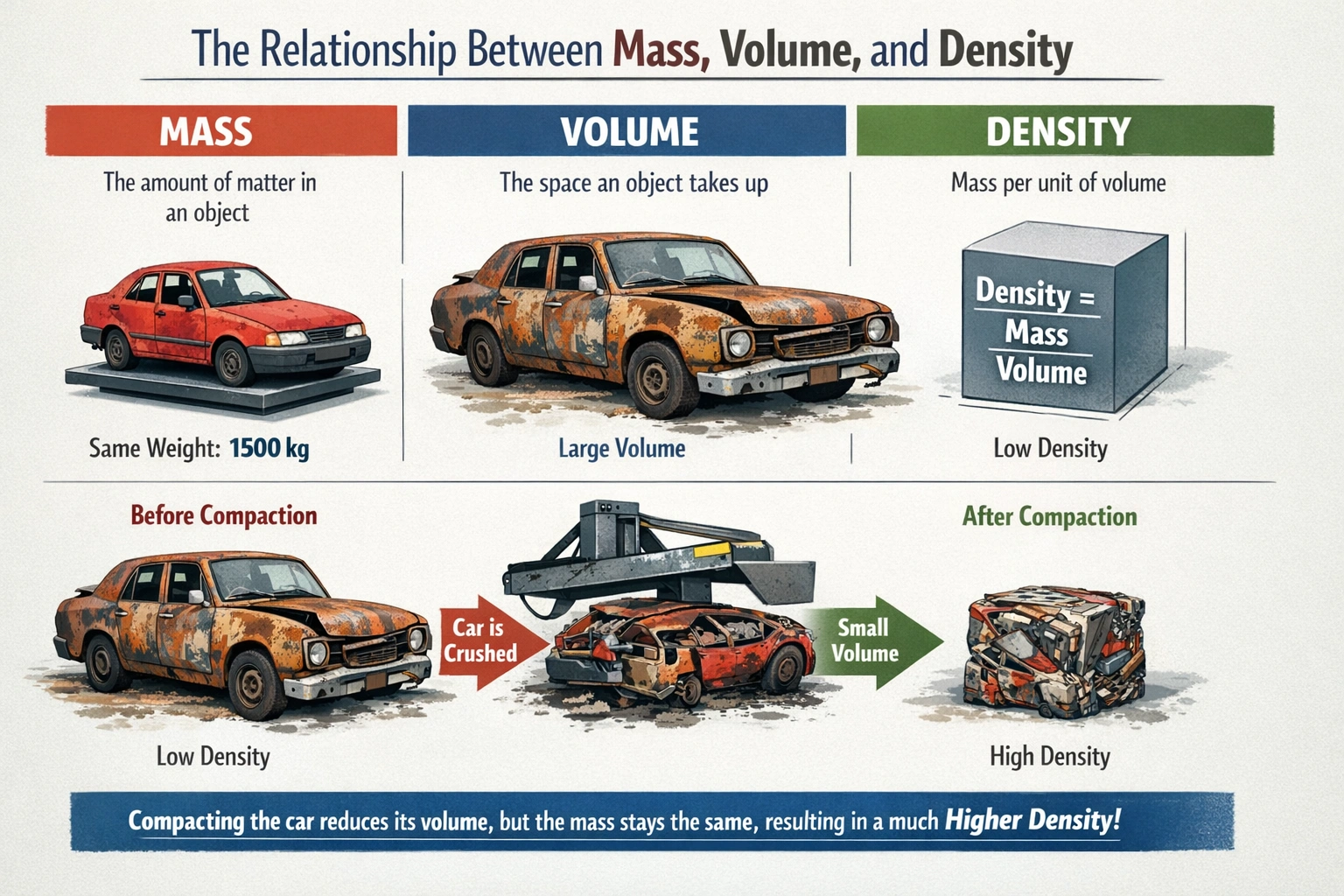
When a junked car is compacted, which statement is true?
-
A
Its mass increases.
-
B
Its mass decreases.
-
C
Its density increases.
-
D
Its density decreases.
When a junked car is compacted, its density increases.
The process reduces the car’s volume while preserving its mass, and since density is defined as mass per unit volume, the resulting material becomes more densely packed.
A) Its mass increases
Mass is conserved during physical deformation; no atoms are added during compaction. Therefore, the mass remains unchanged, and this statement contradicts the law of conservation of mass.
B) Its mass decreases
Similarly, mass cannot decrease without removal of material. Compaction only rearranges the existing metal structure, so the total mass stays constant.
C) Its density increases
This is correct. For example, if the original volume is halved, the density doubles. This increased density is why compacted cars are easier to transport and store, they occupy less space for the same mass.
D) Its density decreases
This would require the car to expand or lose mass, neither of which occurs. Compaction does the opposite: it compresses the material into a smaller volume, increasing density.
Conclusion
Density is inversely proportional to volume at constant mass, and compaction reduces volume. Thus, the correct answer is C) Its density increases

Topic Flashcards
Click to FlipA solid metal cube is heated until it melts into a liquid. Assuming no spills, what happens to its density and why?
Its density decreases. While its mass is conserved, heating causes the atoms/molecules to spread out, increasing the volume. Since density = mass/volume, the density decreases.
You hammer a piece of iron into a flat sheet. Has the iron's specific heat capacity changed? Explain.
No, it has not. Specific heat capacity is an intensive property that depends on the material itself, not on its shape or amount. Changing the form does not change this property.
When you crush an empty aluminum soda can, you are applying a force that changes its shape. In this process, is the number of aluminum atoms in the can conserved?
Yes, it is. Crushing is a physical change that rearranges the material but does not create or destroy atoms. The mass (and therefore the number of atoms) remains constant.
If you cut a block of clay in half, what happens to the density of one of the halves compared to the original block?
The density remains exactly the same. Both the mass and volume are halved, so the ratio (mass/volume = density) for the material is unchanged.
A sponge is fully soaked with water, making it very heavy. When you squeeze it tightly, water streams out. What happens to the density of the remaining wet sponge in your hand?
Its density decreases. By squeezing out water, you are removing mass. The sponge's physical volume also decreases, but the proportion of mass lost is greater than the reduction in its porous volume, leading to a lower overall density for the sponge material + remaining water.