Which of the following is supported by the cell theory?
-
A
Cells are alive and recognized as the building blocks for life.
-
B
Scientists can identify and differentiate cells by using a microscope.
-
C
Cells are produced from existing cells using meiosis instead of mitosis.
-
D
Living things are composed of a single cell that remains undifferentiated.
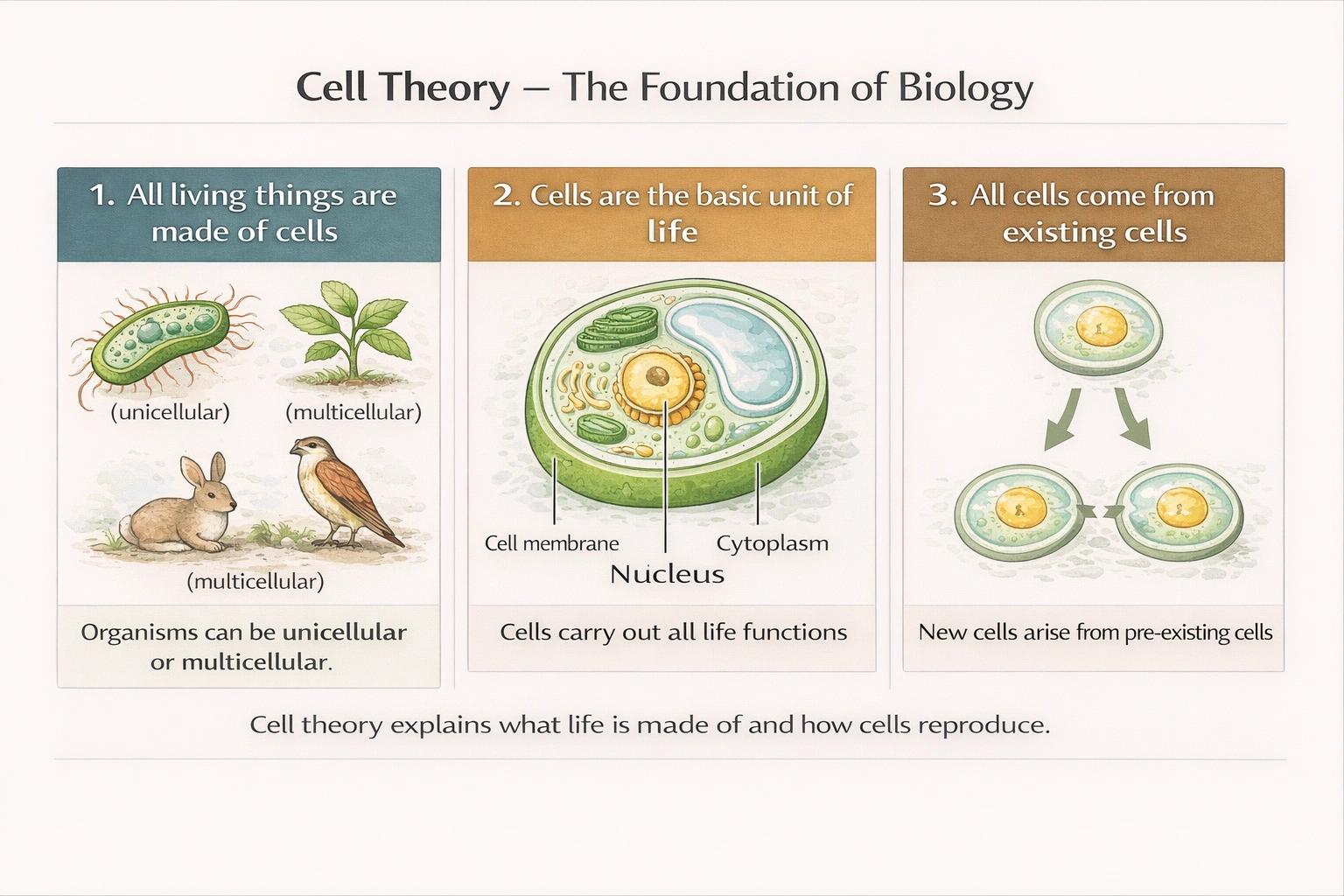
Cells are alive and recognized as the building blocks for life.
The modern Cell Theory is a unifying principle composed of three core tenets: all living organisms are composed of one or more cells; the cell is the basic structural and functional unit of life; and all cells arise from pre-existing cells. The statement that cells are alive and are the building blocks for life directly and accurately summarizes the first two tenets, establishing cells as the smallest living entities from which all larger life forms are constructed.
A) Cells are alive and recognized as the building blocks for life.
This captures the essence that cells are the fundamental living units from which all organisms are built. It aligns perfectly with the first two tenets of the Cell Theory.
B) Scientists can identify and differentiate cells by using a microscope.
The invention of the microscope was a historical prerequisite for the development of the Cell Theory, allowing cells to be observed. However, this statement describes a methodological tool and its application, not a postulate of the theory itself. The theory is about the nature of life, not the techniques used to study it.
C) Cells are produced from existing cells using meiosis instead of mitosis.
The third tenet states that all cells arise from pre-existing cells, but it does not specify the mechanism of division. Cells can divide via mitosis, meiosis, or binary fission. Adding the specification "using meiosis instead of mitosis" imposes an unwarranted limitation not present in the theory and is factually incorrect for many cell types (e.g., somatic cells divide by mitosis).
D) Living things are composed of a single cell that remains undifferentiated.
This statement contradicts the Cell Theory. The theory encompasses both unicellular and multicellular organisms. In multicellular organisms, cells become specialized for different functions through differentiation. The theory does not state that organisms are only single-celled, nor does it claim that cells are undifferentiated.
Conclusion:
The Cell Theory describes the fundamental relationship between cells and life. The use of microscopes is a tool, not a tenet. The theory does not specify a division mechanism and fully accommodates both differentiated cells in multicellular organisms and unicellular life. The statement that cells are the living building blocks of life is a direct reflection of the theory's core principles.
Topic Flashcards
Click to FlipWhat are the three core tenets of the modern Cell Theory?
1. All living things are composed of one or more cells. 2. The cell is the basic unit of structure and function in life. 3. All cells arise from pre-existing cells.
True or False: The Cell Theory helps explain that the function of an entire organism is the result of the activities and interactions of its cells.
True. This is a key implication of the theory, connecting cellular processes to the function of the whole organism.
Which scientist's observations of cork cells under a microscope provided early evidence that eventually contributed to the Cell Theory?
Robert Hooke. He coined the term "cell" in 1665, though he was observing non-living cell walls.
How does the third tenet of Cell Theory ("all cells from pre-existing cells") contradict the earlier idea of spontaneous generation?
Spontaneous generation proposed life could arise from non-living matter. The cell theory established that life only comes from existing life (cells).
Does the Cell Theory apply to bacteria and archaea as well as to plants and animals?
Yes. The theory applies to all life forms classified in the biological domains of Bacteria, Archaea, and Eukarya.