Why does photosynthesis need ATP?
-
A
Make membranes
-
B
Establish a gradient
-
C
Produce chloroplasts
-
D
Create sugar molecules
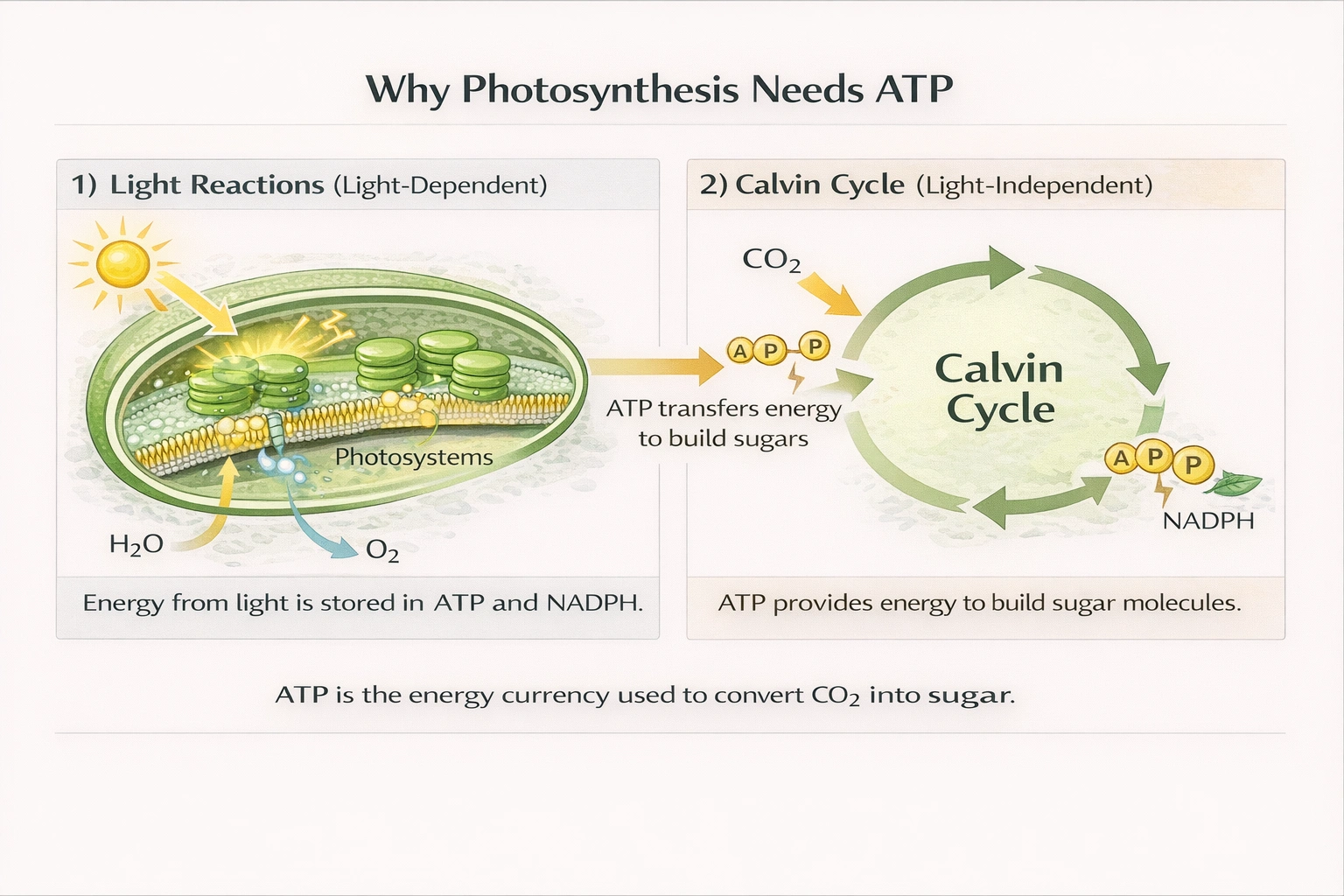
Photosynthesis requires ATP to provide the chemical energy necessary to drive the anabolic synthesis of sugar molecules from carbon dioxide during the light-independent Calvin cycle.
Photosynthesis occurs in two stages. The light-dependent reactions produce ATP and NADPH. These energy carriers are then used in the Calvin cycle (light-independent reactions) to fuel the reduction and rearrangement of carbon compounds, ultimately producing glyceraldehyde-3-phosphate (G3P), which is used to build glucose and other sugars.
A) Make membranes
The synthesis of cellular membranes is a general anabolic activity that requires ATP in any cell. While chloroplasts have internal membranes, the ATP generated during photosynthesis is not primarily allocated for building these membranes. Membrane biogenesis is a separate, ongoing process supported by the cell's overall ATP pool.
B) Establish a gradient
During the light-dependent reactions, light energy is used to pump protons into the thylakoid lumen, establishing a proton gradient. This gradient is not the reason photosynthesis needs ATP; rather, it is the means to produce ATP. The flow of protons back down their gradient through ATP synthase drives the phosphorylation of ADP to ATP (chemiosmosis). The gradient is a precursor to ATP synthesis, not a consumer of ATP.
C) Produce chloroplasts
Chloroplasts develop from proplastids. Their biogenesis involves importing proteins and synthesizing internal components, which requires cellular energy. However, this is not the immediate, defined role of ATP within the photosynthetic process. Photosynthesis occurs inside mature chloroplasts; ATP is a reactant in photosynthesis, not a tool for building the organelle itself.
D) Create sugar molecules
The Calvin cycle uses the ATP (and NADPH) produced in the light reactions to power the synthesis of carbohydrates. The cycle fixes CO₂ into an organic molecule and then uses energy from ATP to reduce that molecule and convert it into stable, energy-rich sugars. Without the chemical energy provided by ATP, these endergonic reduction and rearrangement steps could not proceed.
Conclusion:
ATP is a vital energy currency in photosynthesis. Its primary role is not to build membranes or organelles, nor is it used to establish the proton gradient; that process actually generates ATP. The fundamental need for ATP in photosynthesis is to supply the energy required to build sugar molecules from inorganic carbon dioxide, storing captured light energy in chemical bonds.
Topic Flashcards
Click to FlipIn which stage of photosynthesis is ATP primarily used as an energy source?
The light-independent reactions (Calvin cycle).
What is the primary anabolic product that the ATP from the light reactions helps to build?
Sugar molecules (e.g., glucose from G3P).
How is the proton gradient related to ATP in photosynthesis?
The energy stored in the proton gradient is used to make ATP via ATP synthase; the gradient does not consume ATP.
True or False: The ATP produced during photosynthesis is mainly used to construct new chloroplasts.
False. The ATP is used within the photosynthetic process (the Calvin cycle) itself. Organelle biogenesis is a separate cellular process.
What two energy carriers are produced by the light-dependent reactions for use in the Calvin cycle?
ATP and NADPH.