Extract:
Imagine that two parents both carry the recessive gene for cystic fibrosis. Any homozygous recessive offspring will manifest the disease.
What percentage of the offspring is predicted to be carriers but not manifest the disease?
-
A
0%
-
B
25%
-
C
50%
-
D
100%
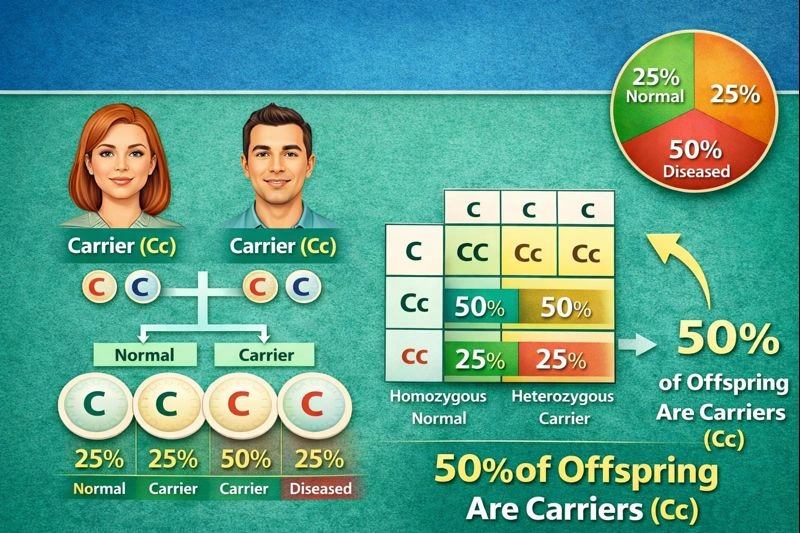
Fifty percent of the offspring will be carriers who do not manifest the disease.
When two heterozygous parents carry a recessive disease allele, classic Mendelian inheritance predicts a 1:2:1 genotypic ratio. This means some children will be unaffected non-carriers, some will be unaffected carriers, and some will express the disease.
A) 0%
A value of 0 percent would indicate that none of the offspring inherit the recessive allele.
However, when both parents are carriers (Cc), each parent contributes either a dominant (C) or recessive (c) allele. This guarantees that some children will inherit at least one recessive allele.
Therefore, it is genetically impossible for 0% of the offspring to be carriers in this scenario, making this option incorrect.
B) 25%
Twenty-five percent represents the proportion of offspring who inherit two recessive alleles (cc).
These individuals would manifest the disease because they lack a normal dominant allele. This group is affected, not merely carriers.
Since the question asks for carriers who do not show symptoms, this option is incorrect.
C) 50%
A Punnett square for Cc × Cc produces the following outcomes:
- 25% CC → unaffected, not carriers
- 50% Cc → unaffected carriers
- 25% cc → affected
Individuals with genotype Cc carry one copy of the disease allele but do not express the disorder because the dominant allele masks it.
Thus, half of all offspring are expected to be carriers without manifesting the disease, making this option correct.
D) 100%
One hundred percent would mean that every child inherits exactly one recessive allele.
This outcome would only occur if one parent were homozygous recessive (cc) and the other homozygous dominant (CC), not when both parents are heterozygous.
With two carrier parents, offspring can be CC, Cc, or cc, so 100% carriers is not possible.
This option is incorrect.
Conclusion:
When both parents are heterozygous carriers of a recessive disease, the expected distribution of offspring is:
- 25% unaffected non-carriers (CC)
- 50% unaffected carriers (Cc)
- 25% affected (cc)
Therefore, the percentage of offspring who are carriers but do not manifest the disease is 50%.

Topic Flashcards
Click to FlipIf both parents are carriers (heterozygous) for a recessive disorder like cystic fibrosis, what is their genotype?
Both parents have the genotype Cc (where 'C' is the dominant healthy allele and 'c' is the recessive disease allele).
What is the genotypic ratio expected from a cross between two heterozygous parents (Cc x Cc)?
1 CC : 2 Cc : 1 cc (25% homozygous dominant, 50% heterozygous, 25% homozygous recessive).
In a recessive disorder, what distinguishes a "carrier" from an "affected" individual?
A carrier has one recessive allele (Cc) and does not manifest the disease. An affected individual has two recessive alleles (cc) and manifests the disease.
What tool is used to predict the probability of offspring genotypes from parental crosses?
A Punnett square.
For a recessive disorder, can two unaffected parents have an affected child? Under what condition?
Yes, but only if both parents are carriers (heterozygous). The child would need to inherit the recessive allele from each parent (cc).