Why is yeast used to make bread rise?
-
A
It engages in photosynthesis, which produces oxygen gas.
-
B
Carbon dioxide forms while yeast carries out photosynthesis.
-
C
Yeast carries out fermentation, producing ethanol and carbon dioxide.
-
D
Yeast breathes in oxygen and produces carbon dioxide through aerobic respiration.
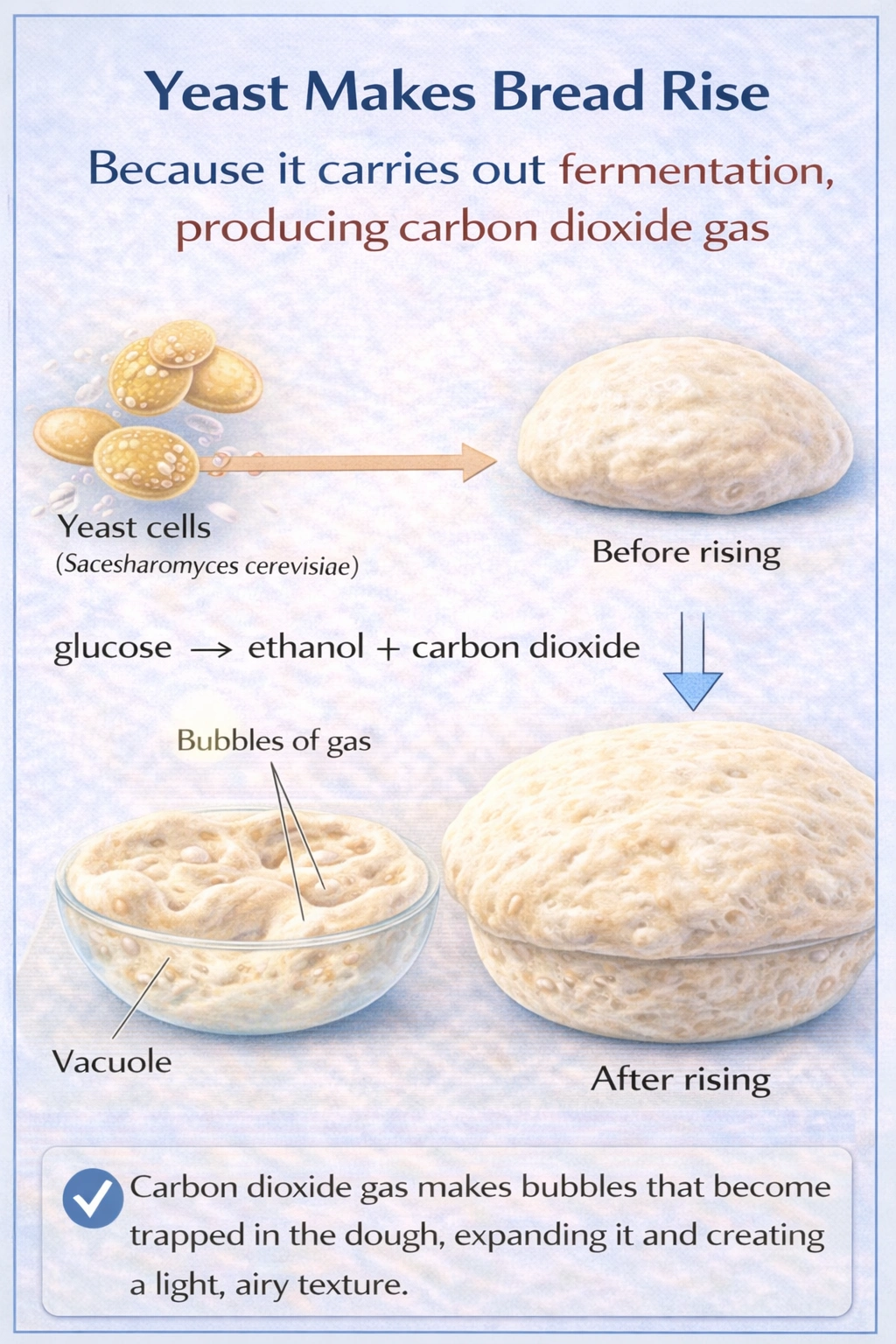
Yeast is used to make bread rise because it carries out fermentation, producing carbon dioxide gas that becomes trapped in the dough and causes it to expand.
During bread making, yeast metabolizes sugars in the dough under low-oxygen conditions. This biochemical process releases carbon dioxide, which forms bubbles inside the dough. These gas bubbles stretch the gluten network, increasing the dough’s volume and creating the soft, airy texture of bread.
A) It engages in photosynthesis, which produces oxygen gas
Yeast are fungi and are heterotrophic organisms, meaning they obtain energy from organic compounds rather than from sunlight.
They do not possess chlorophyll or chloroplasts and therefore cannot perform photosynthesis. Photosynthesis is a process limited to plants, algae, and some bacteria, where light energy is used to produce glucose and oxygen.
Because yeast cannot photosynthesize and does not produce oxygen in this way, this option is incorrect.
B) Carbon dioxide forms while yeast carries out photosynthesis
This option is incorrect for two reasons.
First, yeast does not perform photosynthesis at all. Second, photosynthesis consumes carbon dioxide rather than producing it. In photosynthesis, carbon dioxide is used to build glucose molecules.
Therefore, this statement is biologically inaccurate and cannot explain why bread rises.
C) Yeast carries out fermentation, producing ethanol and carbon dioxide
Yeast species such as Saccharomyces cerevisiae perform alcoholic fermentation when oxygen is limited.
In this process:
glucose → ethanol + carbon dioxide + energy (ATP)
The carbon dioxide gas released forms tiny bubbles that become trapped within the elastic gluten network of the dough. As these bubbles accumulate, the dough expands and rises. The ethanol produced largely evaporates during baking, leaving behind the porous structure that gives bread its light texture.
Because this process directly explains dough expansion, this option is correct.
D) Yeast breathes in oxygen and produces carbon dioxide through aerobic respiration
Yeast can carry out aerobic respiration when oxygen is available, producing carbon dioxide and water.
However, bread dough is dense and relatively low in oxygen. Under these conditions, yeast primarily switches to anaerobic fermentation rather than aerobic respiration. Fermentation is the dominant process responsible for the steady and abundant carbon dioxide production needed for effective leavening.
Therefore, while respiration can occur, it is not the main mechanism used in bread rising, making this option incorrect.
Conclusion:
Yeast makes bread rise by fermenting sugars in the dough and releasing carbon dioxide gas. This gas inflates the dough by forming bubbles that are trapped in the gluten structure, producing a soft and airy loaf after baking.
Photosynthesis does not occur in yeast, and aerobic respiration is not the primary process in dough. The defining mechanism is alcoholic fermentation.
Therefore, the correct answer is that yeast carries out fermentation, producing ethanol and carbon dioxide.
Topic Flashcards
Click to FlipWhat metabolic process do yeast cells primarily use to make bread dough rise?
Alcoholic fermentation (anaerobic respiration).
What are the two main products of yeast fermentation in bread making?
Carbon dioxide (CO₂) gas and ethanol.
Why is the carbon dioxide produced by yeast crucial for bread?
The CO₂ forms bubbles that get trapped in the gluten network, causing the dough to expand and become airy.
Can yeast perform photosynthesis? Why or why not?
No. Yeast are fungi, lack chlorophyll and chloroplasts, and are heterotrophs that consume organic compounds for energy.
Does bread dough provide a high-oxygen environment that favors aerobic respiration in yeast?
No. The dense dough creates low-oxygen conditions, favoring anaerobic fermentation over aerobic respiration for leavening.