Which organelles work together to ensure plant cells have enough energy to use?
-
A
Ribosome and nucleus
-
B
Chloroplast and mitochondria
-
C
Cell membrane and cytoplasm
-
D
Golgi apparatus and endoplasmic reticulum
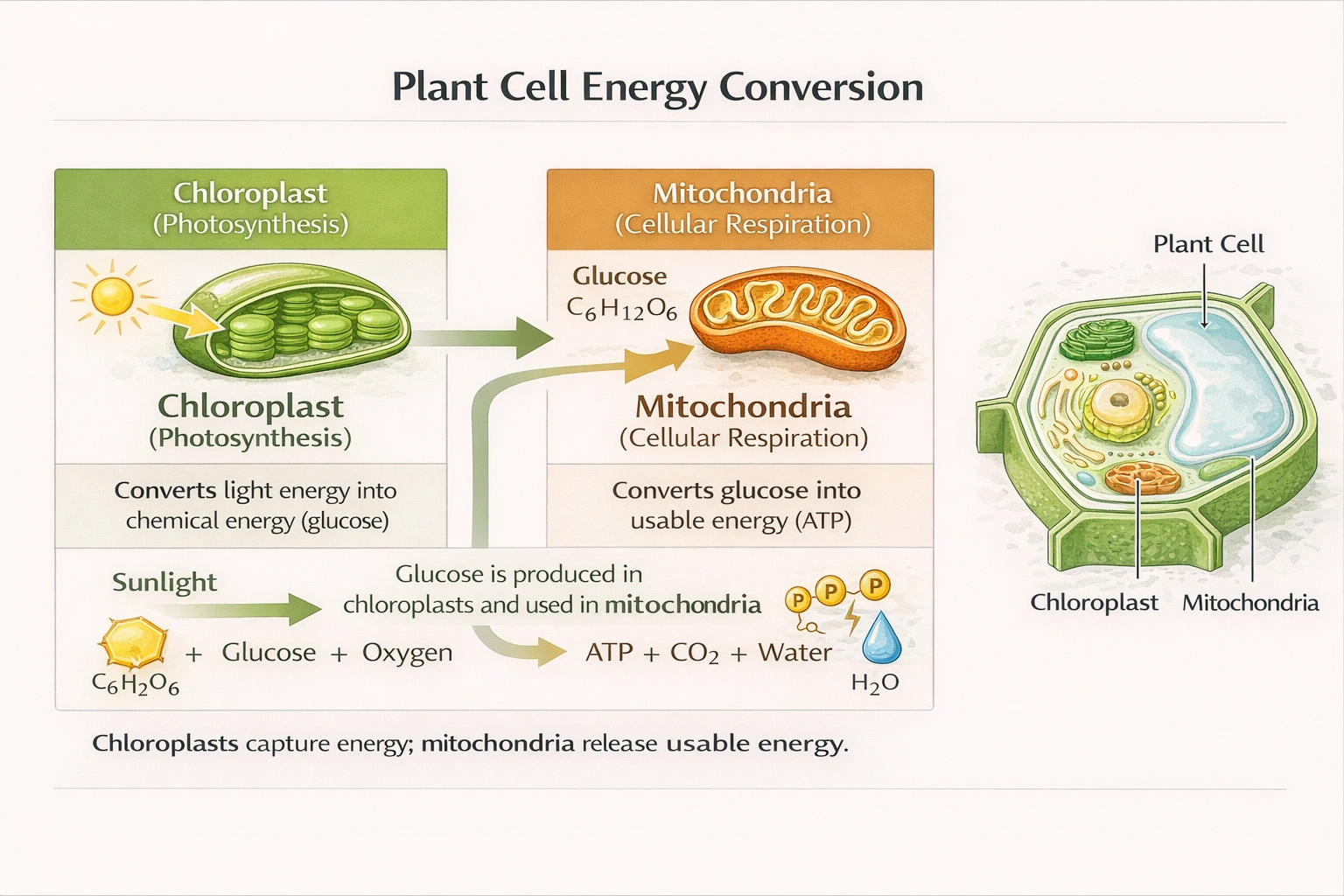
Chloroplasts and mitochondria work in a complementary cycle to capture, store, and convert energy into a readily usable form for plant cells.
Chloroplasts are the sites of photosynthesis, capturing light energy and storing it in the chemical bonds of glucose and other carbohydrates. Mitochondria are the sites of cellular respiration, breaking down these carbohydrates through glycolysis, the Krebs cycle, and oxidative phosphorylation to release the stored energy and produce the cell's universal energy currency, ATP.
A) Ribosome and nucleus
The nucleus contains genetic material and controls gene expression. Ribosomes, assembled in the nucleolus, synthesize proteins by translating mRNA. This partnership is fundamental for producing the enzymes and structural proteins required for all cellular activities, including metabolism. However, they are not directly involved in the primary conversion of energy from sunlight to ATP; they are the information and manufacturing system.
B) Chloroplast and mitochondria
Chloroplasts act as the cell's solar panels and sugar factories, producing energy-rich organic molecules. Mitochondria act as power plants, converting the chemical energy stored in those molecules into ATP. This partnership ensures a continuous supply of usable energy, driving virtually every energy-requiring process in the cell.
C) Cell membrane and cytoplasm
The cell membrane regulates transport and maintains homeostasis. The cytoplasm is the aqueous medium where glycolysis and many metabolic reactions occur. While both are essential for creating a stable internal environment and housing metabolic pathways, they are not specialized organelles dedicated to the major energy transduction processes of photosynthesis and aerobic respiration.
D) Golgi apparatus and endoplasmic reticulum
The endoplasmic reticulum is involved in synthesizing proteins and lipids. The Golgi apparatus modifies, sorts, and packages these products for secretion or delivery. This endomembrane system is crucial for cellular logistics—building and distributing cellular components. Its functions are biosynthetic and secretory, not directly related to the core conversion of light energy to chemical energy in ATP.
Conclusion:
Meeting a cell's energy demands requires specialized organelles for energy capture and conversion. The nucleus and ribosomes govern protein synthesis, the cell membrane and cytoplasm provide the general environment, and the Golgi and ER manage biosynthesis and transport. Only the chloroplast and mitochondria form a direct, integrated partnership dedicated to the transformation of light energy into the chemical energy of ATP that powers cellular work.
Topic Flashcards
Click to FlipWhat two organelles are responsible for converting light energy into the ATP that powers a plant cell's activities?
Chloroplasts (convert light to chemical energy in sugars) and mitochondria (convert sugar energy to ATP).
Which organelle produces the sugars that the other organelle breaks down to make ATP?
Chloroplasts produce sugars via photosynthesis. Mitochondria break down those sugars via cellular respiration to produce ATP.
True or False: Mitochondria are unnecessary in plant cells because chloroplasts produce all the energy the cell needs.
False. Chloroplasts make energy-rich sugars, but mitochondria are needed to convert that stored energy into the usable ATP format required for most cellular work.
What are the primary energy-transforming processes that occur inside the chloroplast and the mitochondrion?
Photosynthesis (in chloroplasts) and Cellular Respiration (in mitochondria).
Why is the partnership between chloroplasts and mitochondria described as a cycle?
Chloroplasts use CO₂ and water to make sugars and release O₂. Mitochondria use those sugars and O₂ to make ATP, releasing CO₂ and water back, which can be reused by the chloroplasts.