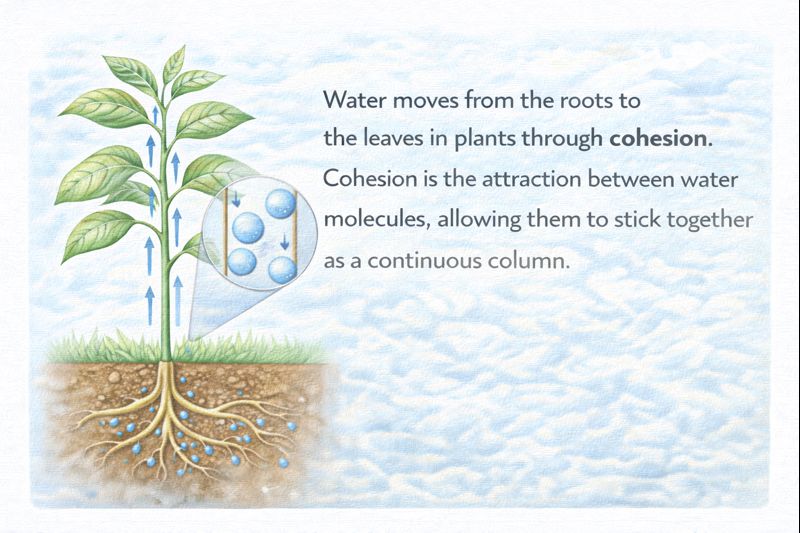
Which property of water enables it to move from the roots to the leaves of a plant?
-
A
Heat capacity
-
B
Conductivity
-
C
Solution
-
D
Cohesion
The cohesive property of water is primarily responsible for its ability to move from roots to leaves in tall plants.
The movement of water and dissolved minerals upward through the xylem vessels of a plant is explained by the cohesion-tension theory. Cohesion refers to the attraction between water molecules due to hydrogen bonding. This attraction allows water to form a continuous column within the narrow xylem tubes. As water evaporates from the leaves through stomata (transpiration), it creates a negative pressure or tension. This tension pulls the cohesive water column upward from the roots, much like sucking on a straw. Adhesion, the attraction between water molecules and the walls of the xylem vessels, also helps support the column against gravity. The combined forces of cohesion and adhesion, driven by transpiration, enable water transport to great heights.
A) Heat capacity
Water's high specific heat capacity allows it to absorb and release large amounts of heat with minimal temperature change. This property is crucial for temperature regulation in organisms and ecosystems, but it does not directly contribute to the upward movement of water in plants.
B) Conductivity
Conductivity generally refers to the ability to conduct heat or electricity. Water is a good conductor of heat and, when ions are dissolved, electricity. However, this property is not the mechanism for bulk water flow in xylem. The xylem conducts water via mass flow, not via thermal or electrical conduction.
C) Solution
Water's excellence as a solvent creates the xylem sap, a solution of minerals and ions. This property is important for nutrient transport, but the physical movement of the solution itself is driven by the cohesion-tension mechanism, not simply its solubility.
D) Cohesion
Cohesion is the key property that allows water to be pulled up as a continuous column under tension. Without the strong hydrogen bonds between water molecules, the column would break under the stress of evaporation and gravity, and water transport would be limited to very short distances.
Conclusion
While water's solvent properties and heat capacity are vital for life, the specific challenge of lifting water against gravity in tall plants is solved by its cohesive nature. Cohesion, coupled with adhesion and the driving force of transpiration, forms the basis of the cohesion-tension theory, which explains the ascent of sap.
Topic Flashcards
Click to FlipTrue or False: The upward pull on the water column in a plant is created by the active pumping of water by root cells.
False. The pull is primarily passive, created by the evaporation of water from leaves (transpiration). Root pressure can contribute minimally.
What property of water, caused by hydrogen bonding, allows it to form a continuous column inside the narrow tubes of a plant's xylem?
Cohesion. This mutual attraction between water molecules enables them to be pulled upward as a unit.
What is the name of the theory that explains how water moves from roots to leaves, relying on water's cohesive properties?
The Cohesion-Tension Theory. Transpiration creates tension (pull), and cohesion transmits that pull down the water column.
What role does adhesion play in helping water move upward in a plant?
Adhesion is the attraction of water molecules to the xylem wall. It helps hold the water column in place and prevents it from breaking under tension.
Besides cohesion, what is the essential process in the leaves that provides the energy to pull water upward?
Transpiration. The evaporation of water from leaf surfaces creates the negative pressure (tension) that pulls the cohesive water column.