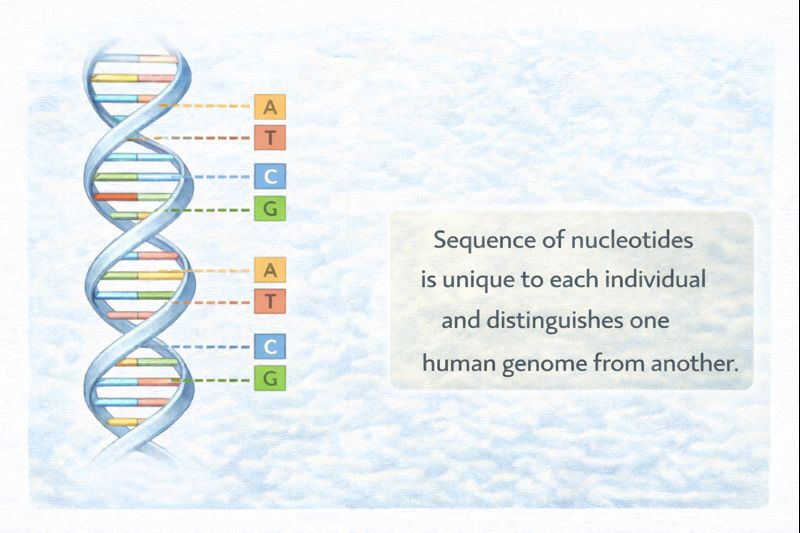
Which specific genetic characteristic is unique to an individual human being?
-
A
Number of chromosomes
-
B
Shape of DNA
-
C
Sequence of nucleotides
-
D
Size of base pairs
The sequence of nucleotides in an individual's DNA is the genetic characteristic that is unique to that person.
DNA carries genetic information in the linear sequence of its four nucleotide bases: adenine (A), thymine (T), cytosine (C), and guanine (G). While all humans share over 99.9% of their DNA sequence, the small fraction that differs, about 0.1%, contains variations that make each person's genome unique (except for identical twins). These variations include single nucleotide polymorphisms (SNPs), insertions, deletions, and variations in repetitive sequences. This unique nucleotide sequence forms the basis of DNA fingerprinting used in forensics and paternity testing. The other options describe universal features of DNA that are shared by all humans or all life.
A) Number of chromosomes
With very rare exceptions due to chromosomal disorders (e.g., Down syndrome with 47 chromosomes), every human has the same number of chromosomes: 46, or 23 pairs. The diploid chromosome number is a species-wide characteristic, not an individual one.
B) Shape of DNA
The double-helix structure of DNA, described by Watson and Crick, is universal. The helical structure, with its sugar-phosphate backbones and inwardly facing bases, is consistent in all human cells and across virtually all organisms. It is not unique to individuals.
C) Sequence of nucleotides
The precise order of A, T, C, and G bases along the DNA strands constitutes the genetic code. The combination of sequences inherited from both parents creates a unique genetic identity for each individual. It is this specific sequence that determines all inherited traits and distinguishes one person from another at the molecular level.
D) Size of base pairs
The physical dimensions of a DNA base pair are constant. An A-T base pair and a G-C base pair have specific and consistent sizes (approximately 0.34 nm per base pair along the helix axis). This is a property of molecular geometry and chemistry, not a variable genetic characteristic.
Conclusion
Genetic uniqueness arises from differences in the informational content of DNA, not its universal structural properties. The number of chromosomes, the double-helix shape, and the size of base pairs are shared by all members of the species. It is the exact sequence of nucleotides, the order of the genetic "letters", that varies between individuals and provides a unique genetic signature.
Topic Flashcards
Click to FlipWhat is the specific term for the variations in a single DNA nucleotide (e.g., an A instead of a G) that contribute to genetic uniqueness?
Single Nucleotide Polymorphisms (SNPs). These are the most common type of genetic variation between people.
True or False: The double-helix structure of DNA is a unique genetic characteristic that differs from person to person.
False. The double-helix is a universal structural feature shared by all humans and most life forms.
Which genetic feature do forensic scientists analyze to create a DNA profile that can uniquely identify an individual?
The sequence of nucleotides in non-coding, highly variable regions (like short tandem repeats, STRs). The pattern of these sequences is unique.
Why is the number of chromosomes NOT a unique identifier for an individual human?
The vast majority of humans have exactly 46 chromosomes. It is a species-wide trait, not an individual one (barring rare genetic disorders).
What is the name for the complete set of genetic instructions in an organism, which contains its unique nucleotide sequence?
The genome. An individual's genome is their unique genetic blueprint.