Who discovered the special theory of relativity?
-
A
Alfred Nobel
-
B
Max Plank
-
C
James Chadwick
-
D
Albert Einstein
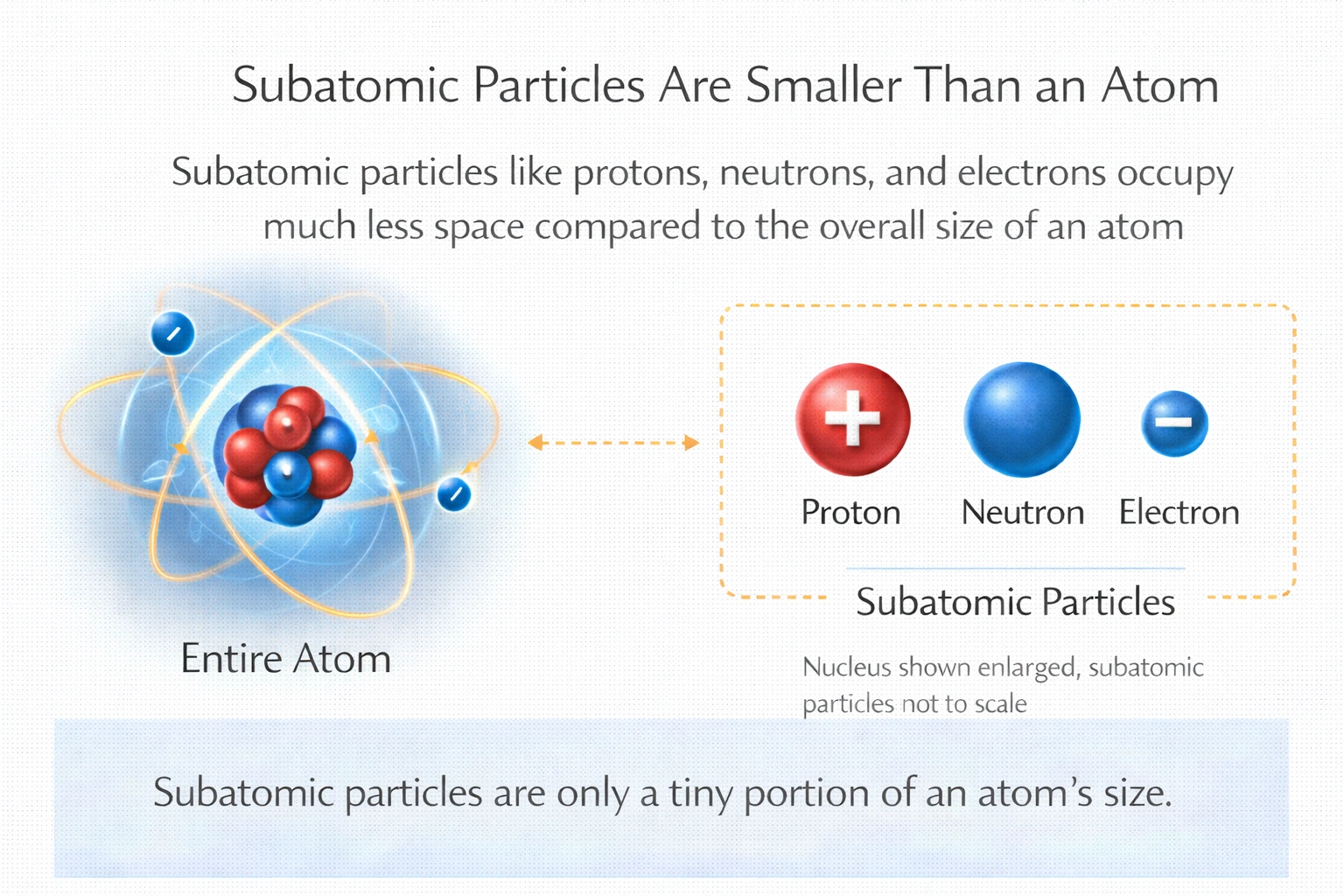
Subatomic particles are smaller than an atom.
They occupy much less space compared to the overall size of the atom, with protons, neutrons, and electrons being key components.
- A) Alfred Nobel:
- Alfred Nobel was a Swedish inventor and the founder of the Nobel Prizes. While he made significant contributions to chemistry and engineering, he is not associated with the discovery of the special theory of relativity. This theory was developed by Albert Einstein, not Alfred Nobel. Therefore, this option is incorrect.
- B) Max Planck:
- Max Planck was a German physicist who is often regarded as the father of quantum theory. His work laid the foundation for quantum mechanics, but he did not develop the special theory of relativity. That was Einstein's work. Planck’s contributions are important in the realm of quantum mechanics, not relativity. Therefore, this option is not correct.
- C) James Chadwick:
- James Chadwick was the physicist who discovered the neutron in 1932. While he made important contributions to atomic theory, he is not credited with the development of the special theory of relativity. That accomplishment belongs to Albert Einstein.
- D) Albert Einstein:
- Albert Einstein is the physicist who developed the special theory of relativity in 1905. This theory revolutionized our understanding of space, time, and energy. It introduced the famous equation E = mc², which shows the equivalence of mass and energy. Einstein’s contributions to physics, particularly through the theory of relativity, are some of the most profound in modern science.
Conclusion: The scientist who discovered the special theory of relativity is Albert Einstein, making D) Albert Einstein the correct answer.

Topic Flashcards
Click to FlipWhat is the famous equation derived from the special theory of relativity that relates energy and mass?
E=mc 2 .
In what year did Albert Einstein publish his paper on the special theory of relativity?
1905
Which fundamental postulate of special relativity states that the laws of physics are the same in all inertial frames of reference?
The principle of relativity.
What is the other fundamental postulate of special relativity, which states that the speed of light in a vacuum is constant for all observers?
The constancy of the speed of light.
What revolutionary concept in special relativity describes how time passes at different rates for observers in relative motion?
Time dilation.