Why does oxygen diffuse out of lungs into the bloodstream?
-
A
The oxygen is repulsed by the blood.
-
B
The oxygen is being pulled into the blood.
-
C
The oxygen is polar, and the blood has the opposite charge.
-
D
The oxygen is going from a higher area of concentration to a lower one.
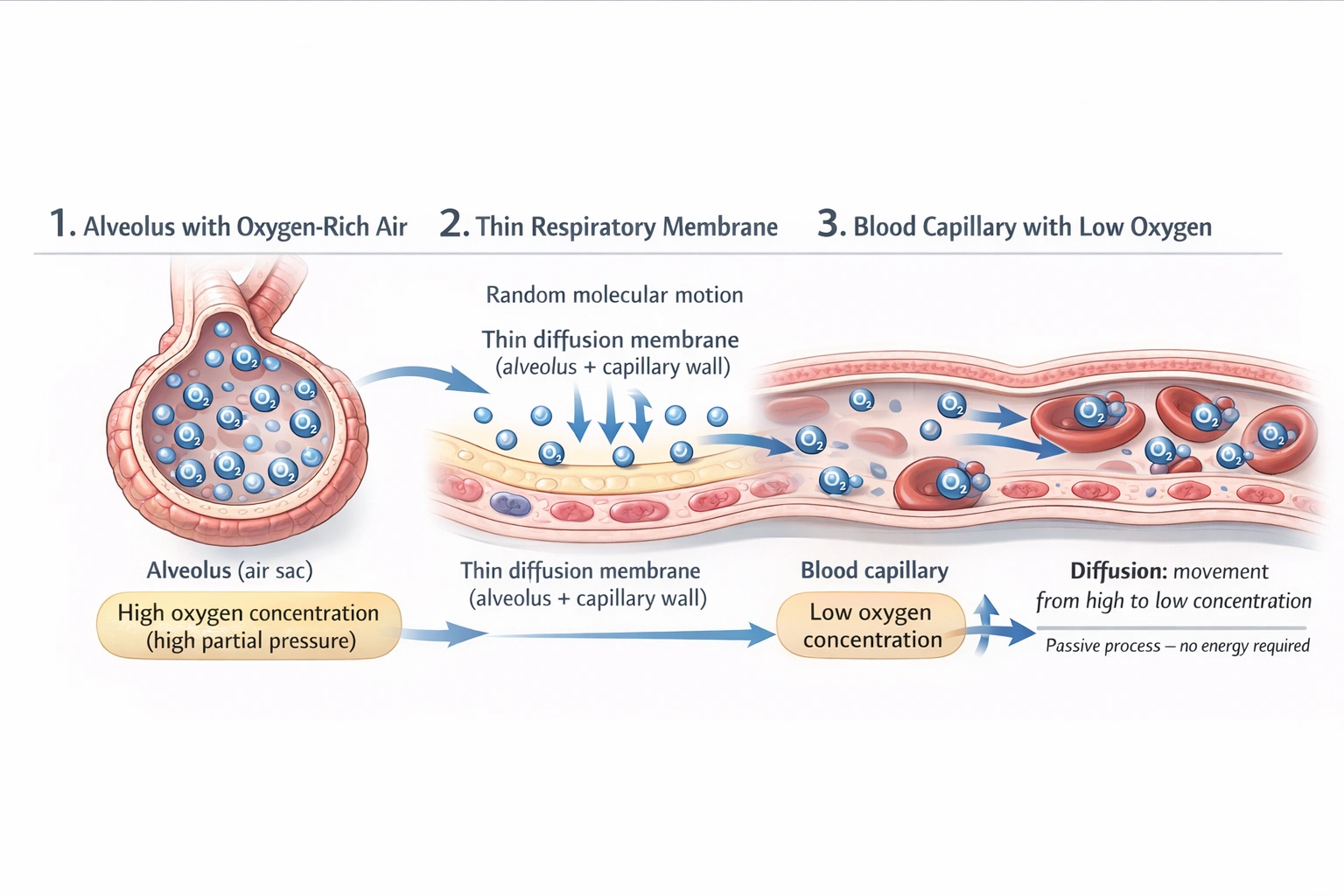
Oxygen diffuses out of the lungs into the bloodstream because it is going from a higher area of concentration to a lower one.
This process is a fundamental example of passive diffusion, the net movement of particles from a region of higher concentration to a region of lower concentration. This movement is driven by the random kinetic motion of particles and will continue until equilibrium is reached or the gradient is maintained.
A) The oxygen is repulsed by the blood.
There is no repulsive force between oxygen molecules and blood components that drives diffusion. In fact, once oxygen enters the blood, it forms a reversible chemical bond with hemoglobin in red blood cells, which is an attractive interaction. Repulsion is not a factor in this physiological process.
B) The oxygen is being pulled into the blood.
This language suggests an active, directed force. While hemoglobin's affinity for oxygen maintains a low concentration of free oxygen in the blood plasma (thus sustaining the concentration gradient), the actual movement of individual oxygen molecules across the alveolar-capillary membrane is passive. It is the random motion of oxygen molecules down their concentration gradient, not an active "pulling" by the blood. The binding occurs after diffusion brings oxygen into contact with hemoglobin.
C) The oxygen is polar, and the blood has the opposite charge.
This is incorrect on two counts. First, the oxygen molecule (O₂) is nonpolar because the two identical oxygen atoms share electrons equally, resulting in no permanent dipole. Second, the driving force for gas exchange is a difference in partial pressure (which relates to concentration), not an electrical charge difference. Blood is not uniformly charged in a way that would attract nonpolar oxygen molecules.
D) The oxygen is going from a higher area of concentration to a lower one.
This is the correct explanation. During inhalation, the alveoli (tiny air sacs in the lungs) are filled with air containing a high concentration (high partial pressure) of oxygen. The deoxygenated blood arriving in the pulmonary capillaries has a very low concentration of free oxygen. This establishes a steep concentration gradient across the thin, gas-permeable membranes separating the alveoli and the capillaries. Oxygen molecules, due to their constant random motion, move from the area where they are more concentrated (alveolar air) to the area where they are less concentrated (capillary blood). This continues until the oxygen partial pressures nearly equalize.
Conclusion:
The transport of respiratory gases like oxygen and carbon dioxide across the alveolar membrane occurs via simple diffusion, a passive process governed solely by concentration (or partial pressure) gradients. The direction of net movement is always from higher concentration to lower concentration.
Topic Flashcards
Click to FlipWhat is the name of the passive process that moves oxygen from the lungs into the bloodstream?
Diffusion.
During gas exchange in the lungs, oxygen moves from an area of ______ concentration in the alveoli to an area of ______ concentration in the blood.
Higher concentration; lower concentration.
What molecule in red blood cells binds to oxygen after it diffuses into the blood, helping to maintain the concentration gradient?
Hemoglobin.
In the context of lung physiology, what is the term for the measure of oxygen concentration that drives diffusion?
Partial pressure.
True or False: Oxygen gas (O₂) is a polar molecule that is electrically attracted to components in the blood.
False. Oxygen (O₂) is a nonpolar molecule, and its movement is driven by concentration differences, not charge.