A 1.0-kg block on a table is given a push so that it slides along the table. If the block is accelerated at 6 m/s2, what was the force applied to the block?
-
A
0 N
-
B
3 N
-
C
6 N
-
D
The answer cannot be determined from the information given.
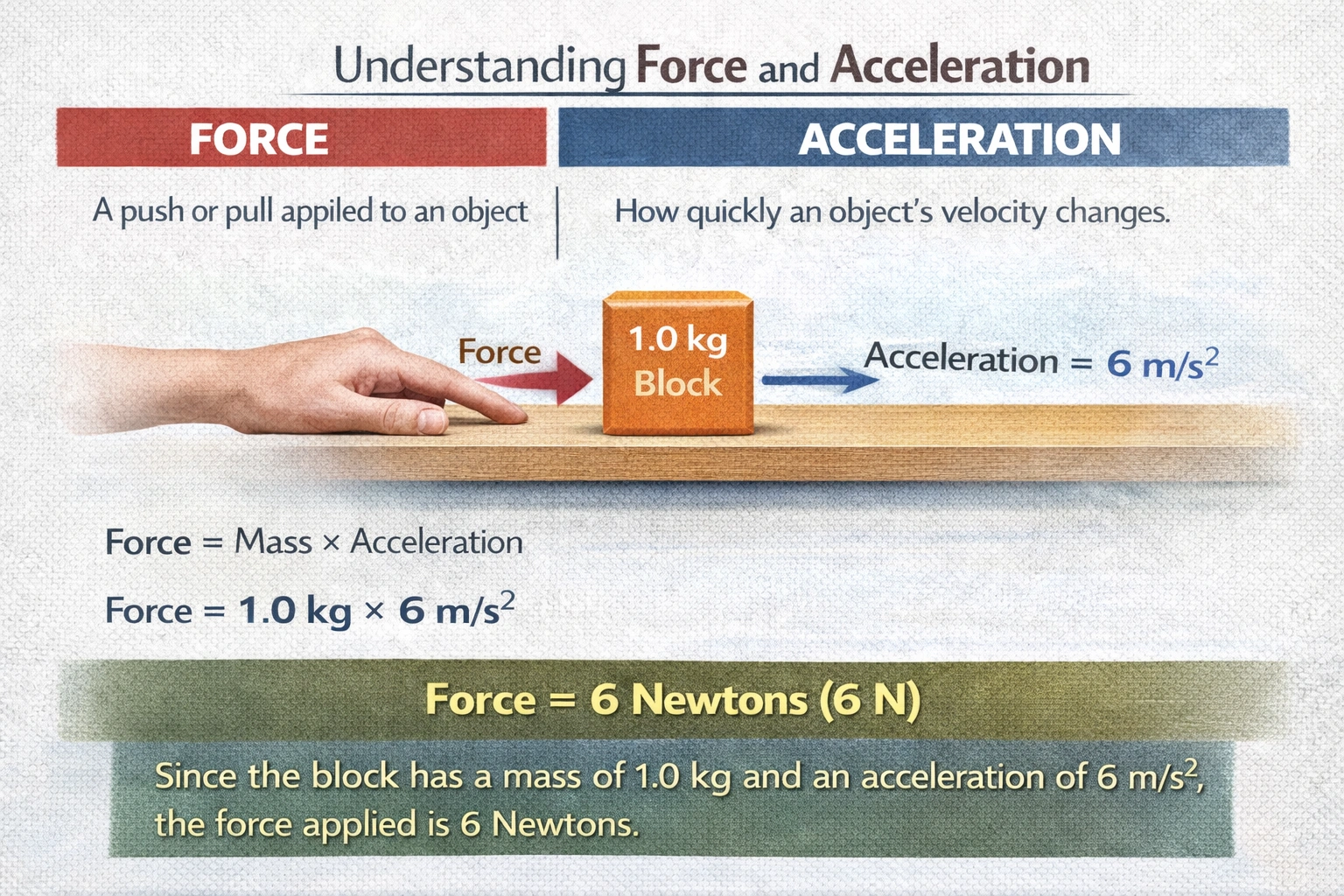
The force applied to the block is 6 N.
According to Newton’s second law, force equals mass times acceleration, and with a mass of 1.0 kg and an acceleration of 6 m/s², the net force must be exactly 6 newtons.
A) 0 N
Zero force would produce no acceleration, contradicting the given motion. This violates Newton’s second law and is physically impossible in this scenario.
B) 3 N
This would yield only 3 m/s² of acceleration for a 1.0-kg mass, half the stated value. It does not satisfy the condition of 6 m/s² acceleration.
C) 6 N
This is correct. The problem states the block accelerates at 6 m/s², so the net force is F=ma=1.0 kg×6 m/s2=6 NF=ma=1.0 kg×6 m/s2=6 N. Friction is either absent or already accounted for in the net acceleration.
D) The answer cannot be determined from the information given
The acceleration is explicitly provided, and mass is given, so force is directly calculable. No additional information is needed.
Conclusion
Newton’s second law allows direct computation of force from mass and acceleration. The correct answer is C) 6 N.

Topic Flashcards
Click to FlipUsing Newton's second law, calculate the net force required to accelerate a 2.5-kg object at 4 m/s².
F_net = m * a = (2.5 kg) * (4 m/s²) = 10 N.
In the original problem (1-kg block, 6 m/s² acceleration), if a kinetic friction force of 2 N opposed the motion, what was the magnitude of the initial push force?
The net force was 6 N (F_net = m*a). Net force = Push - Friction. Therefore, Push = F_net + Friction = 6 N + 2 N = 8 N.
If the 1.0-kg block from the problem was on a frictionless surface and accelerated at 6 m/s², what can you conclude about the applied force?
On a frictionless surface, the applied force is the net force. Therefore, the applied force would be exactly 6 N.
What would the acceleration of the 1.0-kg block be if the applied force from the push was 9 N, but a friction force of 3 N acted against it?
F_net = Applied Force - Friction = 9 N - 3 N = 6 N. Acceleration a = F_net / m = 6 N / 1 kg = 6 m/s².
How much force is needed to give a 6.0 kg block the same acceleration (6 m/s²) as the 1.0 kg block in the original problem?
m * a = (6.0 kg) * (6 m/s²) = 36 N