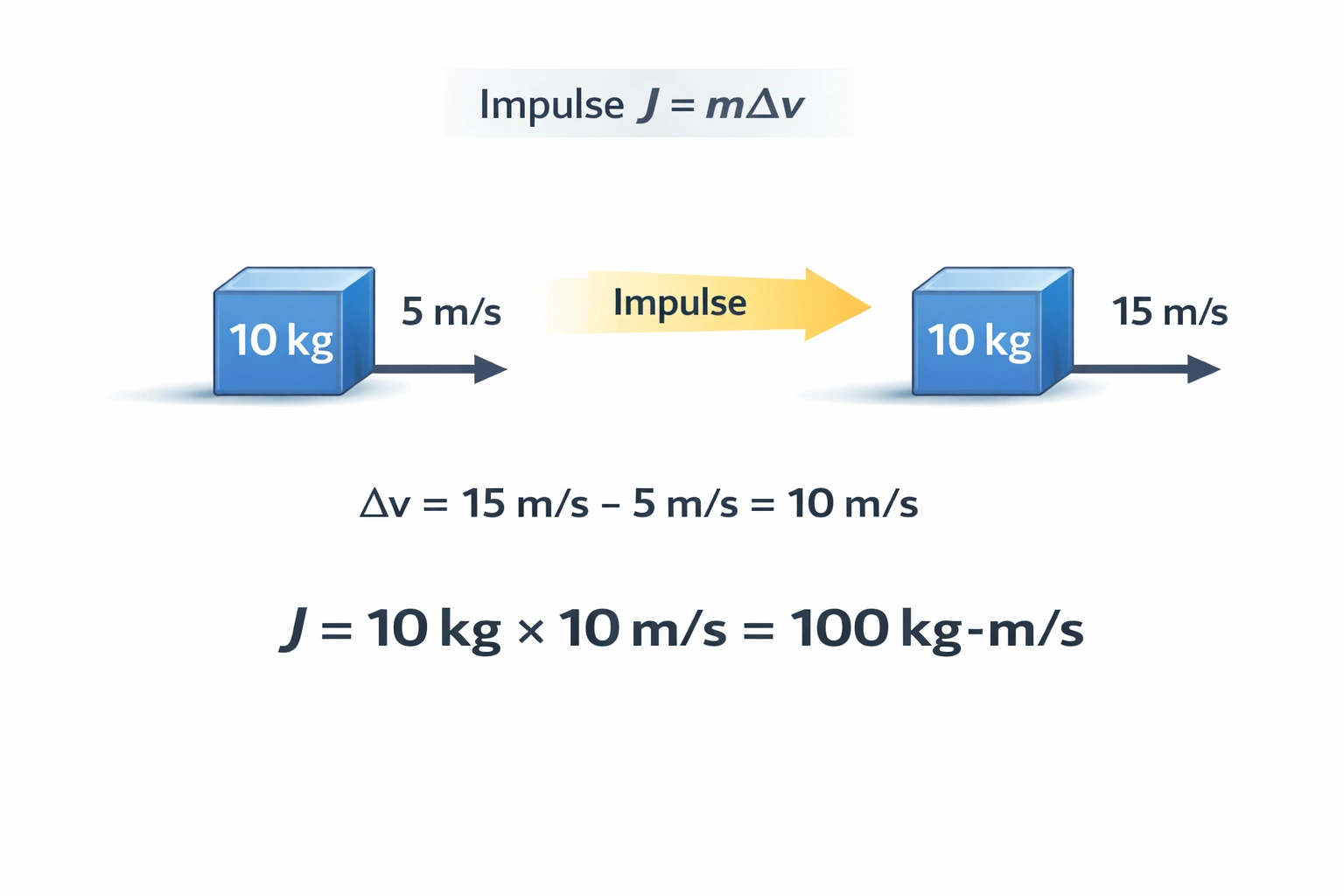
A 10-kg object moving at 5 m/s has an impulse acted on it causing the velocity to change to 15 m/s. What was the impulse that was applied to the object?
-
A
10 kg·m/s
-
B
15 kg·m/s
-
C
20 kg·m/s
-
D
100 kg·m/s
The impulse applied to the 10-kg object equals 100 kg·m/s, calculated as the product of mass and velocity change (J = mΔv = 10 kg × 10 m/s). This impulse-momentum relationship quantifies the net effect of force acting over time to alter the object's motion from 5 m/s to 15 m/s.
A) 10 kg·m/s
This equals the mass alone (10 kg) or the initial velocity alone (10 m/s difference misapplied). Correct impulse requires multiplying mass by velocity change: 10 kg × 10 m/s = 100 kg·m/s. This option underestimates impulse by omitting the essential multiplication step between mass and Δv.
B) 15 kg·m/s
This matches the final velocity value but ignores both initial velocity and mass multiplication. Impulse depends on velocity change (15 − 5 = 10 m/s), not final velocity alone. Using final velocity without accounting for initial conditions and mass yields an incorrect result.
C) 20 kg·m/s
This might result from adding initial and final velocities (5 + 15 = 20) then neglecting mass multiplication, or doubling the velocity change without proper scaling. Correct calculation requires mass times velocity difference: 10 kg × 10 m/s = 100 kg·m/s. This option misapplies arithmetic operations to the given values.
D) 100 kg·m/s
Velocity change Δv = 15 m/s − 5 m/s = 10 m/s. Impulse J = mΔv = 10 kg × 10 m/s = 100 kg·m/s. This calculation correctly implements the impulse-momentum theorem, recognizing that impulse equals the change in momentum when mass remains constant during the interaction.
Conclusion
Impulse quantifies momentum change through the product of mass and velocity difference. For a 10-kg object accelerating from 5 to 15 m/s, the 10 m/s velocity increase multiplied by mass yields 100 kg·m/s impulse, a value representing the net effect of whatever force acted over time to produce this motion change.

Topic Flashcards
Click to FlipWhat is the Impulse-Momentum Theorem? State the formula.
The Impulse-Momentum Theorem states that the impulse on an object equals its change in momentum. Formula: J = Δp = mΔv, where J is impulse, Δp is change in momentum, m is mass, and Δv is change in velocity.
How do you calculate the change in velocity (Δv) for an object?
Δv = final velocity (v_f) - initial velocity (v_i). It is a vector quantity, but for straight-line motion, it's the difference between the final and initial speeds, considering direction.
An object has a mass of 5 kg. Its velocity changes from 2 m/s to 8 m/s. What impulse was applied?
Δv = 8 - 2 = 6 m/s. Impulse J = mΔv = (5 kg)(6 m/s) = 30 kg·m/s.
An object has a mass of 5 kg. Its velocity changes from 2 m/s to 8 m/s. What impulse was applied?
Δv = 8 - 2 = 6 m/s. Impulse J = mΔv = (5 kg)(6 m/s) = 30 kg·m/s.
What are the units of impulse? How are they equivalent to the units of momentum?
The units of impulse are newton-seconds (N·s) or kilogram-meters per second (kg·m/s). They are identical to the units of momentum (p = mv), which is kg·m/s. This equivalence comes from Newton's Second Law (F=ma) and its relation to impulse (J=FΔt).
Can impulse be negative? What would a negative impulse indicate?
Yes, impulse can be negative. Since impulse equals change in momentum (mΔv), a negative impulse means the object's momentum has decreased. This typically occurs when a force is applied opposite to the direction of motion, causing the object to slow down.