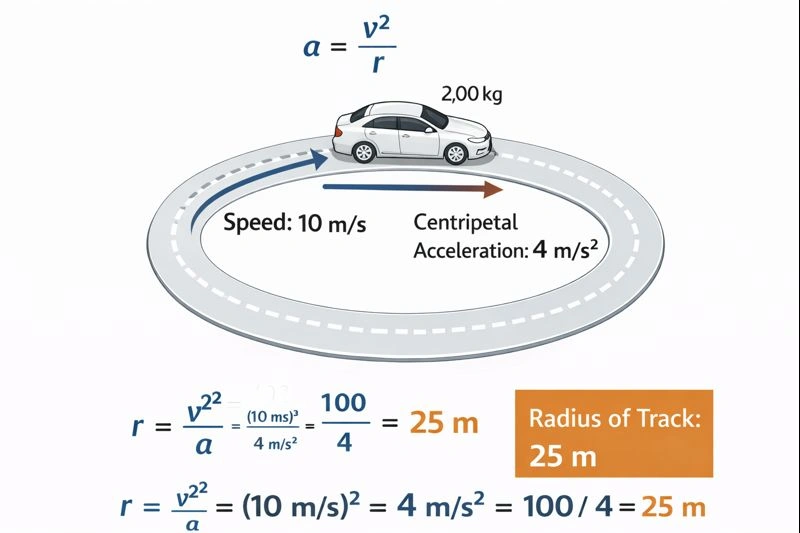
A 2,000 kg car runs around a track at 10 m/s with a centripetal acceleration of 4 m/s². What is the radius of the track?
-
A
1,000 m
-
B
400 m
-
C
25 m
-
D
12 m
The radius of the track is 25 m.
In uniform circular motion, centripetal acceleration depends on the speed of the object and the radius of the circular path. The relationship is given by:
centripetal acceleration = speed squared ÷ radius
where a is the centripetal acceleration, v is the speed, and r is the radius. Rearranging this equation allows the radius to be calculated directly from the given speed and acceleration. The mass of the car does not affect the radius in this kinematic relationship.
A) 1,000 m
This value might result from incorrectly including the mass of the car in the calculation. In centripetal motion, mass cancels out when determining radius from speed and acceleration, so using mass here leads to an exaggerated and incorrect value.
B) 400 m
This option reflects an incorrect manipulation of the formula, such as inverting the relationship to radius = acceleration ÷ speed squared, or mishandling units. Applying the correct formula does not produce this result.
C) 25 m
Using the centripetal acceleration formula:
radius = speed squared ÷ centripetal acceleration
radius = (10 m per second) squared ÷ 4 m per second squared
radius = 100 ÷ 4
radius = 25 m
This calculation correctly applies the physics of circular motion and shows that the radius depends only on speed and centripetal acceleration.
D) 12 m
This value appears to be an arbitrary reduction of the correct radius without any basis in the formula for centripetal acceleration. It does not follow from the given data.
Conclusion
Centripetal acceleration is related to speed and radius by centripetal acceleration = speed squared ÷ radius. Substituting the given values yields a radius of 25 m, demonstrating that the mass of the car is irrelevant in this calculation.
Topic Flashcards
Click to FlipWhat is the formula that relates centripetal acceleration (a_c), speed (v), and radius (r) for an object in uniform circular motion?
a_c = v² / r.
Rearrange the centripetal acceleration formula to solve for the radius (r).
r = v² / a_c.
A car moves in a circle with a constant speed of 10 m/s and a centripetal acceleration of 4 m/s². Calculate the radius of its path.
r = (10 m/s)² / (4 m/s²) = 100 / 4 = 25 m.
If the speed of the car is doubled to 20 m/s but the centripetal acceleration remains 4 m/s², what would the new radius of the track need to be?
r = (20 m/s)² / (4 m/s²) = 400 / 4 = 100 m.
In circular motion, does the mass of the object affect the relationship between centripetal acceleration, speed, and radius? Why or why not?
No. The formula a_c = v² / r is purely kinematic and independent of mass. Mass would only be relevant for calculating the centripetal force (F_c = m × a_c).