Which of the following describes a vector quantity?
-
A
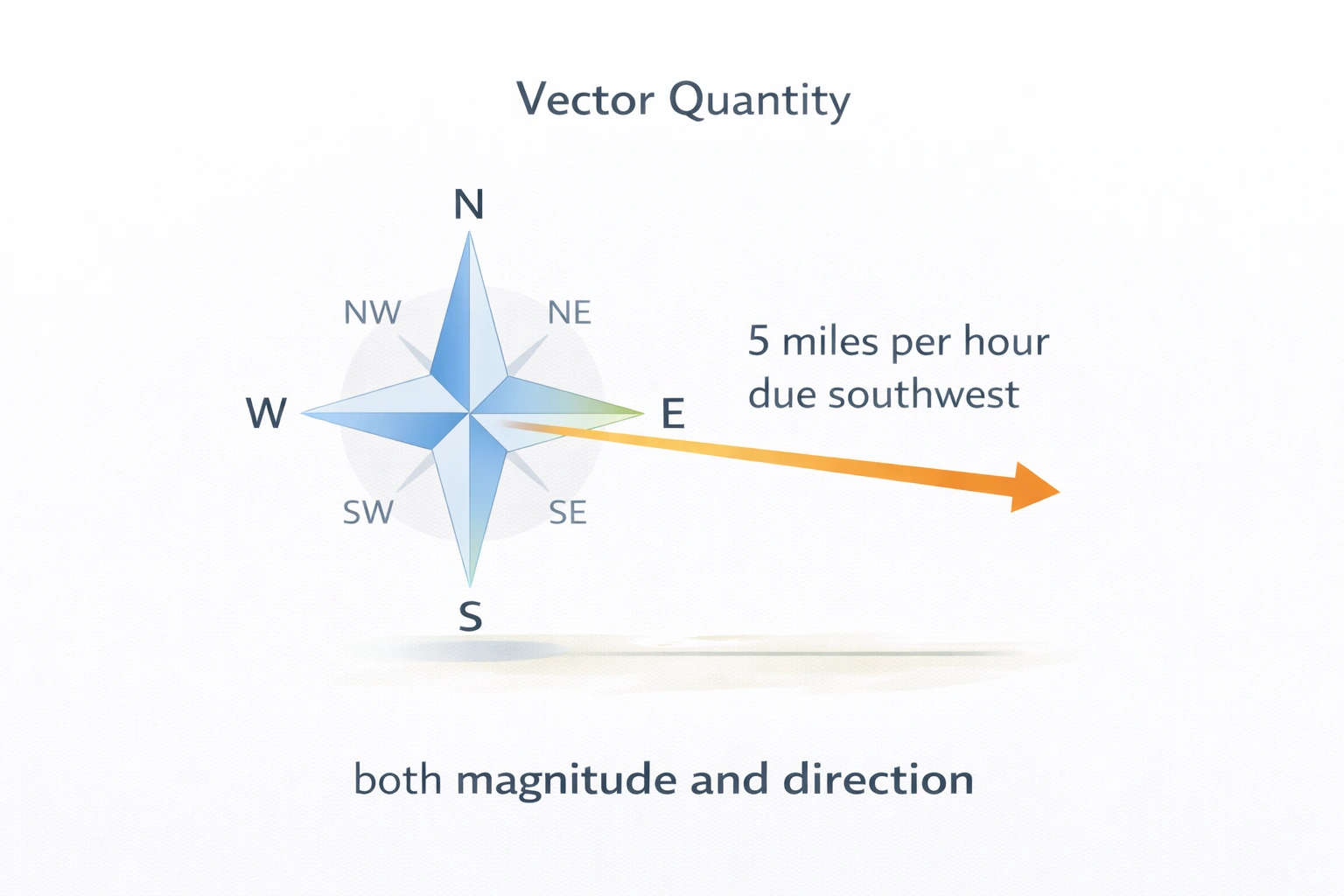
5 miles per hour due southwest
-
B
5 miles per hour
-
C
5 miles
-
D
None of the above
The quantity "5 miles per hour due southwest" describes a vector because it specifies both magnitude (5 mph) and explicit direction (southwest), satisfying the dual requirements for vector quantities. Velocity, speed with directional specification, qualifies as vectorial unlike scalar speed lacking directional information.
A) 5 miles per hour due southwest
This specifies both magnitude (5 mph) and precise direction (southwest), satisfying vector requirements. Velocity, speed with direction, qualifies as a vector quantity. The explicit directional qualifier "due southwest" completes the vector description, distinguishing it from scalar speed.
B) 5 miles per hour
This represents speed alone, a scalar quantity lacking directional information. Without compass bearing, angle, or directional qualifier, this measurement describes only magnitude. Five miles per hour could occur in any direction, making it insufficient for vector specification.
C) 5 miles
Distance represents a scalar quantity measuring path length without directional component. Displacement (5 miles northeast) would be vectorial, but distance alone lacks direction. Five miles of travel could follow any route geometry, preventing unique vector representation.
D) None of the above
Option A correctly describes a vector quantity (velocity with direction), making this choice incorrect. At least one option satisfies vector requirements, disproving the "none" assertion.
Conclusion
Vectors require both magnitude and direction for complete specification. "5 miles per hour due southwest" qualifies as a vector (velocity) because it combines speed magnitude with explicit directional information, whereas options lacking directional qualifiers represent scalars, demonstrating the essential distinction between vector and scalar physical quantities.
Topic Flashcards
Click to FlipWhat two pieces of information are required to fully define a vector quantity?
A vector quantity requires both a magnitude (a numerical value with units) and a direction.
Which of the following is a vector quantity: Distance, Displacement, Speed, or Velocity?
Displacement and Velocity are vector quantities. Distance and Speed are scalar quantities.
From the options, why is "5 miles per hour" not a vector, but "5 miles per hour due southwest" is?
"5 miles per hour" is just speed (scalar). Adding the direction "due southwest" makes it a velocity, which is a vector.
What is the key difference between the distance you travel and your displacement?
Distance is the total length of the path traveled (scalar). Displacement is the straight-line change in position from start to finish, including direction (vector).
Give an example of a vector quantity other than velocity.
Examples include: Force, Acceleration, Momentum, Impulse, Displacement, and Weight. (Any answer that includes magnitude and direction is correct, e.g., "20 Newtons downward").