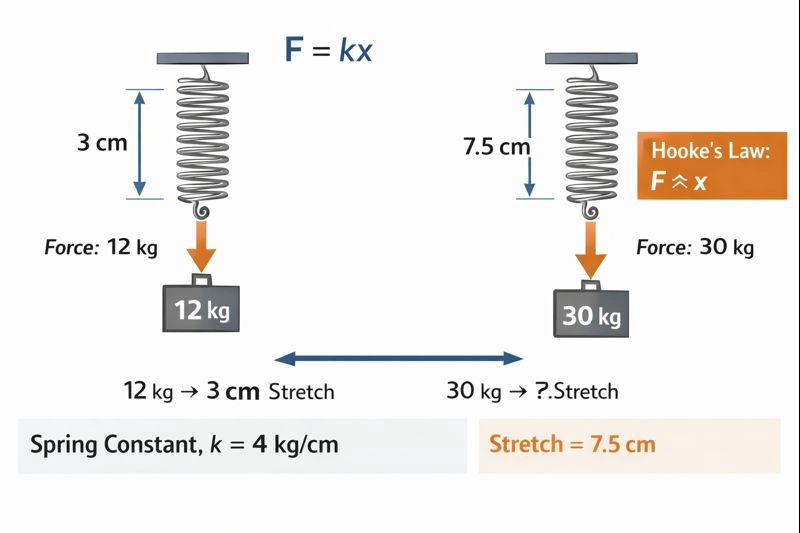
A force of 12 kg stretches a spring 3 cm. How far will the spring stretch given a force of 30 kg?
-
A
6 cm
-
B
7.5 cm
-
C
9 cm
-
D
10.5 cm
The spring will stretch 7.5 cm when a force of 30 kg is applied.
The stretching of a spring under an applied force follows Hooke’s law, which states that the extension of a spring is directly proportional to the applied force, provided the elastic limit is not exceeded. This relationship is expressed as:
Force = spring constant × extension
where F is the force, x is the extension, and k is the spring constant.
From the given information, a force of 12 kg produces an extension of 3 cm. This allows the spring constant to be determined and then used to calculate the new extension under a larger force.
A) 6 cm
This value would correspond to doubling the original extension from 3 cm to 6 cm. However, doubling the extension would require doubling the force from 12 kg to 24 kg. Since the applied force is 30 kg, not 24 kg, this option underestimates the stretch.
B) 7.5 cm
Using Hooke’s law, the spring constant is calculated as:
spring constant = force ÷ extension
spring constant = 12 kg ÷ 3 cm
spring constant = 4 kg per cm
Applying a force of 30 kg gives:
extension = force ÷ spring constant
extension = 30 kg ÷ 4 kg per cm
extension = 7.5 cm
This result follows the correct proportional relationship between force and extension.
C) 9 cm
An extension of 9 cm would represent three times the original stretch of 3 cm. That amount of stretching would require a force of 36 kg, not 30 kg. This option overestimates the extension.
D) 10.5 cm
This value appears to result from adding the original 3 cm extension to 7.5 cm, rather than calculating the total extension directly from the applied force. Hooke’s law requires proportional scaling, not additive reasoning, making this approach incorrect.
Conclusion
Because extension is directly proportional to force under Hooke’s law, calculating the spring constant from the initial data and applying it to the new force shows that the spring stretches 7.5 cm.
Topic Flashcards
Click to FlipWhat physical law describes the relationship between the force applied to a spring and its resulting stretch?
Hooke's Law (The extension is directly proportional to the applied force, within the elastic limit).
Using the initial condition (12 kg force → 3 cm stretch), calculate the spring constant (k) for this spring.
k = Force / Extension = 12 kg / 3 cm = 4 kg/cm.
A spring stretches 3 cm under a 12 kg force. Under an 18 kg force, what would the stretch be?
Since extension is proportional to force, 18 kg is 1.5 times 12 kg, so the stretch is 1.5 × 3 cm = 4.5 cm.
Write the formula for Hooke's Law that relates Force (F), spring constant (k), and extension (x).
F = k × x
If the same spring from the problem stretches 10 cm, what force must be applied?
Using F = k × x and k = 4 kg/cm: Force = 4 kg/cm × 10 cm = 40 kg.