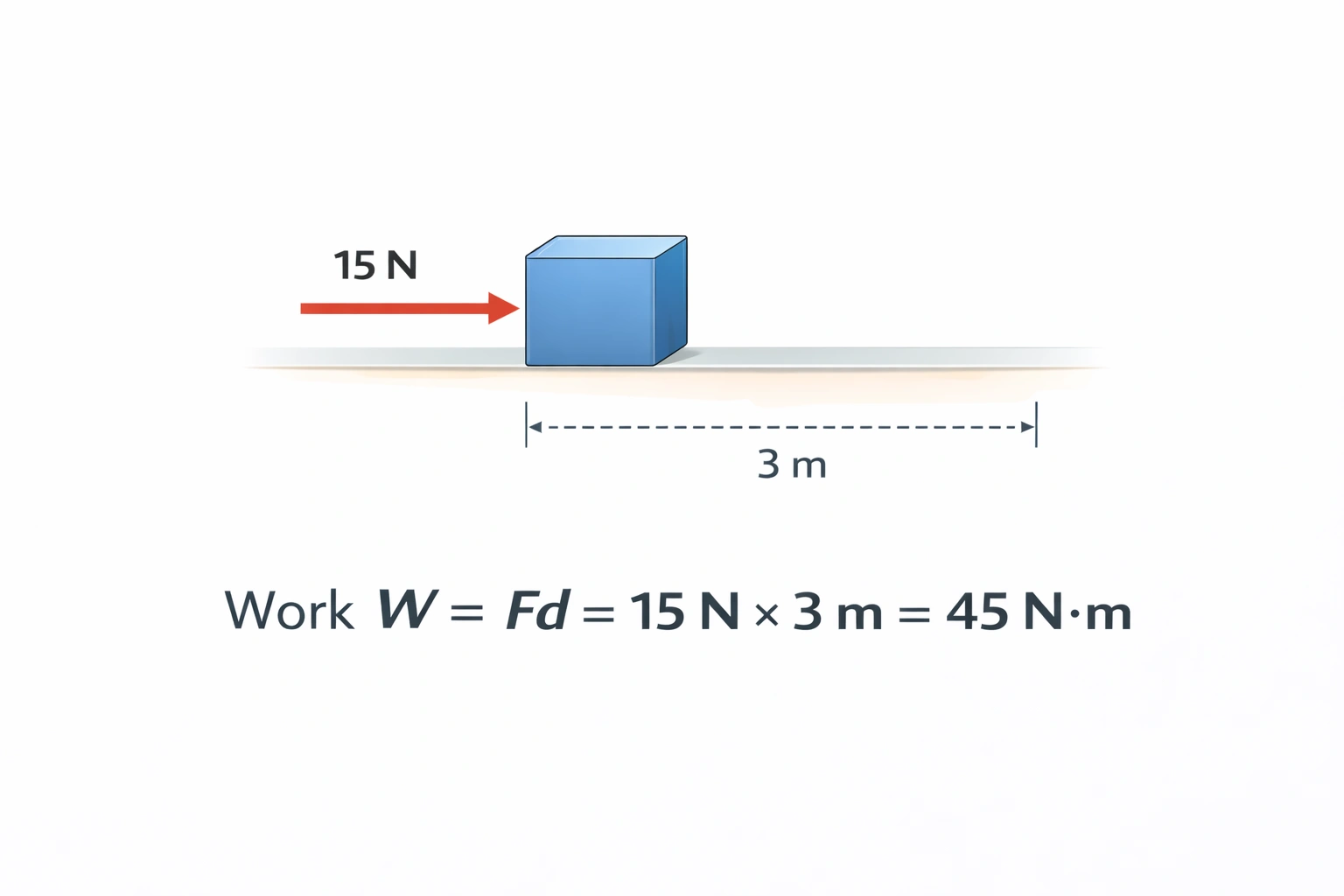
A box is moved by a 15 N force over a distance of 3 m. What is the amount of work that has been done?
-
A
5 W
-
B
5 N·m
-
C
45 W
-
D
45 N·m
The work done equals 45 N·m, calculated by multiplying the 15 N force by the 3 m displacement distance (W = Fd). This energy transfer occurs because force and motion align directionally, producing newton-meters, equivalent to joules, as the appropriate unit for work rather than watts, which measure power.
A) 5 W
Watts measure power (energy per time), not work. Additionally, 5 results from dividing force by distance (15 N / 3 m) rather than multiplying them. Work requires force-distance multiplication, not division, and must be expressed in energy units (joules or N·m), not power units.
B) 5 N·m
This value results from incorrect division (15 N / 3 m = 5) rather than required multiplication. Work equals force times distance when aligned, not force divided by distance. The unit (N·m) is appropriate for work, but the magnitude is mathematically incorrect for the given values.
C) 45 W
While 45 correctly calculates 15 N × 3 m, watts remain inappropriate units for work. Watts measure power, the rate of energy transfer over time, which requires a time component absent from this problem. Work represents total energy transferred, properly measured in joules or newton-meters.
D) 45 N·m
Work W = Fd = 15 N × 3 m = 45 N·m (equivalent to 45 joules). The newton-meter correctly represents work's energy unit when force and displacement align directionally. This calculation properly implements the fundamental work-energy relationship without introducing extraneous time components required for power calculations.
Conclusion
Work equals force multiplied by displacement distance when force and motion align, producing energy measured in newton-meters or joules. The 15-newton force acting through 3 meters transfers 45 N·m of energy, distinct from power (watts), which would require knowing how quickly this work occurred. This distinction between energy transfer and energy transfer rate proves essential in mechanical analysis.
Topic Flashcards
Click to FlipA 20 N force is applied to push a crate across a floor. If the crate moves 2 meters in the direction of the force, how much work is done on the crate?
40 Joules (or 40 N·m). (Work = Force × Distance = 20 N × 2 m = 40 J).
What is the standard SI unit of work, and what is an equivalent unit expressed in terms of force and distance?
The SI unit is the Joule (J). An equivalent unit is the Newton-meter (N·m), where 1 J = 1 N·m.
Under what condition is the work done by a force on an object equal to zero, even if a force is applied and the object moves?
When the direction of the force is perpendicular to the direction of the object's displacement. (Example: carrying a box horizontally; the upward force does no work on the box).
How is the concept of power fundamentally different from work? Provide the key variable that distinguishes them.
Power is the rate at which work is done. The key distinguishing variable is time. Work measures total energy transferred (Joules), while Power measures how fast that energy is transferred (Joules/second or Watts).
If the net work done on an object is positive, what is happening to the object's kinetic energy?
The object's kinetic energy is increasing. This is a consequence of the Work-Energy Theorem (Net Work = Change in Kinetic Energy).