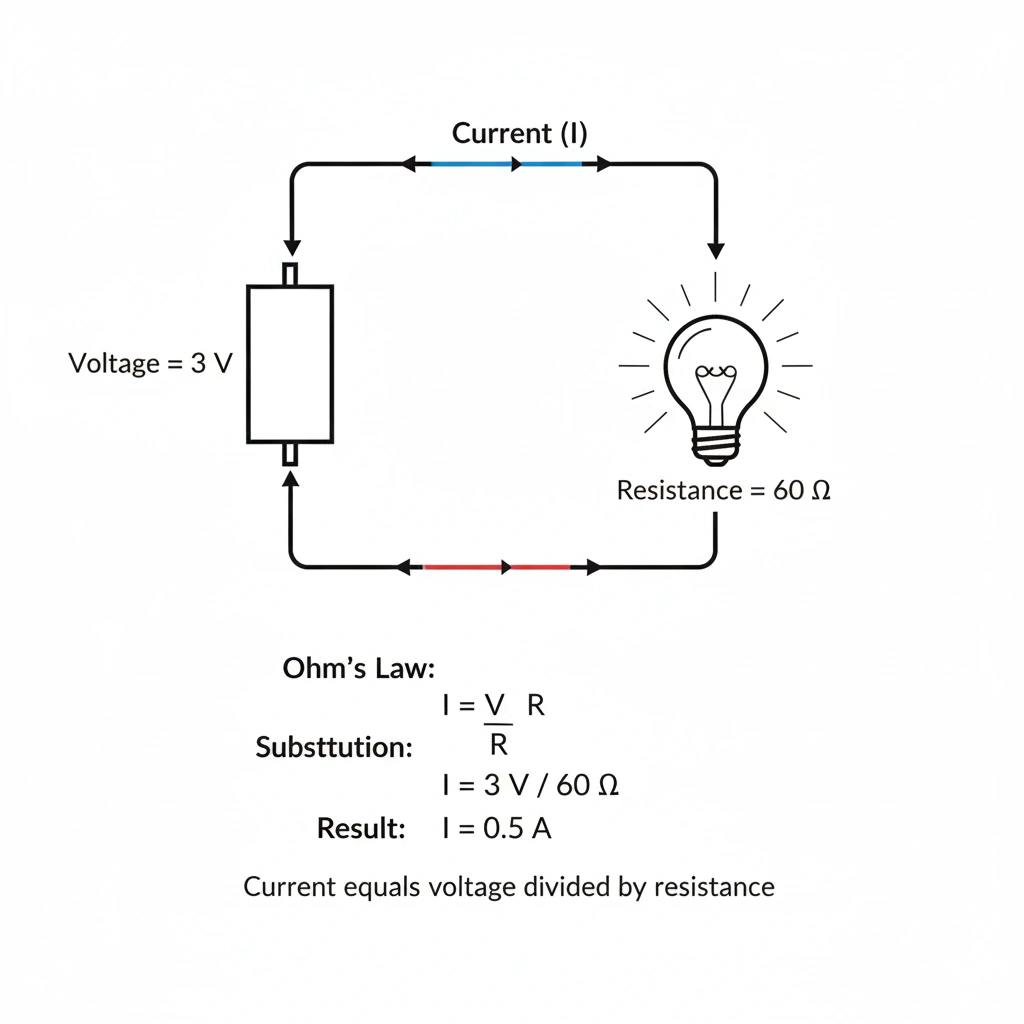
A 3-volt flashlight uses a bulb with 60-ohm resistance. What current flows through the flashlight?
-
A
0.05 amp
-
B
0.5 amp
-
C
1.8 amp
-
D
18 amp
A 3-volt flashlight with a 60-ohm bulb draws a current of 0.05 amperes.
Ohm’s law dictates that current equals voltage divided by resistance, and 3 volts divided by 60 ohms produces this small but sufficient current for illumination.
A) 0.05 amp
This is obtained from I = V / R = 3 V / 60 Ω = 0.05 A. This 50-milliamp current is standard for small incandescent flashlight bulbs and ensures safe, efficient operation.
B) 0.5 amp
This would require a resistance of only 6 ohms, which is uncharacteristically low for a flashlight bulb and would lead to excessive power dissipation and rapid burnout.
C) 1.8 amp
Such a high current implies a resistance under 2 ohms, which is unrealistic for a 3-volt portable light and would cause immediate failure of the filament.
D) 18 amp
This enormous current is characteristic of industrial circuits, not handheld devices. It likely stems from multiplying voltage and resistance, a fundamental misuse of Ohm’s law.
Conclusion
Ohm’s law yields a current of 0.05 A for the given circuit. The correct answer is A) 0.05 amp.

Topic Flashcards
Click to FlipUsing Ohm's Law (I = V / R), calculate the current in a circuit with a voltage of 3 V and a resistance of 60 Ω.
0.05 Amperes (or 50 milliamps).
f the resistance of the flashlight bulb were halved to 30 Ω, what would the new current be?
0.1 Amperes (I = 3V / 30Ω = 0.1 A).
What is the power (in watts) dissipated by the 60-ohm bulb when operating at 3 volts? (Use P = V * I or P = V²/R)
0.15 Watts (P = 3V * 0.05A = 0.15 W, or P = (3V)² / 60Ω = 9/60 = 0.15 W).
Rearrange Ohm's Law to solve for resistance. What would the resistance be if a current of 0.5 A flowed from a 3V battery?
6 Ohms (R = V / I = 3V / 0.5A = 6Ω).
In the original problem, which answer choice (0.5 A) would result from a common calculation error? What wrong operation was likely performed?
The error is multiplying voltage and resistance (3V * 60Ω = 180, then misplacing decimal) instead of dividing them.