100%
4
Rated
Attempts
127
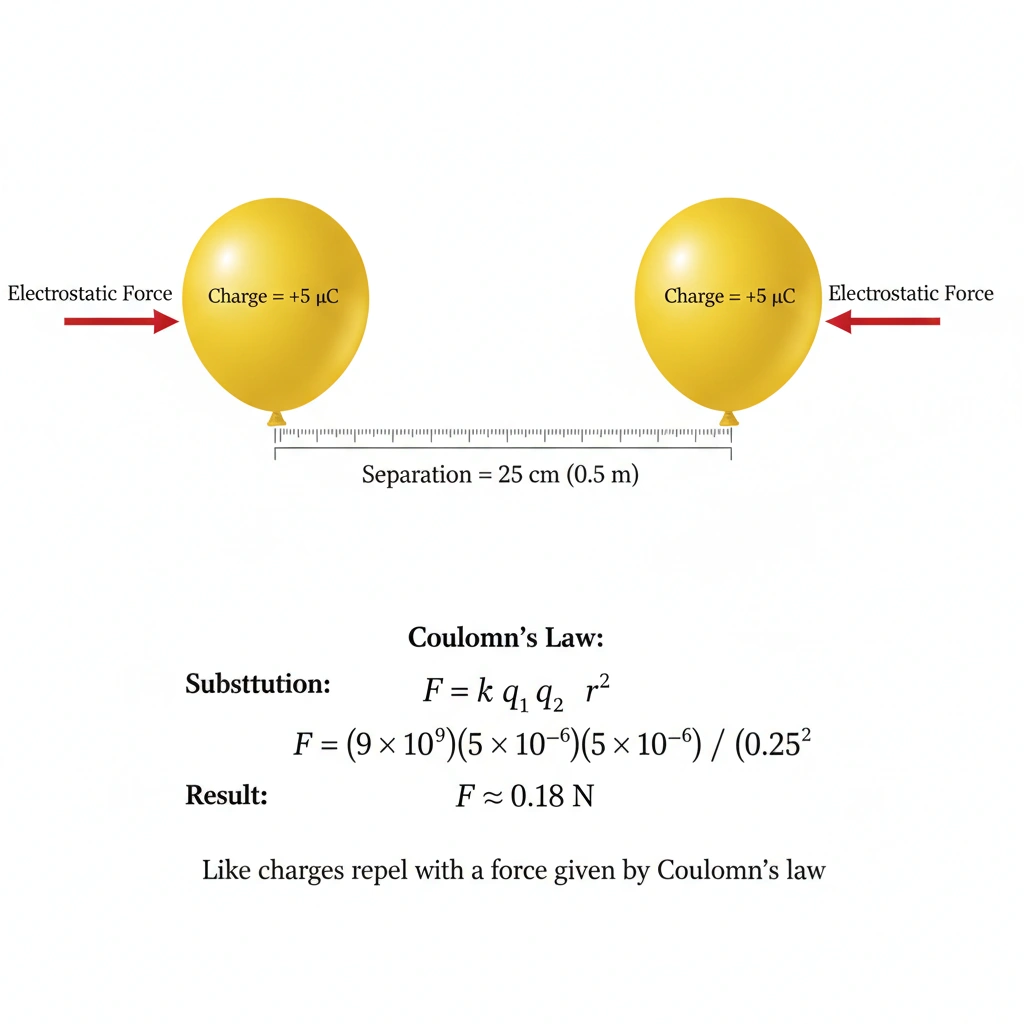
A balloon with a charge of 5 μC is placed 25 cm from another balloon with the same charge. What is the magnitude of the resulting repulsive force?
-
A
0.18 N
-
B
1.8 N
-
C
10⁻³ N
-
D
5 × 10⁻³ N
A
0.18 N
B
1.8 N
C
10⁻³ N
D
5 × 10⁻³ N
Topic Flashcards
Click to FlipMini Quiz
1 / 3
Is the electrostatic force between two charged objects directly proportional to the magnitude of each charge?
Related Questions
Top Picks
A go-kart is set into motion with an initial speed of 5 m/sec. It moves for 20 seconds. At the end of that time, its speed is 25 m/sec. What is the magnitude of the go-kart’s acceleration?
In one minute, 15 waves break onto the shore. What is the frequency of the waves?
A box is moved by a 15 N force over a distance of 3 m. What is the amount of work that has been done?
A kilogram of air is compressed from 1 m3 to 0.5 m3. Which statement is true?
A 110-volt hair dryer delivers 1,525 watts of power. How many amperes does it draw?
Available FREE Test
Sets
Available Test
Sets