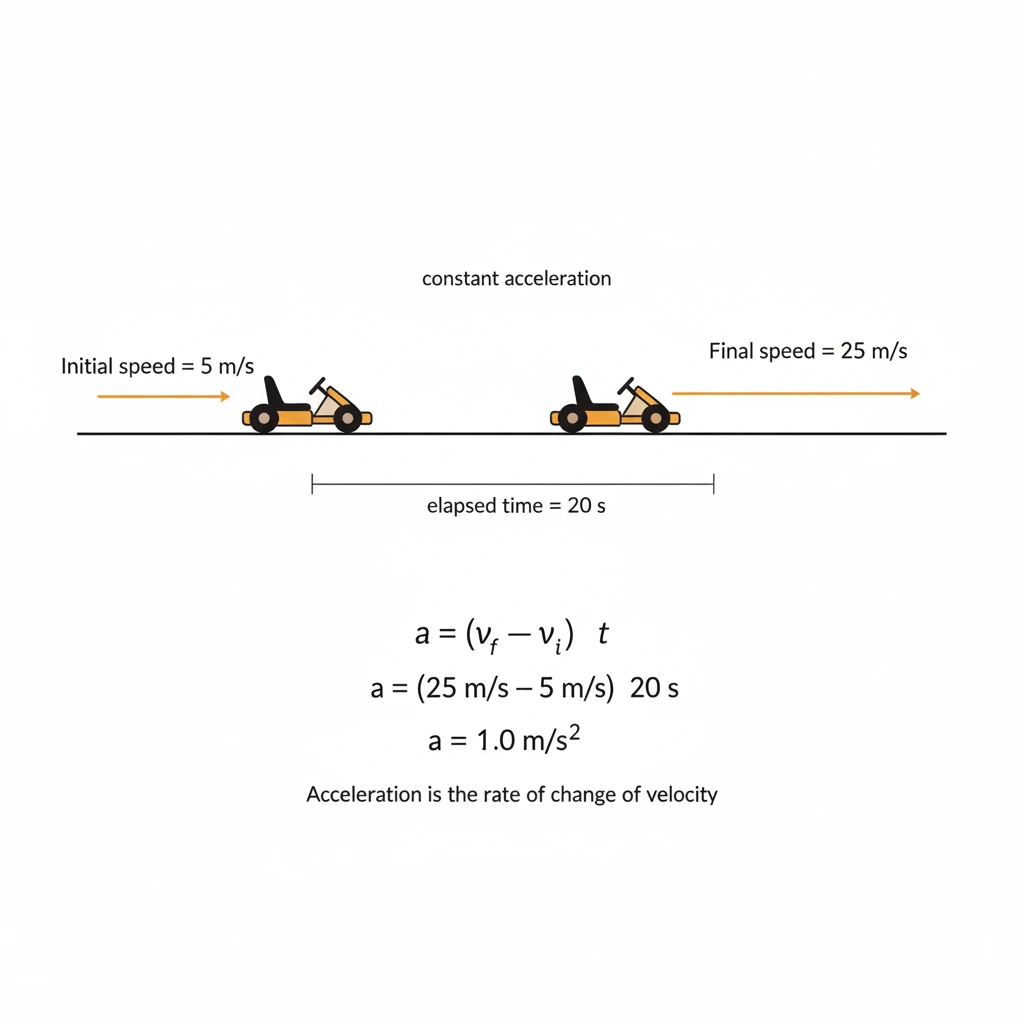
A go-kart is set into motion with an initial speed of 5 m/sec. It moves for 20 seconds. At the end of that time, its speed is 25 m/sec. What is the magnitude of the go-kart’s acceleration?
-
A
1.0 m/sec²
-
B
2.5 m/sec²
-
C
15 m/sec²
-
D
20 m/sec²
The magnitude of the go-kart’s acceleration is 1.0 m/s².
Starting from 5 m/s and reaching 25 m/s over a 20-second interval, the rate of change in velocity is consistently 1.0 meter per second squared, as dictated by the definition of average acceleration.
A) 1.0 m/s²
This value is obtained by applying the standard kinematic formula for constant acceleration: a=vf−vit=25 m/s−5 m/s20 s=1.0 m/s2a=tvf−vi=20 s25 m/s−5 m/s=1.0 m/s2. It correctly accounts for both the initial and final velocities and the elapsed time, yielding a physically meaningful and dimensionally consistent result.
B) 2.5 m/s²
This would imply the go-kart reached 25 m/s in just 8 seconds from rest, or ignored the initial velocity entirely. It misapplies the acceleration formula and does not reflect the actual motion described, making it inconsistent with the given data.
C) 15 m/s²
This number equals the numerical difference between the final and initial speeds but fails to divide by time. Acceleration requires a temporal component; without it, the value represents only a change in velocity, not an acceleration, and thus lacks physical validity in this context.
D) 20 m/s²
This is simply the total change in velocity (20 m/s) reported as if it were acceleration. It omits the essential division by the 20-second duration, violating the definition of acceleration as change in velocity per unit time.
Conclusion
Only option A correctly computes acceleration using the proper relationship between velocity change and time. The go-kart’s acceleration is therefore 1.0 m/s². The correct answer is A) 1.0 m/s².

Topic Flashcards
Click to FlipAn object starts with an initial velocity and undergoes constant acceleration for a given time interval, resulting in a final velocity. Write the kinematic equation that defines average acceleration in terms of these three variables.
a = v f − v i t a= t v f −v i , where v i v i is initial velocity, v f v f is final velocity, and t t is the time interval.
A car accelerates uniformly from 10 m/s to 30 m/s over a period of 5 seconds. What is its acceleration in m/s²?
4m/s2=.(a=30-10/5=20/5=4
If an object has an initial velocity of 8 m/s and accelerates at 2 m/s² for 6 seconds, what is its final velocity?
20m/s=.(vf =vi+at=8+(2×6)=8+12=20 )
On a velocity-time graph, what graphical feature represents the acceleration of an object?
The slope of the velocity-time graph. (Acceleration is the rate of change of velocity, which is the slope of the v-t line.)
An object's velocity changes from 15 m/s to 5 m/s over 4 seconds. What is the magnitude and direction (sign) of its average acceleration?
Magnitude: 2.5 m/s². Direction/Sign: Negative (deceleration). a=5-15/4=-10/4=-2.5m/s2)