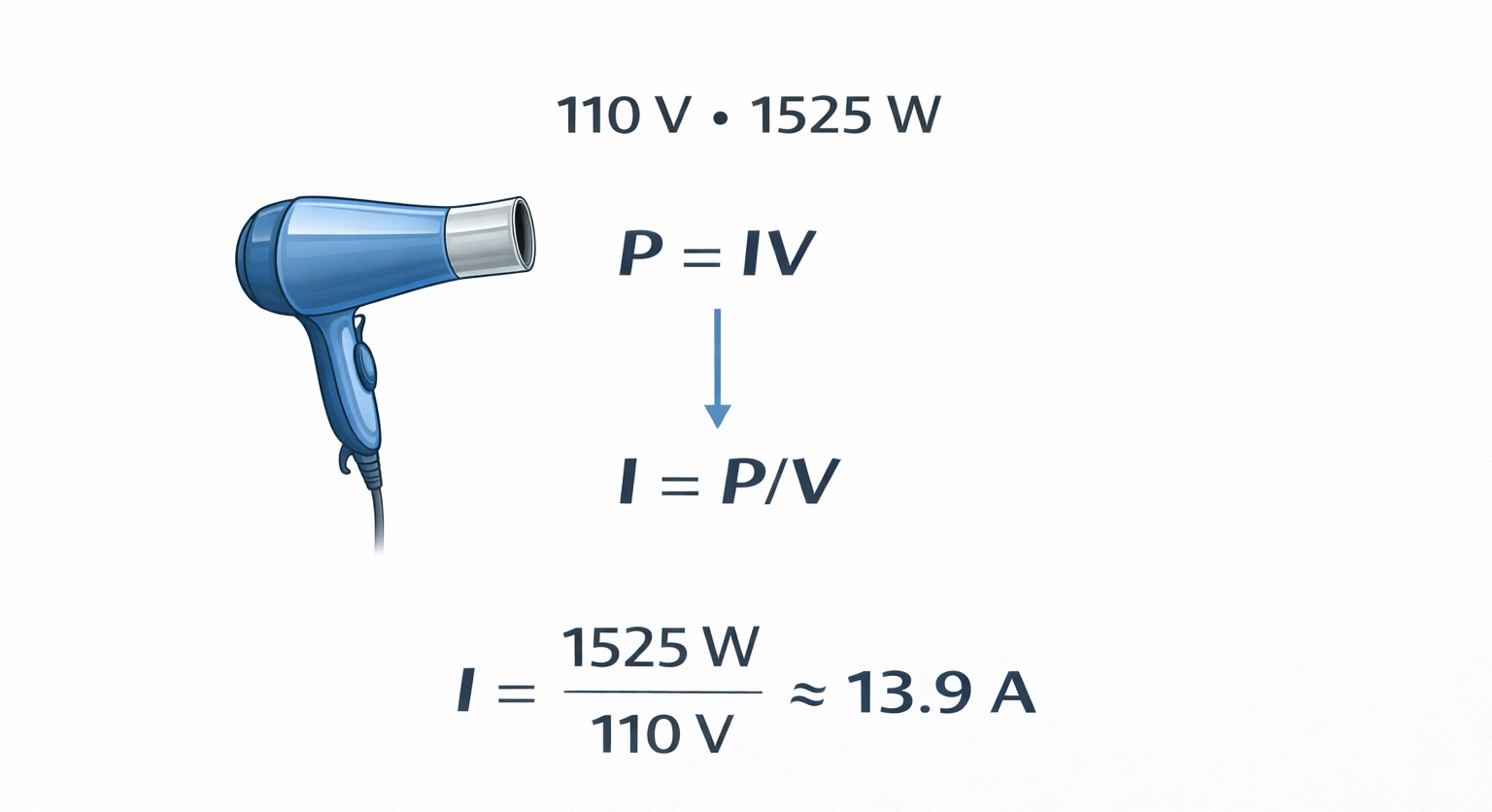
A 110-volt hair dryer delivers 1,525 watts of power. How many amperes does it draw?
-
A
167,750 amperes
-
B
1,635 amperes
-
C
1,415 amperes
-
D
13.9 amperes
The hair dryer draws 13.9 amperes of current, determined by rearranging the power equation P = IV to I = P/V = 1,525 W / 110 V ≈ 13.9 A. This calculation reflects the fundamental relationship between electrical power consumption, supply voltage, and current draw in resistive appliances.
A) 167,750 amperes
This enormous value results from multiplying voltage and power (110 V × 1,525 W) rather than dividing them. Such current would vaporize any household appliance instantly. Correct calculation requires division: I = P/V = 1,525 W / 110 V ≈ 13.9 A, not multiplication.
B) 1,635 amperes
This appears to add voltage and power (110 + 1,525 = 1,635), which lacks physical meaning since these quantities have different units and relationships. Current must derive from power divided by voltage per P = IV, not arithmetic addition of unrelated electrical parameters.
C) 1,415 amperes
This seems to subtract voltage from power (1,525 − 110 = 1,415), another operation without physical basis in electrical theory. Subtraction cannot relate power and voltage to yield current; only division per I = P/V produces dimensionally and physically correct results.
D) 13.9 amperes
Applying I = P/V = 1,525 W / 110 V ≈ 13.86 A, which rounds to 13.9 A. This calculation correctly implements the power-voltage-current relationship. Typical hair dryers draw 10–15 A on 110–120 V circuits, confirming this result's physical plausibility and mathematical accuracy.
Conclusion
Current draw equals power consumption divided by supply voltage according to P = IV. A 1,525-watt hair dryer operating on 110 volts draws approximately 13.9 amperes, a value consistent with household circuit capacities and the fundamental relationship between electrical power, voltage, and current in resistive loads.
Topic Flashcards
Click to FlipWrite the fundamental electrical equation that relates Power (P), Current (I), and Voltage (V). Then, rearrange it to solve for Current.
The equation is P = I × V P=I×V. Rearranged to solve for current: I=p/v
A standard 1,200-watt microwave oven is plugged into a 120-volt outlet. Approximately how much current, in amperes, does it draw while operating?
10 Amperes. ( I = P / V = 1200 W / 120 V = 10 A I=P/V=1200W/120V=10A ).
If a circuit breaker on a standard 120V home circuit is rated for 15 A, what is the maximum total power (in watts) of appliances you can safely run on that circuit without tripping it?
1,800 Watts. ( P m a x = I m a x × V = 15 A × 120 V = 1800 W P max =I max ×V=15A×120V=1800W ).
An appliance draws 5 A of current from a 220-volt source (common in many countries). What is its power consumption in kilowatts (kW)?
1.1 kW. ( P = I × V = 5 A × 220 V = 1100 W = 1.1 kW P=I×V=5A×220V=1100W=1.1kW ).
You have two identical light bulbs, each rated for 60 W at 120 V. If they are connected in parallel to a 120 V source, what is the total current drawn from the source?
1 A. (Each bulb draws I = 60 W / 120 V = 0.5 A I=60W/120V=0.5A. In parallel, currents add, so total I t o t a l = 0.5 A + 0.5 A = 1 A I total =0.5A+0.5A=1A ).