How do you determine the velocity of a wave?
-
A
Multiply the frequency by the wavelength.
-
B
Add the frequency and the wavelength.
-
C
Subtract the wavelength from the frequency.
-
D
Divide the wavelength by the frequency.
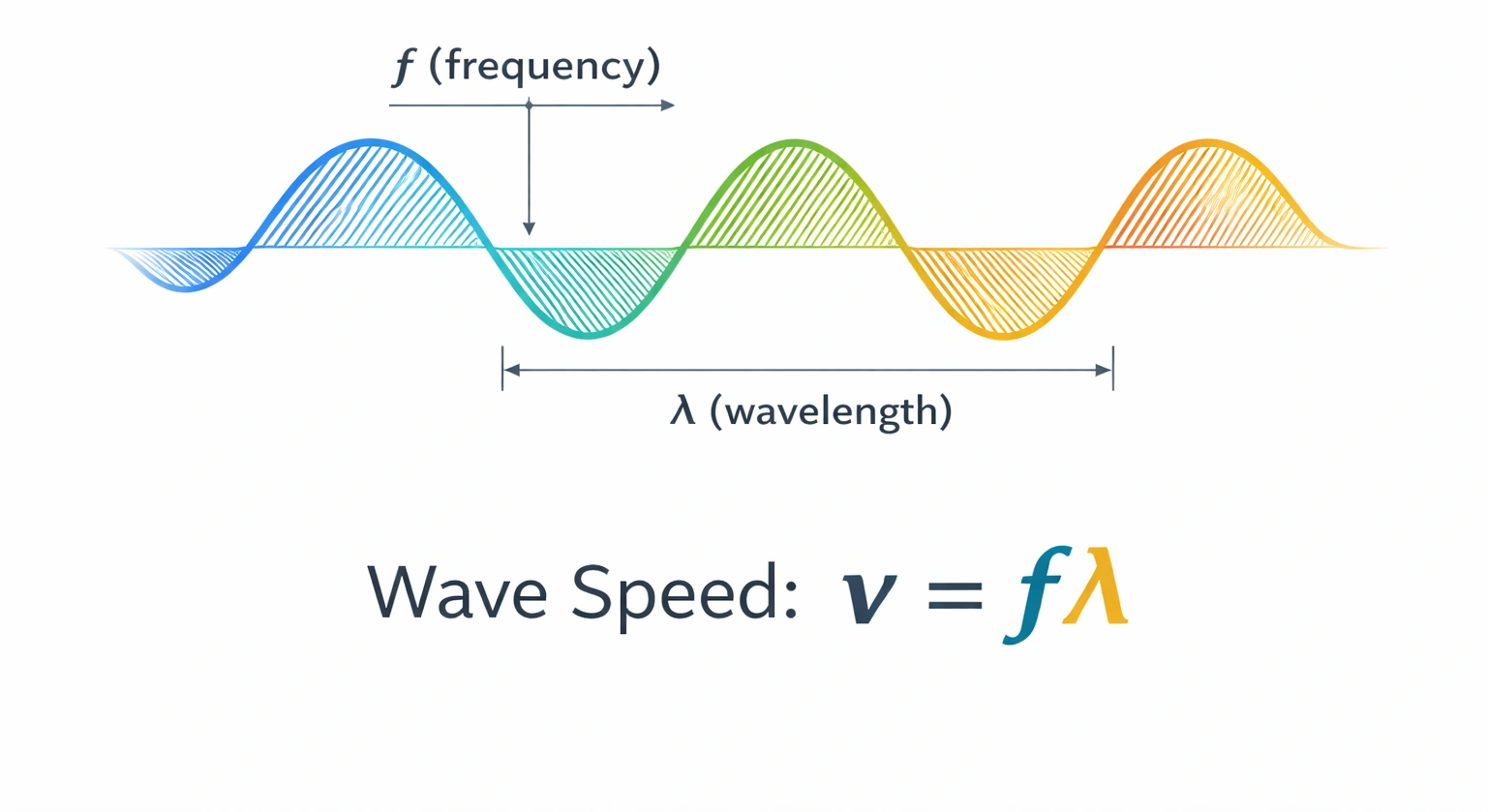
Wave velocity equals the product of frequency and wavelength (v = fλ), a universal relationship where multiplying cycles per second by meters per cycle yields meters per second. This dimensionally consistent operation connects temporal and spatial wave characteristics across all wave phenomena.
A) Multiply the frequency by the wavelength.
The wave equation v = fλ states that velocity equals frequency multiplied by wavelength. Frequency (cycles per second) times wavelength (meters per cycle) yields meters per second, dimensionally correct velocity units. This relationship holds for sound, light, water waves, and all periodic disturbances.
B) Add the frequency and the wavelength.
Addition cannot combine frequency (s⁻¹) and wavelength (m) because they possess different physical dimensions. Adding quantities with incompatible units produces meaningless results that cannot represent velocity (m/s). Physics requires dimensionally consistent operations.
C) Subtract the wavelength from the frequency.
Subtraction suffers the same dimensional incompatibility as addition, frequency and wavelength measure fundamentally different properties with different units. Their difference cannot yield velocity, which requires a product relationship to properly combine temporal and spatial wave characteristics.
D) Divide the wavelength by the frequency.
This yields λ/f, which equals period (T) rather than velocity. Since v = fλ, rearranging gives λ/f = λ²/v, neither velocity nor a standard wave parameter. Correct velocity calculation requires multiplication, not division, of frequency and wavelength.
Conclusion
Wave velocity equals the product of frequency and wavelength (v = fλ), a universal relationship arising because each wave cycle spans one wavelength and occurs once per period. Multiplying cycles-per-second by meters-per-cycle yields meters-per-second, providing a dimensionally consistent, physically meaningful velocity calculation applicable to all wave types.
Topic Flashcards
Click to FlipWhat is the fundamental equation that relates the velocity (v), frequency (f), and wavelength (λ) of a wave?
v=f×λ (velocity equals frequency multiplied by wavelength).
A wave has a frequency of 50 Hz and a wavelength of 4 meters. What is its velocity?
200 m/s. ( v = f × λ = 50 Hz × 4 m = 200 m/s v=f×λ=50Hz×4m=200m/s ).
If a wave travels at 340 m/s (speed of sound in air) and has a wavelength of 0.5 m, what is its frequency?
680 Hz. ( f = v / λ = 340 m/s / 0.5 m = 680 Hz f=v/λ=340m/s/0.5m=680Hz ).
For a wave in a fixed medium where the velocity is constant, if the frequency is tripled, what happens to the wavelength?
The wavelength becomes one-third of its original value. (Since v = f λ v=fλ is constant, λ λ is inversely proportional to f f).
A radio wave travels at the speed of light ( 3 × 10 8 m/s 3×10 8 m/s). If its frequency is 100 MHz ( 1 × 10 8 Hz 1×10 8 Hz), what is its wavelength?
3 meters. ( λ = v / f = 3 × 10 8 m/s / 1 × 10 8 Hz = 3 m λ=v/f=3×10 8 m/s/1×10 8 Hz=3m ).