An airplane travels 500 miles northeast and then, on the return trip, travels 500 miles southwest. Which of the following is true?
-
A
The displacement of the plane is 1,000 miles, and the distance traveled is 0 miles.
-
B
The displacement of the plane is 1,000 miles, and the distance traveled is 1,000 miles.
-
C
The displacement of the plane is 0 miles, and the distance traveled is 0 miles.
-
D
The displacement of the plane is 0 miles, and the distance traveled is 1,000 miles.
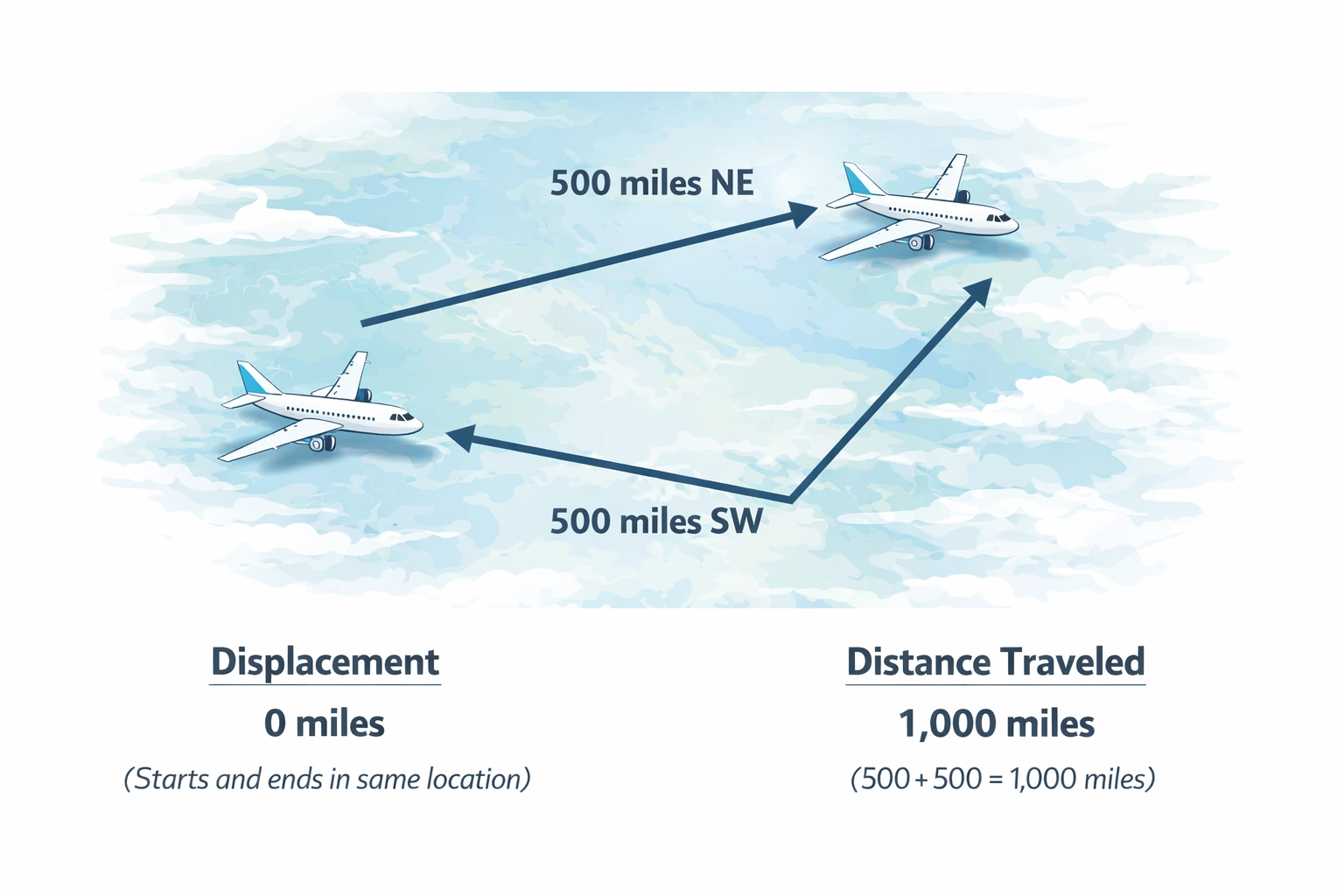
The airplane's displacement equals zero miles while its total distance traveled equals 1,000 miles after flying 500 miles northeast and returning 500 miles southwest.
Displacement measures net position change as a vector quantity, canceling to zero when motion returns to the origin, whereas distance accumulates all path segments as a scalar quantity regardless of direction reversals.
A) The displacement of the plane is 1,000 miles, and the distance traveled is 0 miles.
Displacement cannot equal 1,000 miles when the airplane returns to its origin, displacement would be zero in that case. Simultaneously, distance cannot be zero when the aircraft physically traversed 1,000 miles of airspace. This option incorrectly swaps and misapplies both definitions, violating basic kinematic principles.
B) The displacement of the plane is 1,000 miles, and the distance traveled is 1,000 miles.
While the distance calculation is correct (500 + 500 = 1,000 miles), displacement cannot be 1,000 miles because displacement depends solely on the net position change. Since northeast and southwest are opposite directions, the return journey cancels the initial displacement vector, resulting in zero net displacement rather than additive magnitude.
C) The displacement of the plane is 0 miles, and the distance traveled is 0 miles.
Though displacement correctly equals zero (returning to start), distance cannot be zero after physically traveling 1,000 miles through space. Distance accumulates all path segments regardless of direction changes, making zero distance physically impossible after any actual motion occurs.
D) The displacement of the plane is 0 miles, and the distance traveled is 1,000 miles.
The airplane begins and ends at the same location after traveling equal distances in opposite directions (northeast then southwest), yielding zero displacement, the vector difference between identical initial and final positions. Meanwhile, distance sums all path segments: 500 miles out plus 500 miles back equals 1,000 miles total path length traversed.
Conclusion
Displacement measures net position change as a vector quantity, becoming zero when motion returns to the origin, while distance measures total path length as a scalar quantity that accumulates regardless of direction. This distinction proves essential in navigation, sports analytics, and physics problem-solving where path geometry affects outcomes differently than net position change.

Topic Flashcards
Click to FlipWhat is the definition of displacement, and how does it differ from distance traveled?
Displacement is a vector quantity measuring the straight-line change in position from the start point to the end point. Distance traveled is a scalar quantity measuring the total length of the path taken, regardless of direction.
A plane flies 500 miles northeast and then 500 miles southwest back to its starting point. What is its total displacement?
Zero miles. The start and end positions are identical, so the net change in position is zero.
For the same flight path (500 mi NE, 500 mi SW), what is the total distance traveled by the plane?
1,000 miles. It is the sum of the lengths of both legs of the journey: 500 mi + 500 mi.
If an object returns to its starting point after a trip, what must be true about its displacement?
Its displacement must be zero.
Can the distance traveled ever be less than the magnitude of displacement? Why or why not?
No. The distance traveled is the total path length and is always greater than or equal to the magnitude of displacement, which is the straight-line separation between start and end. They are only equal if the object moves in a single straight line without reversing direction.