A car, starting from rest, accelerates at 10 m/s² for 5 seconds. What is the velocity of the car after 5 seconds?
-
A
2 m/s
-
B
5 m/s
-
C
50 m/s
-
D
The answer cannot be determined from the information given.
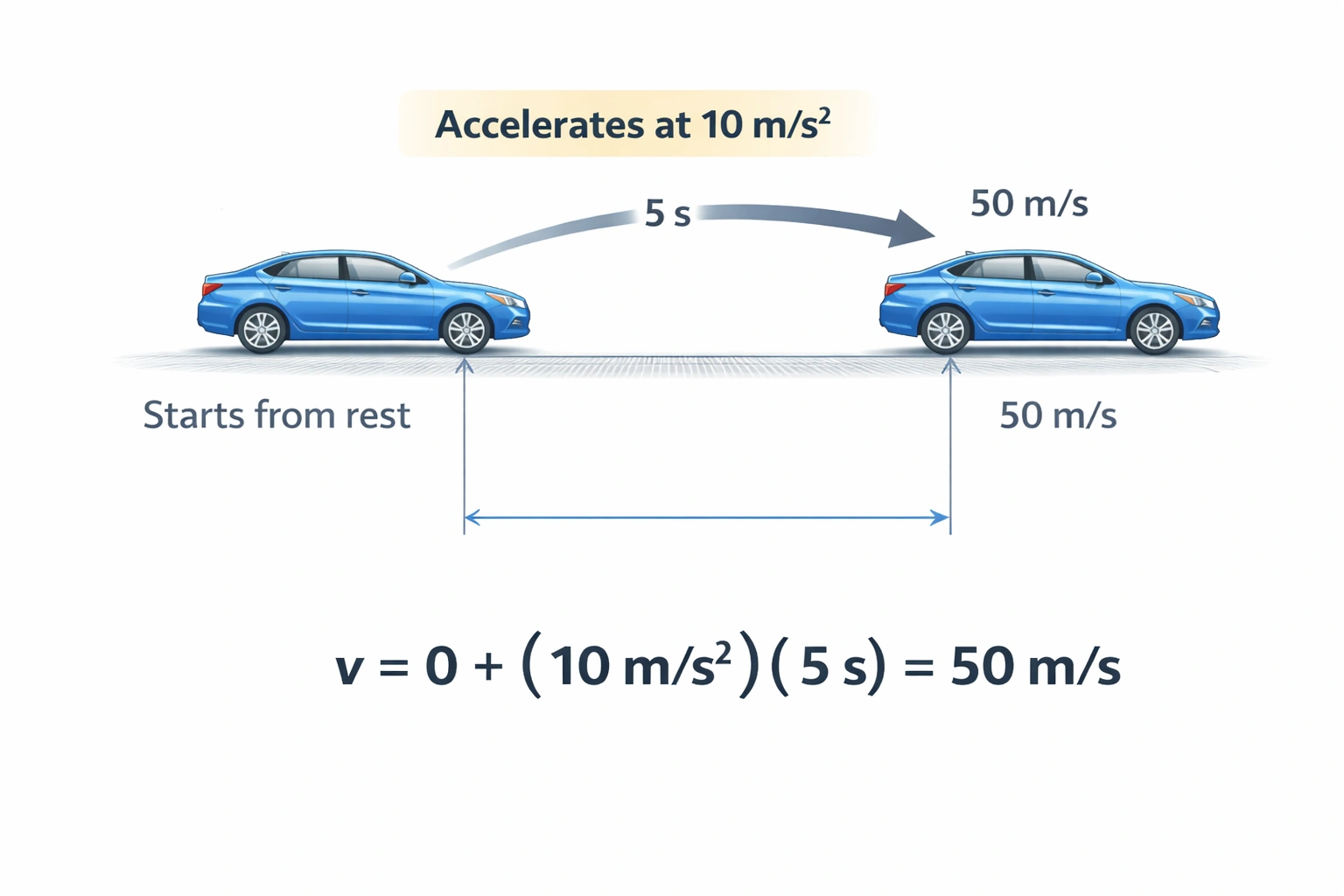
The car reaches a velocity of 50 m/s after accelerating from rest at 10 m/s² for 5 seconds. Applying the kinematic equation v = v₀ + at with initial velocity v₀ = 0 m/s yields v = 0 + (10 m/s²)(5 s) = 50 m/s, a direct consequence of acceleration's definition as velocity change per unit time.
A) 2 m/s
This value would result from dividing acceleration by time (10/5) rather than multiplying them. The kinematic equation requires multiplication: v = at = 10 m/s² × 5 s = 50 m/s. Division yields an incorrect result that misapplies the fundamental relationship between acceleration, time, and velocity change.
B) 5 m/s
This equals the time duration alone and bears no mathematical relationship to the given acceleration value. Achieving only 5 m/s would require either much smaller acceleration (1 m/s²) or much shorter duration (0.5 s), neither matching the problem conditions. This option appears to confuse time with velocity.
C) 50 m/s
Applying v = v₀ + at with v₀ = 0 m/s, a = 10 m/s², and t = 5 s yields v = 0 + (10)(5) = 50 m/s. Acceleration of 10 m/s² means velocity increases by 10 m/s each second; after five seconds, the cumulative increase is 50 m/s. This calculation correctly implements the fundamental kinematic relationship for constant acceleration from rest.
D) The answer cannot be determined from the information given.
All required parameters are explicitly provided: initial velocity (zero, implied by "starting from rest"), acceleration (10 m/s²), and time interval (5 s). These three values fully determine final velocity through the standard kinematic equation. No additional information is necessary for solution.
Conclusion
For constant acceleration starting from rest, final velocity equals the product of acceleration and time duration. A car accelerating at 10 m/s² for five seconds reaches 50 m/s, a direct consequence of acceleration's definition as velocity change per unit time. This linear relationship forms the foundation of kinematic analysis in uniformly accelerated motion.

Topic Flashcards
Click to FlipA car starts from rest (v₀ = 0 m/s) and accelerates at a constant 4 m/s² for 6 seconds. What is its final velocity?
24 m/s. (Using v = v₀ + at: 0 + (4 m/s²)(6 s) = 24 m/s)
What is the definition of constant acceleration, and how is it related to a change in velocity?
Constant acceleration is the rate of change of velocity that is steady over time. It is defined as a = Δv / Δt, meaning the change in velocity (Δv) equals acceleration multiplied by time (Δv = a * t).
In the equation v = v₀ + at, what does each variable represent?
v = final velocity, v₀ = initial velocity, a = constant acceleration, t = time elapsed.
If an object's acceleration is 10 m/s², what does this mean for its velocity each second?
Its velocity increases by 10 meters per second every second.
A bicycle accelerates from 2 m/s at a constant 3 m/s² for 5 seconds. What is its final velocity?
17 m/s. (v = v₀ + at = 2 m/s + (3 m/s²)(5 s) = 2 + 15 = 17 m/s)