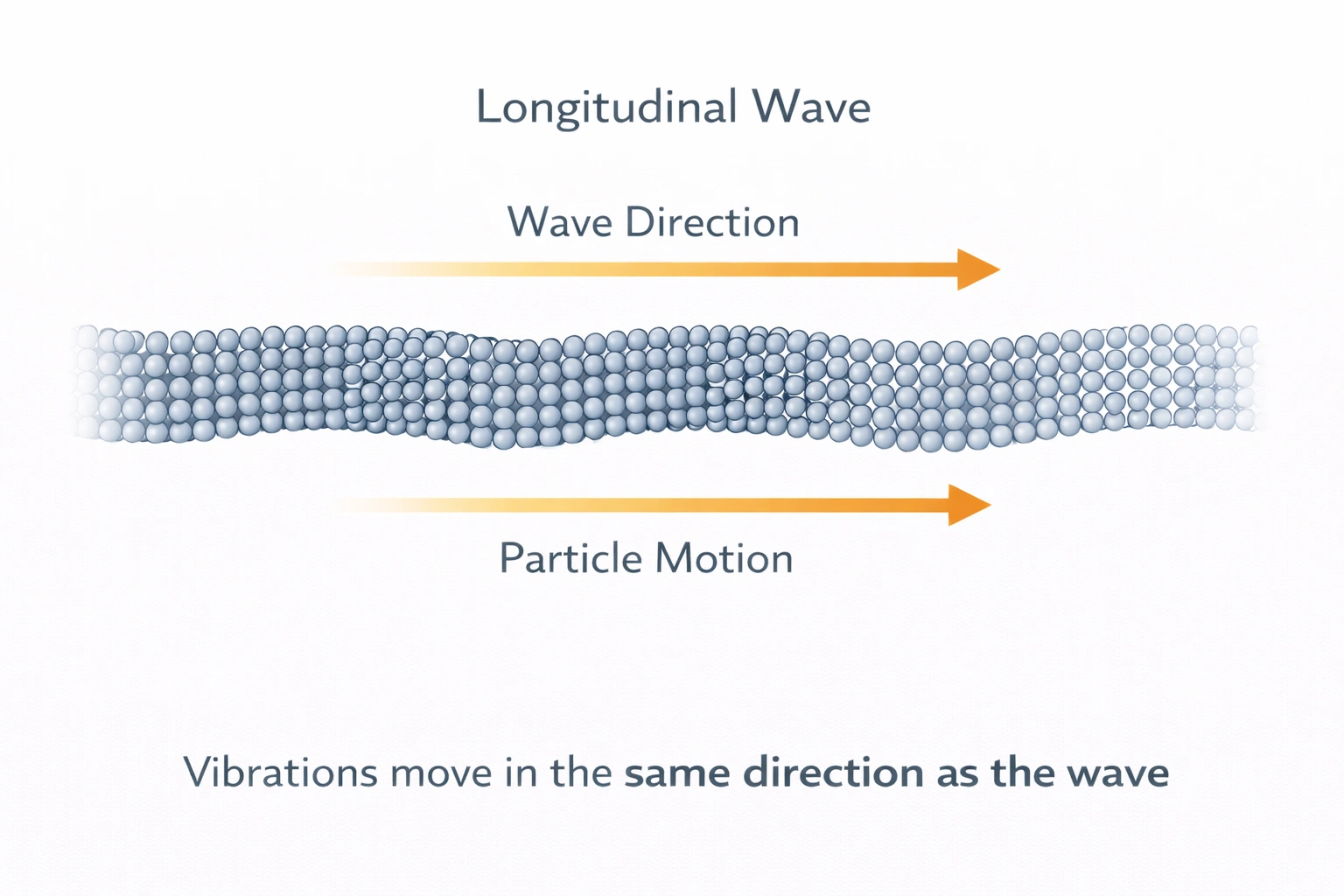
Longitudinal waves have vibrations that move ____.
-
A
at right angles to the direction of the vibrations
-
B
in the direction opposite to that of the wave
-
C
in the same direction as the wave
-
D
in waves and troughs
Longitudinal waves feature particle vibrations moving in the same direction as the wave propagation, creating alternating compressions and rarefactions along the travel axis. Sound waves in air exemplify this behavior, air molecules oscillate back-and-forth parallel to the direction sound energy advances.
A) at right angles to the direction of the vibrations
This describes transverse waves (e.g., light, string waves), not longitudinal waves. "Right angles to vibrations" creates logical confusion since it references vibration direction to define itself. Longitudinal waves require parallel, not perpendicular, vibration relative to propagation.
B) in the direction opposite to that of the wave
Particle vibrations in longitudinal waves oscillate back-and-forth along the propagation axis but don't maintain unidirectional opposition to wave travel. Individual particles move both with and against propagation direction during oscillation cycles. Net particle displacement remains zero while the wave disturbance advances forward.
C) in the same direction as the wave
Longitudinal wave particles vibrate parallel to the wave's propagation direction, oscillating along the same axis that the wave disturbance travels. Sound waves exemplify this: air molecules compress and rarefy along the direction sound travels, creating pressure variations that propagate energy forward while particles merely oscillate locally.
D) in waves and troughs
Crests and troughs characterize transverse waves (e.g., water surface waves), not longitudinal waves. Longitudinal waves feature compressions (high density) and rarefactions (low density) instead of elevation-based features. This option misapplies transverse wave terminology to longitudinal phenomena.
Conclusion
Longitudinal waves exhibit particle vibrations parallel to the direction of wave propagation, creating alternating compressions and rarefactions along the travel axis. Sound waves in air demonstrate this behavior, molecules oscillate back-and-forth along the same line that sound energy advances, distinguishing longitudinal waves from transverse waves with perpendicular vibrations.
Topic Flashcards
Click to FlipWhat is the defining characteristic of particle vibration in a longitudinal wave?
The particles of the medium vibrate back and forth parallel to (in the same direction as) the direction the wave travels.
Name two common examples of longitudinal waves.
Sound waves (in air, liquids, or solids) and seismic P-waves (primary waves).
How do the regions of a longitudinal wave differ? (What are the high-density and low-density regions called?)
The high-density, compressed regions are called compressions. The low-density, stretched regions are called rarefactions.
In a transverse wave, particle vibration is perpendicular to wave travel. In a longitudinal wave, how do the vibrations compare?
In a longitudinal wave, particle vibration is parallel to the direction of wave travel.
Can longitudinal waves travel through a vacuum? Why or why not?
No, they cannot. Longitudinal waves require a medium (solid, liquid, or gas) because they propagate by compressing and expanding the particles of that medium. A vacuum has no particles to compress.